.svg)
Office Furniture for GCCs and MNCs: What Makes These Projects Different

Furnishing a GCC or MNC office in India? This guide covers what global operations actually need, common mistakes, and expert guidance from AFC Furniture Solutions.
Why Are GCCs and MNCs Reshaping Office Furniture Demand in India?
What Is Driving the GCC Boom in India?
According to the FICCI-ANAROCK report "Workplaces 2025: India Commercial Real Estate Reimagined", India is projected to host more than 2,400 Global Capability Centres by 2030, employing over 2.8 million professionals. GCCs already account for over 40% of total gross office leasing across India's top seven cities, with Bengaluru, Pune, Delhi NCR, and Hyderabad capturing the largest shares of this demand.
This scale of growth has changed what office furniture procurement looks like for a meaningful share of India's commercial real estate market. A GCC opening its third floor in Bengaluru or its second site in Hyderabad is not placing a one-time furniture order. It is establishing a furniture specification that needs to be replicated reliably, often within compressed timelines, across multiple buildings and sometimes multiple cities within the same financial year.
How Do MNC Procurement Standards Differ from Domestic Buyers?
Multinational organisations typically bring global design and ergonomic standards developed for their headquarters market and require these standards to be matched or adapted for their Indian operations. This creates a specific procurement challenge: the furniture must satisfy global brand and ergonomic guidelines while also being genuinely suited to Indian climate conditions, body proportions, and commercial use intensity.
A furniture partner unfamiliar with this dual requirement either compromises on global standards to use only Indian-market products, or imports furniture at a cost and lead time that undermines the rapid expansion timelines that GCCs and MNCs typically operate under.
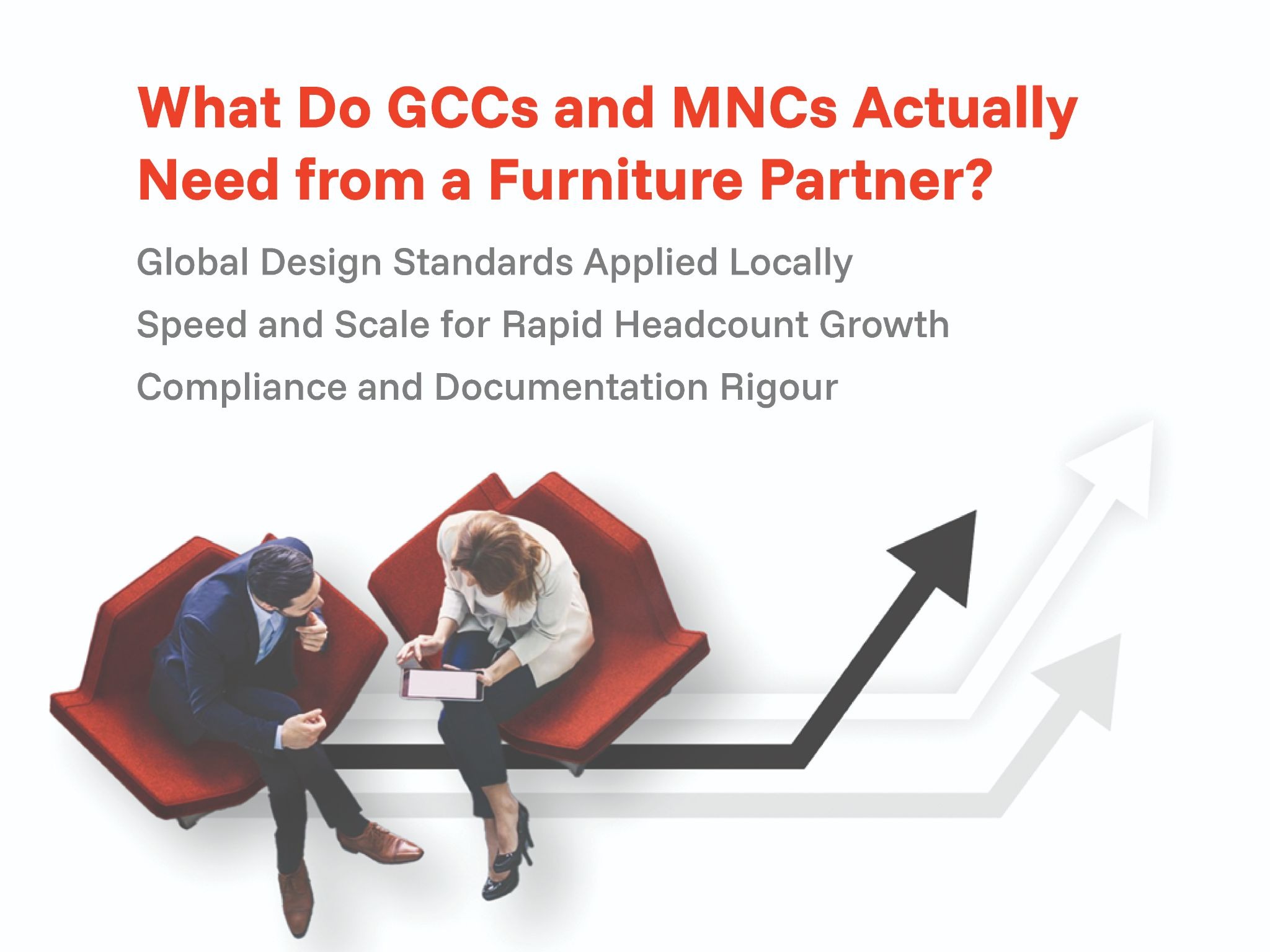
What Do GCCs and MNCs Actually Need from a Furniture Partner?
Global Design Standards Applied Locally
GCCs and MNCs need a furniture partner capable of interpreting global workplace design briefs, often originating from a headquarters design team in another country, and translating them into a locally manufactured specification that meets the same visual and ergonomic intent without the cost and lead time penalty of importing.
Speed and Scale for Rapid Headcount Growth
GCCs in particular are known for compressed hiring timelines, sometimes scaling from fifty to several hundred employees within a single year. A furniture partner serving this segment must be able to deliver and install at the pace headcount growth demands, without the multi-month lead times that custom or imported furniture typically requires.
Compliance and Documentation Rigour
MNC procurement teams operate under corporate governance requirements that domestic buyers rarely face to the same degree. This includes formal vendor due diligence, documented quality certifications, ESG and sustainability reporting, and often a global vendor approval process that a local furniture partner must be prepared to support with proper documentation.
Tip: When a GCC or MNC procurement team requests vendor documentation, prepare a single consolidated compliance pack covering BIFMA certification, ISO certifications, and any sustainability or ESG documentation in one document rather than supplying these piecemeal across multiple email threads. This single step significantly speeds up vendor approval processes that often involve multiple internal stakeholders reviewing the same documentation independently.
What Furniture Categories Matter Most for GCC and MNC Fit-Outs?
High-Density Ergonomic Workstations
GCCs typically operate at higher occupancy densities than traditional Indian corporate offices, requiring workstation systems that maximise floor efficiency without compromising on the ergonomic standards that global parent organisations mandate for employee wellbeing.
Collaboration and Breakout Zones
MNC design briefs frequently specify dedicated collaboration and breakout zones reflecting global workplace design trends around informal teamwork and employee wellness. These zones require soft seating, modular tables, and acoustic considerations that differ meaningfully from standard workstation specification.
Meeting and Boardroom Furniture for Global Stakeholders
GCC and MNC offices host a disproportionate share of video conferences with international stakeholders, making integrated technology infrastructure in meeting and boardroom furniture, including power access, cable management, and display connectivity, a functional requirement rather than a premium feature.
What Should GCCs and MNCs Verify Before Choosing a Furniture Supplier?
International Certification Equivalence
Confirm that the supplier's certifications, particularly BIFMA Level 3, are recognised as equivalent to the certification standards the parent organisation requires globally. This avoids the common friction of a locally certified product being questioned by a headquarters procurement team unfamiliar with Indian certification frameworks.
Capacity to Handle Multi-Floor, Multi-City Rollouts
Verify the supplier's actual production capacity and track record delivering multi-floor or multi-city projects within compressed timelines, not just their stated capability. Ask specifically for examples of projects at a comparable scale to the rollout being planned.
Sustainability and ESG Documentation
Many MNC parent organisations now require documented sustainability commitments from suppliers as part of their own ESG reporting obligations. Confirm what environmental certifications and sustainability documentation the supplier can provide before finalising any vendor agreement.
Bonus Point: When a GCC or MNC project involves a global design brief originating outside India, request a sample unit of any unfamiliar specification before committing to a full floor order. This allows the local facilities team to confirm that a globally specified product, once locally manufactured, genuinely matches the intended visual and ergonomic standard before hundreds of units are committed to the order.
What Are the Common Mistakes GCCs and MNCs Make When Furnishing Indian Offices?
Assuming Global Vendor Contracts Translate Locally
A furniture vendor relationship established at a parent organisation's headquarters market frequently does not have genuine local manufacturing or delivery capability in India. Assuming the same vendor relationship will perform equivalently in India, without separately verifying local capability, is one of the most common and costly assumptions GCCs and MNCs make.
Underestimating Local Lead Times and Logistics
Global design and procurement timelines are sometimes set without input from local manufacturing and logistics realities. Confirming actual local lead times early in the planning process, rather than after a hiring timeline has already been committed to leadership, prevents the most common source of project delay in GCC and MNC fit-outs.
Overlooking Local Climate and Material Suitability
Furniture specifications developed for headquarters markets in temperate climates do not always translate directly to Indian conditions. Material specifications that perform well in a European or North American office may require adaptation for Indian humidity and temperature conditions, and a knowledgeable local partner should flag this proactively rather than supplying an unmodified specification that underperforms.
How AFC Furniture Solutions Supports GCC and MNC Fit-Outs in India
What Makes AFC Suited to Enterprise-Scale Projects?
AFC Furniture Solutions has delivered large-scale fit-out projects for organisations including Tata Consultancy Services, Air India, Maruti Suzuki, and WNS, spanning workstations, ergonomic seating, soft seating, and collaborative zones tailored to each organisation's specific operational and brand requirements. These projects demonstrate the scale, consistency, and adaptability that GCC and MNC fit-outs require.
For further insight into how AFC Furniture Solutions approaches large corporate fit-out projects from planning through installation, see our detailed guide on How We Helped a Corporate Office Get a Complete Modular Office Furniture Setup: A Case Study.
AFC Furniture Solutions manufactures every product at its 150,000 square foot facility in Greater Noida, with production capacity supporting rapid, large-scale rollouts without the extended lead times that imported or custom-fabricated alternatives typically require. Explore the full AFC Furniture Solutions Workstations range to review configurations suited to high-density, enterprise-scale fit-outs.
What Quality Standards Back AFC Furniture Solutions?
AFC Furniture Solutions holds BIFMA Level 3 certification, the highest internationally recognised standard for office furniture quality, sustainability, and safety, providing the certification equivalence that global procurement teams require when evaluating local suppliers against headquarters market standards.
AFC Furniture Solutions also holds ISO 9001, ISO 14001, and ISO 18001 certifications covering quality management, environmental responsibility, and occupational health and safety, supporting the documentation requirements of MNC and GCC vendor approval processes.
Frequently Asked Questions
Q1. Can a local Indian manufacturer meet the global furniture standards MNCs require?
Yes, provided the manufacturer holds internationally recognised certifications such as BIFMA Level 3 and can demonstrate ergonomic and material standards equivalent to those required at the parent organisation's headquarters market. AFC Furniture Solutions has supplied enterprise-scale clients including Tata Consultancy Services and Air India under exactly these requirements.
Q2. How quickly can a GCC scale its furniture order as headcount grows?
This depends entirely on the supplier's manufacturing capacity and lead time commitments. A supplier with significant in-house production capacity, such as AFC Furniture Solutions' 150,000 square foot Greater Noida facility, can typically support rapid scaling far more reliably than a supplier dependent on imported or third-party sourced components.
Q3. Do GCCs need different furniture from standard Indian corporate offices?
Not fundamentally different, but often higher density, with stronger emphasis on collaboration zones and meeting room technology integration reflecting global parent organisation design standards and the high proportion of video conferencing with international stakeholders.
Q4. What documentation should an MNC request before approving a local furniture vendor?
At minimum, current BIFMA certification, ISO 9001, 14001, and 18001 certifications, and any sustainability or ESG documentation the parent organisation requires for its own reporting obligations. Requesting these as a single consolidated compliance pack speeds up internal vendor approval processes significantly.
Q5. Can furniture specified for a headquarters market in a different country be replicated in India?
Yes, in most cases, provided the local manufacturer can interpret the design brief and adapt the material specification for Indian climate and usage conditions. A sample unit evaluation before committing to a full order is the most reliable way to confirm the adaptation has been done correctly.
Q6. Does AFC Furniture Solutions have experience with large multinational and GCC clients?
Yes. AFC Furniture Solutions has delivered large-scale fit-out projects for organisations including Tata Consultancy Services, Air India, Maruti Suzuki, and WNS, demonstrating the scale, consistency, and adaptability required for enterprise-level GCC and MNC office furniture projects across India.
Final Thoughts
Office furniture for GCCs and MNCs is not simply a larger version of standard corporate procurement. It involves a distinct set of requirements around global standard equivalence, rapid scalability, and documentation rigour that not every furniture supplier is equipped to meet.
AFC Furniture Solutions has delivered enterprise-scale projects for organisations including Tata Consultancy Services, Air India, Maruti Suzuki, and WNS, manufacturing every product to BIFMA Level 3 and ISO certified quality standards at its Greater Noida facility, with the capacity and experience that GCC and MNC office fit-outs in India require.
Explore Other Popular Blogs



Let’s build together
Tell us about your project and we’ll help you plan, design, and deliver at scale.
.jpg)
.svg)