.svg)
How to Choose the Right Workstation Table for Your Office

Looking for the right workstation table for your office? This practical guide covers types, key features, common mistakes, and expert guidance from AFC Furniture Solutions India.
Why Does the Workstation Table Matter More Than Most Offices Realise?
The workstation table is the single piece of office furniture that every team member interacts with for the majority of every working day. It determines how much space each person has to work in, how their posture is shaped over eight to ten hours, and how effectively they can organise the tools and materials their role requires.
Despite this central role, workstation tables are frequently selected on price and availability rather than on the specific requirements of the team using them. The consequences are felt daily in cramped working surfaces, tangled cables, inadequate privacy, and layouts that cannot adapt as the team grows.
How Does It Affect Daily Productivity?
According to the Cornell University Ergonomics Lab, a stable working surface with adequate room for correct equipment arrangement is a fundamental requirement for maintaining the neutral body postures that reduce musculoskeletal discomfort and support sustained professional productivity. Every element of the workstation must work together to allow the professional to focus on their work without physical or environmental friction.
A well-specified workstation table removes the daily physical irritants that chip away at focused work time. Adequate surface depth keeps the monitor at the correct distance from the eyes. Integrated cable management eliminates the distraction and safety risk of trailing cables. The correct worksurface width accommodates the full working layout without crowding.
Each of these elements is invisible when correctly specified. Every one of them becomes a daily friction point when it is not.
What Happens When the Wrong One Is Specified?
An undersized worksurface forces the professional to choose daily which materials stay on the desk and which go on the floor or behind them. A workstation without cable management produces the tangle of power and data cables that clutters the surface, restricts leg space, and creates safety risks that facilities teams spend disproportionate time managing.
A layout specified without a growth plan becomes a daily reminder of the organisation's inability to plan ahead every time a new team member joins and cannot be properly accommodated. Getting the workstation table specification right from the outset eliminates all of these entirely avoidable problems before they become operational realities.
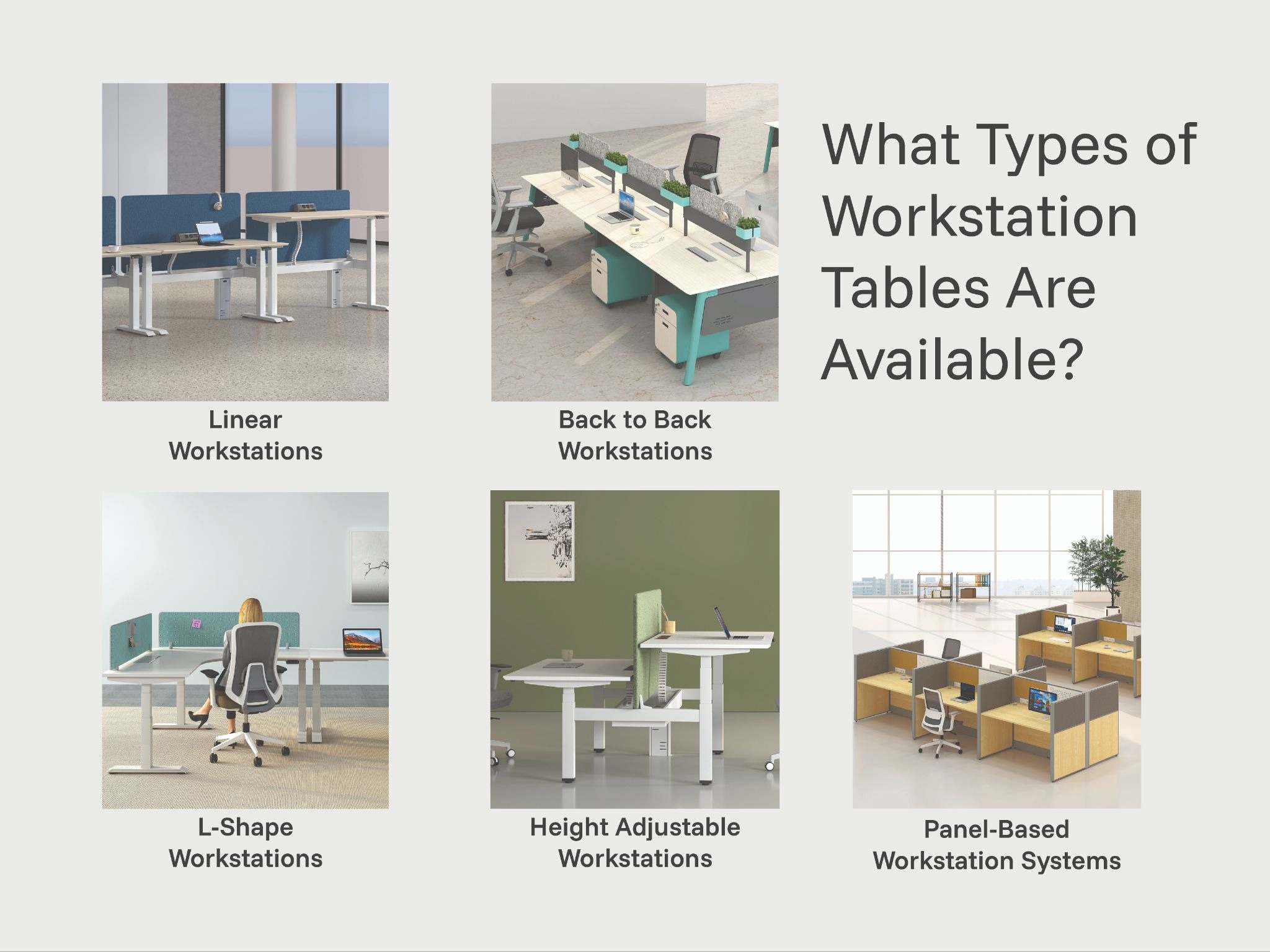
What Types of Workstation Tables Are Available?
Linear Workstations
Linear workstations are single-surface individual workstations arranged in rows along a shared panel run. They are the most space-efficient configuration available and the most common specification in Indian technology and financial services offices where high occupancy density is a consistent requirement.
They suit focused individual screen-based work. Each position has a defined working surface and a clear personal boundary without requiring the floor area that back-to-back or cluster configurations demand. For organisations fitting the maximum number of workstations into a given floor area, linear configuration delivers the highest positions per square metre of any standard layout.
L-Shape Workstations
L-shape workstations provide two connected working surfaces at a right angle, creating a primary active working zone and a secondary reference or storage zone within the same workstation footprint. They are most suited to professionals whose working day involves multiple simultaneous activities across different surface areas.
Design professionals, lawyers, senior analysts, and any role involving sustained multi-screen setups or simultaneous document and screen reference benefit most from the additional surface area and working zone separation that an L-shape configuration provides. The larger footprint per position means L-shape configurations suit environments where generous individual space allocation is a design priority.
Back to Back Workstations
Back to back workstations place two rows of individual positions facing each other across a shared central panel run. This configuration balances space efficiency with a degree of visual separation between facing positions, making it suitable for open-plan floors where some acoustic and visual privacy is valued without the additional floor area of individual panel runs on each side.
The shared central panel reduces the total panel material required per position compared to two independent linear runs, making back-to-back the more cost-effective configuration for large open-plan floors where the total number of positions is high.
Height Adjustable Workstations
Height adjustable workstations allow the working surface to move between sitting and standing heights through an electric or manual lifting mechanism. They represent the fastest-growing workstation category in Indian corporate offices driven by the growing emphasis on employee health and the documented benefits of postural variation during the working day.
They suit any role involving extended continuous screen work, with particular benefit for technology professionals, financial analysts, and senior managers who spend the majority of their working day at a fixed desk. The ability to alternate between sitting and standing across the day reduces the cumulative spinal load of prolonged static sitting without requiring a separate standing desk infrastructure.
Panel-Based Workstation Systems
Panel-based systems build the workstation around an upright panel structure that provides the working surface, privacy screening, cable management infrastructure, and accessory mounting in a single integrated system. They offer the highest level of individual workstation configuration flexibility and the cleanest cable management solution of any workstation type.
They are most appropriate for organisations specifying a permanent, long-term workstation installation where the initial investment in a complete system delivers the highest consistency of result and the widest range of future reconfiguration options.
What Key Features Should a Workstation Table Have?
Worksurface Size and Depth
The minimum adequate worksurface for a single-screen professional setup is 1200mm wide by 600mm deep. For dual-screen setups, a width of 1500mm is the more appropriate specification. For roles involving significant printed material reference alongside screen work, a depth of 750mm allows the monitor to be pushed further back and the primary working zone to remain uncluttered by the screen.
Worksurface depth is the most consistently underestimated specification dimension in Indian office workstation procurement. A 600mm deep surface places the monitor approximately 300mm from the face when the keyboard and mouse are in the correct position, which is below the 500 to 700mm viewing distance that Cornell University's ergonomics guidelines recommend for comfortable sustained screen use.
Cable Management System
Integrated cable management is not an optional premium feature in a workstation table. It is a functional requirement that determines whether the working surface remains usable and organised across the service life of the installation.
A quality cable management system routes power and data cables from the floor box through the worksurface and to each individual position in a completely concealed channel. No trailing cables on the surface. No cables visible beneath the desk. No ad-hoc solutions involving tape, clips, and cable ties that characterise workstation installations without dedicated management infrastructure.
Privacy Panel Height Options
Privacy panel height determines the balance between individual focus and team communication that the workstation floor achieves. Low panels of 300mm to 450mm above the worksurface create an open, visually connected environment suited to highly collaborative teams. Mid panels of 600mm to 750mm provide desktop privacy without isolating positions. Full panels of 1200mm or more create private enclosed positions suited to focused individual work in sensitive or confidential contexts.
The correct panel height must be specified against the actual working culture and role requirements of the team, not against a generic preference for openness or privacy. Most Indian corporate floors benefit from a differentiated panel height specification that varies by team function rather than a single height applied uniformly.
Material Quality for Indian Conditions
BWR grade engineered wood with PVC edge banding on all exposed edges is the correct worksurface specification for Indian commercial conditions. It resists the humidity cycling of Indian seasonal conditions, withstands the daily wear of institutional use, and maintains a clean, professional surface appearance across many years of service.
Powder-coated steel frames are the appropriate structural specification for the workstation base and panel system. They resist the corrosion that affects untreated or inadequately finished metal in humid Indian environments and maintain their structural integrity under the sustained load of commercial daily use without the dimensional changes that humidity cycling causes in inadequately specified wood alternatives.
Tip: Before finalising any workstation table specification, mock up a single position at the actual dimensions you are considering and ask three or four team members to sit at it for thirty minutes with their actual working equipment. The feedback from a brief realistic trial consistently reveals worksurface size, depth, and cable management issues that a scaled drawing or showroom evaluation cannot surface. This step costs an afternoon and can save the disruption and cost of a reconfiguration within the first year of installation.
How to Match Your Workstation Table to Your Team's Working Pattern?
For Focused Individual Work
Teams performing sustained individual focus work including software development, financial analysis, legal research, writing, and data analysis require workstations with adequate surface depth for correct monitor distance, mid to high privacy panels that reduce visual distraction from adjacent positions, and integrated cable management that keeps the working surface completely clear.
For these teams, the workstation is a personal focus environment rather than a social space. The specification should reflect this by prioritising individual working comfort and visual privacy over openness and collaboration visibility.
For Collaborative Open Plan Teams
Sales teams, creative studios, account management teams, and any group whose working day is characterised by frequent peer interaction, spontaneous discussion, and shared project work benefit from low to mid panel heights that allow easy visual and verbal communication between positions without requiring team members to stand or move to a separate collaboration zone.
For these teams, the workstation specification should support both brief individual task focus and frequent team interaction without either working pattern being compromised by the furniture layout.
For Hot Desking and Hybrid Work
Organisations using hot desking or activity-based working arrangements require workstations designed for rapid turnover between different users across the working day. This means fully adjustable chair heights at every position, worksurfaces sized for any working style, power access immediately available at every position, and a clean clear desk policy that the physical storage provision actively supports.
For further guidance on how to balance individual privacy needs with collaborative working requirements in a shared workstation environment, explore our detailed guide on Single Seater vs Linear Workstation Table: Which Works Better for Your Team.
What Are the Common Mistakes When Buying Workstation Tables?
Underestimating Worksurface Area
The most consistently reported workstation dissatisfaction across Indian corporate offices is insufficient surface area. Organisations that specify 1200mm wide surfaces for dual-screen professional setups discover within weeks of installation that the working surface cannot comfortably accommodate the monitor, keyboard, mouse, notebook, and incidental materials that a professional working day requires.
The cost of rectifying this after installation is significantly higher than the cost of specifying the correct width from the outset. Always specify the worksurface width against the actual equipment and working material profile of the role rather than the minimum standard dimension.
Ignoring Cable Management
A workstation installation without adequate cable management produces a working environment that looks disorganised within days of installation. Professionals adapt by managing cables themselves with whatever materials are available, producing the ad-hoc solutions of tape, clips, and bundled cables that characterise installations where this was not planned from the outset.
Cable management infrastructure cannot be retrofitted effectively to workstations that were not designed to accommodate it. It must be specified as part of the original workstation system. Any workstation specification that does not include an integrated cable management solution is incomplete for commercial professional use.
Not Planning for Team Growth
A workstation layout specified for the current team size without growth provision forces a complete reconfiguration every time the team expands significantly. In Indian corporate environments where team sizes grow rapidly in high-growth sectors, this can mean a full floor reconfiguration within eighteen months of the initial installation.
Specifying a modular workstation system that can extend with matching components in the same finish, and reserving realistic floor space for the positions the team will need within the next two to three years, protects the initial investment and eliminates the disruption cost of reactive growth management.
Bonus Point: When planning a new workstation installation, always produce a scaled 2D floor plan of the proposed layout before any order is placed. Place the furniture outlines on the actual floor plan of your space and verify that every position has the required circulation space, that emergency exit routes remain clear, and that the natural light from every window is not blocked by panel heights that would shadow individual positions. A scaled drawing takes half a day to produce and consistently reveals layout problems that are far easier to resolve on paper than after delivery and installation.
How AFC Furniture Solutions Designs Workstation Tables for Indian Offices
What Options Does AFC Offer?
AFC Furniture Solutions offers a complete workstation range covering every configuration type and working pattern requirement for Indian corporate offices, manufactured at the Greater Noida facility to consistent BIFMA Level 3 certified quality standards.
The Desking Series provides the core open-plan workstation range for Indian corporate environments. The Curvivo offers a contemporary curved worksurface design suited to collaborative open-plan floors. The Deskpro provides a robust commercial-grade linear specification suited to high-density technology and financial services floors. The Sleek delivers a clean minimal-profile aesthetic suited to modern workplace design environments. The Trio provides a three-position cluster configuration suited to collaborative team pods. The X-Bench offers a bench-style linear configuration maximising position density without sacrificing worksurface quality. The Fenix provides a premium linear specification in finishes suited to design-forward corporate environments.
For organisations prioritising employee health and postural variation, the Height Adjustable Adaptable series provides electric sit-stand functionality within the same modular system as the standard Desking Series, allowing mixed height-adjustable and fixed positions to be integrated within a single cohesive floor layout.
The Panel Pro from the Panel Series provides a complete panel-based workstation system with integrated cable management infrastructure, configurable panel heights, and the widest range of accessory and configuration options available in the AFC workstation range.
Every AFC workstation is manufactured using BWR grade engineered wood worksurfaces with PVC edge banding and powder-coated steel frames. AFC Furniture Solutions workspace consultants provide scaled 2D and 3D floor plans for every commercial project before any order is finalised, ensuring the proposed layout genuinely serves the team's working patterns and the space's physical constraints.
AFC Furniture Solutions operates a 150,000 square foot manufacturing facility in Greater Noida with a production capacity of up to 18,000 workstations per month, ensuring consistent quality and reliable supply for workstation orders at any corporate scale across India.
Explore the full AFC Furniture Solutions Workstations range to compare every desk and workstation configuration suited to different team sizes, working patterns, and corporate environments across India.
What Quality Standards Back AFC Workstations?
AFC Furniture Solutions holds BIFMA Level 3 certification, the highest internationally recognised standard for office furniture quality, sustainability, and safety. Every workstation in the range is manufactured at the Greater Noida facility and tested to BIFMA-compliant structural, durability, and worksurface load standards appropriate for sustained commercial daily use.
AFC Furniture Solutions also holds ISO 9001, ISO 14001, and ISO 18001 certifications covering quality management, environmental responsibility, and occupational health and safety across the full manufacturing operation. Named institutional clients including Tata Consultancy Services, Air India, Maruti Suzuki, and DXC Technology confirm the quality consistency and scale capability of AFC Furniture Solutions across India's most demanding corporate environments.
Frequently Asked Questions
Q1. What is the ideal worksurface size for a professional workstation table in India?
For a single-screen setup, a minimum of 1200mm wide by 600mm deep is adequate. For dual-screen setups, 1500mm wide by 750mm deep is the more appropriate specification. For roles involving significant printed material reference alongside screen work, a deeper surface of 750mm to 800mm allows correct monitor distance to be maintained without compromising the primary working zone.
Q2. What is the difference between a workstation table and a regular office desk?
A regular office desk is a standalone individual working surface. A workstation table is part of a modular system that connects with adjacent positions, shares panel and cable management infrastructure, and allows the total floor layout to be extended, reconfigured, and adapted as the organisation grows. For any corporate floor with more than a few positions, a modular workstation system delivers meaningfully better long-term value than individual standalone desks.
Q3. How high should a workstation table be in an Indian office?
Standard commercial worksurface height is 750mm for fixed-height workstations. This is appropriate for users of average adult Indian height with a correctly adjusted ergonomic chair. For teams with significant height variation, height-adjustable workstations that can move between 650mm and 1250mm provide the most inclusive specification across the full range of user heights.
Q4. Are height adjustable workstations worth the additional cost for Indian offices?
Yes, for any role involving six or more hours of sustained daily screen work. The ability to alternate between sitting and standing reduces cumulative spinal load, improves afternoon energy levels, and directly benefits the occupational health outcomes that Indian organisations are increasingly measuring and managing. The additional cost per position is recovered in reduced physical fatigue and lower absenteeism across the service life of the installation.
Q5. How do I choose the right privacy panel height for my office?
Match panel height to the primary working pattern of each team zone. Focused individual work zones benefit from mid to high panels of 600mm to 750mm above the worksurface. Collaborative team zones benefit from low panels of 300mm to 450mm that allow visual connection between positions. Mixed zones can use a graduated panel height specification that transitions between these standards across the floor.
Q6. Can AFC Furniture Solutions supply workstation tables for large corporate floor installations across multiple cities?
Yes. AFC Furniture Solutions manages large multi-city corporate workstation installations through a single account relationship with consistent product specification, delivery coordination, and installation management across all locations. The Greater Noida manufacturing base and pan-India experience centre and installation network covering Noida, Gurugram, Mumbai, Pune, Bengaluru, Hyderabad, and Chennai support projects of any scale across India.
Final Thoughts
The right workstation table is not simply a surface to put a screen on. It is the physical foundation of every professional working day for every team member who sits at it for eight to ten hours across the working week.
Getting the specification right, from worksurface size and cable management through to panel height and material quality suited to Indian conditions, is one of the most lasting and most practical improvements any Indian organisation can make to the daily working environment of its people.
AFC Furniture Solutions has been designing and supplying workstation tables for Indian corporate offices for over 15 years, with a complete range from standard linear desking to height-adjustable and panel-based systems, all manufactured to BIFMA Level 3 and ISO certified quality standards at the Greater Noida facility and available through experience centres across India.
Explore Other Popular Blogs



Let’s build together
Tell us about your project and we’ll help you plan, design, and deliver at scale.
.jpg)
.svg)