.svg)
Why Sustainable Office Furniture Is the Future of Indian Workplaces

Discover why sustainable office furniture is becoming essential for Indian workplaces. Expert guidance on eco-friendly materials, certifications, and long-term value from AFC Furniture Solutions.
What Is Happening to India's Corporate Workspace Culture?
Indian businesses are going through one of the most significant shifts in workplace thinking in a generation. The office is no longer just a place where work gets done. It is increasingly a physical expression of what an organisation believes in and how it treats its people and the planet.
Sustainability has moved from a corporate social responsibility talking point to a genuine operational priority for organisations across every major Indian industry. This shift is visible in procurement decisions, supplier selection, and the specific materials and products being specified for new office fit-outs.
The furniture in an office is one of the most tangible and long-lasting expressions of this shift. Every chair, desk, and storage unit in an office represents a material and manufacturing decision that either supports or undermines the organisation's stated environmental commitments.
How Are Indian Businesses Rethinking Their Office Environments?
Progressive Indian organisations are increasingly applying the same environmental criteria to their office furniture that they apply to their energy suppliers, their packaging, and their operational processes.
This means asking questions that were rarely asked even five years ago. What materials were used in this furniture? How long will it last before replacement? What happens to it at the end of its service life? Who manufactured it and under what conditions?
These questions reflect a genuine maturation in how Indian corporate procurement is conducted and they are driving a meaningful shift toward environmentally responsible furniture specifications.
Why Is Sustainability Now a Business Priority in India?
Three converging forces have elevated sustainability from a peripheral concern to a central business priority in India. The first is regulatory. India's national climate commitments under the Paris Agreement and the Bureau of Energy Efficiency's expanding mandate are creating a compliance environment that rewards organisations with verifiable environmental credentials.
The second is commercial. Global clients, international investors, and multinational supply chain partners increasingly evaluate Indian organisations against environmental, social, and governance standards that include workspace and procurement practices.
The third is talent. India's growing professional workforce, particularly in technology, financial services, and consulting, actively evaluates the environmental values of prospective employers when making career decisions.
What Is Sustainable Office Furniture?
What Makes Furniture Sustainable?
Furniture qualifies as genuinely sustainable when it meets verified standards across three dimensions: the materials used in its production, the manufacturing processes that created it, and its expected service life and end-of-life impact.
Sustainable materials include low-emission engineered wood boards, responsibly sourced timber, recycled steel content in frames, and upholstery fabrics produced without harmful chemical treatments. Each of these choices reduces the environmental load of the furniture across its full lifecycle.
The manufacturing process matters equally. Sustainable furniture production uses energy-efficient processes, minimises waste at every stage of production, avoids toxic chemical finishes, and operates under documented environmental management standards that can be independently verified.
How Is It Different from Regular Office Furniture?
Standard office furniture is typically specified and manufactured with the primary objectives of cost efficiency and visual appearance. Environmental impact across the production chain, the durability of the product under sustained daily use, and the material's recyclability at end of life are rarely primary considerations.
Eco-friendly office furniture India reverses these priorities. The environmental performance of materials and processes is built into the specification from the outset rather than addressed as an afterthought if addressed at all.
The practical result is furniture that is not only better for the environment but typically better for the people using it, because the same standards that reduce environmental harm also reduce the chemical emissions and material failures that affect occupant health and comfort.
Why Does Sustainable Office Furniture Matter for Indian Offices?
How Does It Affect Employee Health and Well-being?
According to the World Health Organisation, indoor air pollutants including volatile organic compounds emitted by furniture materials are among the most significant contributors to poor indoor air quality in occupied buildings. People spend approximately 90% of their time indoors, making the material quality of interior furnishings a direct health factor.
Low-emission board materials, non-toxic powder-coat finishes, and chemical-free upholstery treatments collectively reduce the volatile organic compound load in office air. This directly benefits the cognitive clarity, respiratory health, and daily comfort of everyone working in the space.
Studies referenced by the United States Environmental Protection Agency found that poor indoor air quality reduces cognitive performance by up to 50% in some measured conditions, a figure that represents a significant and largely invisible productivity cost in standard office environments furnished with conventional materials.
How Does It Contribute to a Company's Environmental Goals?
Office furniture represents a substantial proportion of a corporate organisation's total material footprint. The combined weight of desks, chairs, storage units, and soft seating across a fully furnished floor runs into thousands of kilograms of manufactured material.
Specifying environmentally responsible furniture reduces the carbon intensity of that material footprint through lower-emission production processes, higher recycled content, and longer service lives that reduce the frequency of replacement and the associated disposal burden.
For organisations reporting against environmental, social, and governance frameworks or pursuing green building certifications such as LEED or IGBC in India, furniture specification is a meaningful input to the overall environmental score.
How Does It Influence Brand Perception and Talent Attraction?
The physical office environment communicates something specific about an organisation's values to every person who enters it. Furniture that is visibly of high quality, well maintained, and aligned with environmental principles creates a positive and coherent impression that generic budget alternatives do not.
India's most in-demand professionals, particularly in the under-35 workforce cohort that drives growth in technology, consulting, and financial services, actively evaluate workplace quality and environmental values as factors in employment decisions.
A workplace furnished with certified, environmentally responsible products communicates that the organisation takes its stated values seriously in the daily details of how it operates, which is a more persuasive signal than any employer brand campaign.
What Are the Key Features of Sustainable Office Furniture?
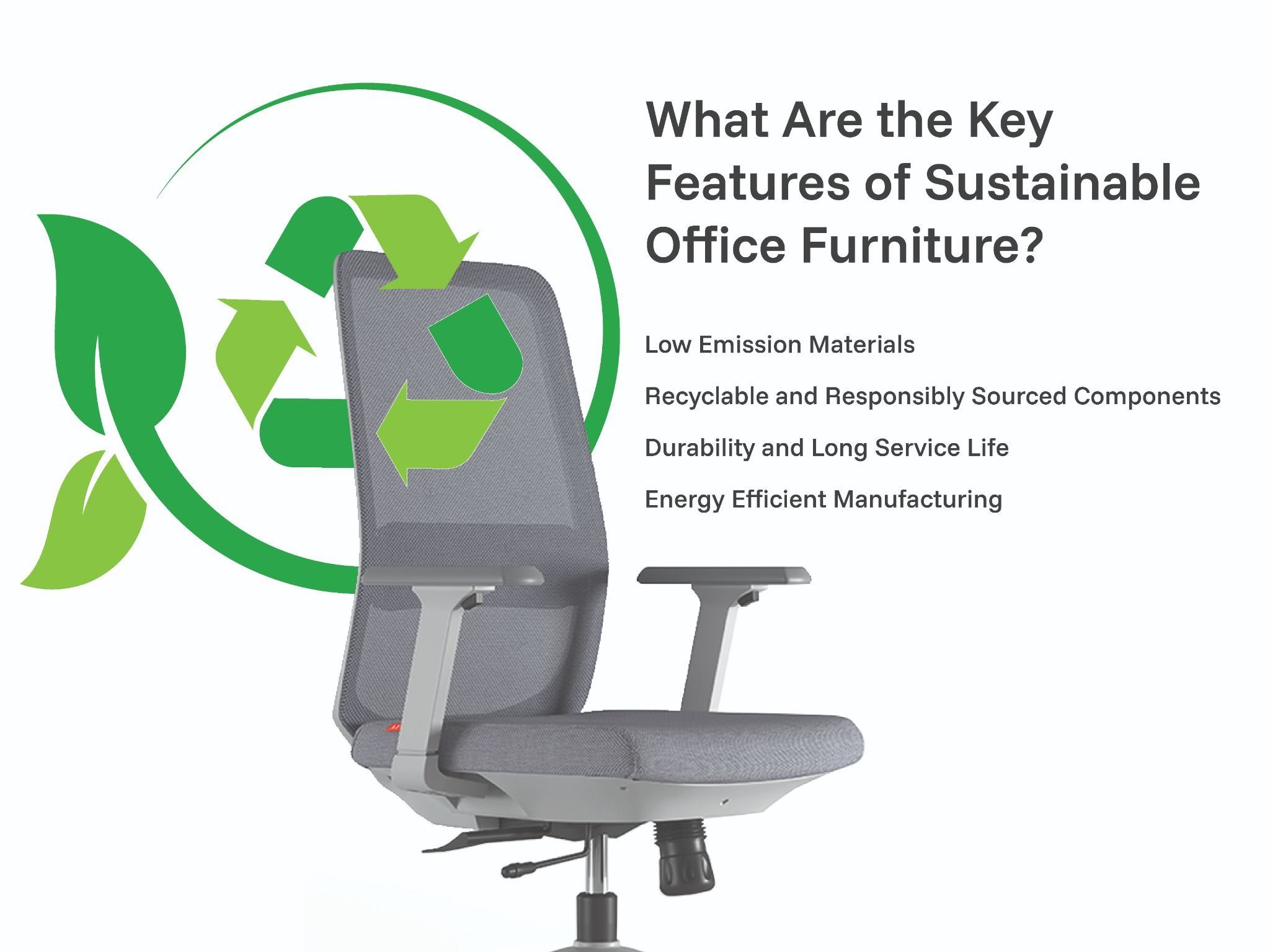
Low Emission Materials
The most important material specification for indoor environmental quality is the formaldehyde emission rating of any engineered wood components used in desks, workstations, storage units, and educational furniture.
E1 or E0 grade engineered wood boards have significantly lower formaldehyde emission levels than standard E2 grade alternatives. In a fully furnished office where hundreds of square metres of board surface are present, the difference in indoor air quality between E0 and E2 specification is measurable and meaningful.
Always ask specifically about the emission grade of any board material in a furniture product before accepting an environmental claim at face value.
Recyclable and Responsibly Sourced Components
Steel frames are among the most environmentally positive components in office furniture because steel is one of the most recycled materials on earth. A powder-coated steel frame at end of service life enters a well-established global recycling stream with near-zero residual waste.
Responsibly sourced timber and timber products should carry Forest Stewardship Council certification or an equivalent verified chain of custody that confirms the wood was not sourced from illegally cleared or environmentally sensitive forests.
Durability and Long Service Life
The most sustainable piece of furniture is one that does not need to be replaced. A commercial-grade desk or chair that serves reliably for ten to fifteen years under daily institutional use generates a fraction of the lifetime environmental impact of a budget alternative replaced every two to three years.
Durability is therefore not just a commercial quality attribute. It is a direct sustainability metric. Organisations that specify genuinely durable furniture are making an environmental choice as well as an economic one.
Energy Efficient Manufacturing
The carbon footprint of a piece of furniture is substantially determined by the energy used in its production. Manufacturers operating with energy-efficient production processes, renewable energy inputs, and documented waste reduction programmes produce furniture with a materially lower carbon intensity than those operating without these controls.
BIFMA Level certification specifically evaluates the manufacturing environment as well as the product, which is why it provides more meaningful sustainability assurance than product-only certifications that do not address the production context.
Tip: When evaluating any furniture supplier's sustainability claims, ask for the specific certification documents rather than accepting general statements about environmental responsibility. Legitimate certifications include certificate numbers, issuing body details, and validity dates. A supplier who cannot produce these documents when asked is making claims that cannot be verified.
What Does Sustainability Mean in the Indian Office Context?
What Indian Standards and Certifications Should You Look For?
BIFMA Level certification is the most internationally recognised and independently verified sustainability standard for office furniture. It evaluates environmental performance across material chemistry, energy use in manufacturing, social responsibility in production, and end-of-life management. BIFMA Level 3 is the highest tier of this certification.
For green building projects in India, furniture specification contributes to LEED (Leadership in Energy and Environmental Design) and IGBC (Indian Green Building Council) certification scores. Specifying furniture that holds BIFMA Level certification or equivalent independently verified credentials supports these building-level certifications directly.
The Bureau of Indian Standards BIS mark confirms compliance with Indian quality and safety standards and is a relevant additional credential for furniture used in institutional and government applications across India.
How Do Indian Climate Conditions Influence Sustainable Furniture Choices?
India's climate creates specific requirements for sustainable furniture materials that differ from those in temperate markets. High humidity in coastal and monsoon-affected regions accelerates the degradation of poorly specified board materials and finishes, shortening the service life of furniture that was not specified for Indian conditions.
BWR (Boiling Water Resistant) grade engineered wood is the appropriate specification for Indian commercial environments because it resists moisture-related degradation far more effectively than standard MR (Moisture Resistant) grade alternatives. Specifying BWR grade boards extends service life, which is itself a sustainability outcome.
Powder-coated steel frames are more appropriate for Indian conditions than painted or anodised alternatives because the powder coat process produces fewer solvent emissions and provides superior surface durability under the temperature and humidity cycles of Indian commercial environments.
How Sustainable Furniture Saves Money Over Time
Lower Replacement Costs
The most straightforward financial argument for sustainable furniture specification is the replacement cycle. A commercial-grade desk or chair specified for a ten-year service life requires no replacement investment during that period. A budget alternative that fails within three years requires three replacements across the same horizon at a combined cost that typically exceeds the original quality specification by a significant margin.
This calculation does not yet include the operational disruption of managing replacements, the installation costs of each replacement cycle, or the disposal cost of the failed furniture.
Reduced Health-Related Productivity Loss
The indoor air quality benefit of low-emission furniture materials has a direct financial expression in reduced health-related productivity loss. Furniture that contributes to better indoor air quality supports the cognitive clarity and respiratory health of every person in the office every working day.
The compounded productivity benefit of a materially better indoor environment across a team of fifty people over a ten-year period represents a return on the sustainable specification premium that dwarfs the upfront cost difference in most realistic calculations.
Long Term Value vs Upfront Cost
The single most common barrier to sustainable furniture specification in Indian corporate procurement is the upfront cost premium. Certified, sustainably specified furniture typically costs more per unit than standard alternatives because the materials, processes, and testing behind it are genuinely more rigorous.
The relevant comparison is not upfront cost per unit but total cost of ownership across the full service life. When replacement cycles, health costs, and disposal costs are included, sustainably specified furniture is consistently more economical over any planning horizon of five years or more.
Bonus Point: When building the business case for sustainable furniture specification in your organisation, calculate the total cost of your current furniture specification over a ten-year horizon including replacements, installation, and disposal. Compare this to the ten-year cost of a quality sustainable specification with a single replacement cycle. In most Indian corporate environments, the sustainable specification wins the cost argument before the environmental argument is even made.
What Types of Office Furniture Can Be Sustainably Specified?
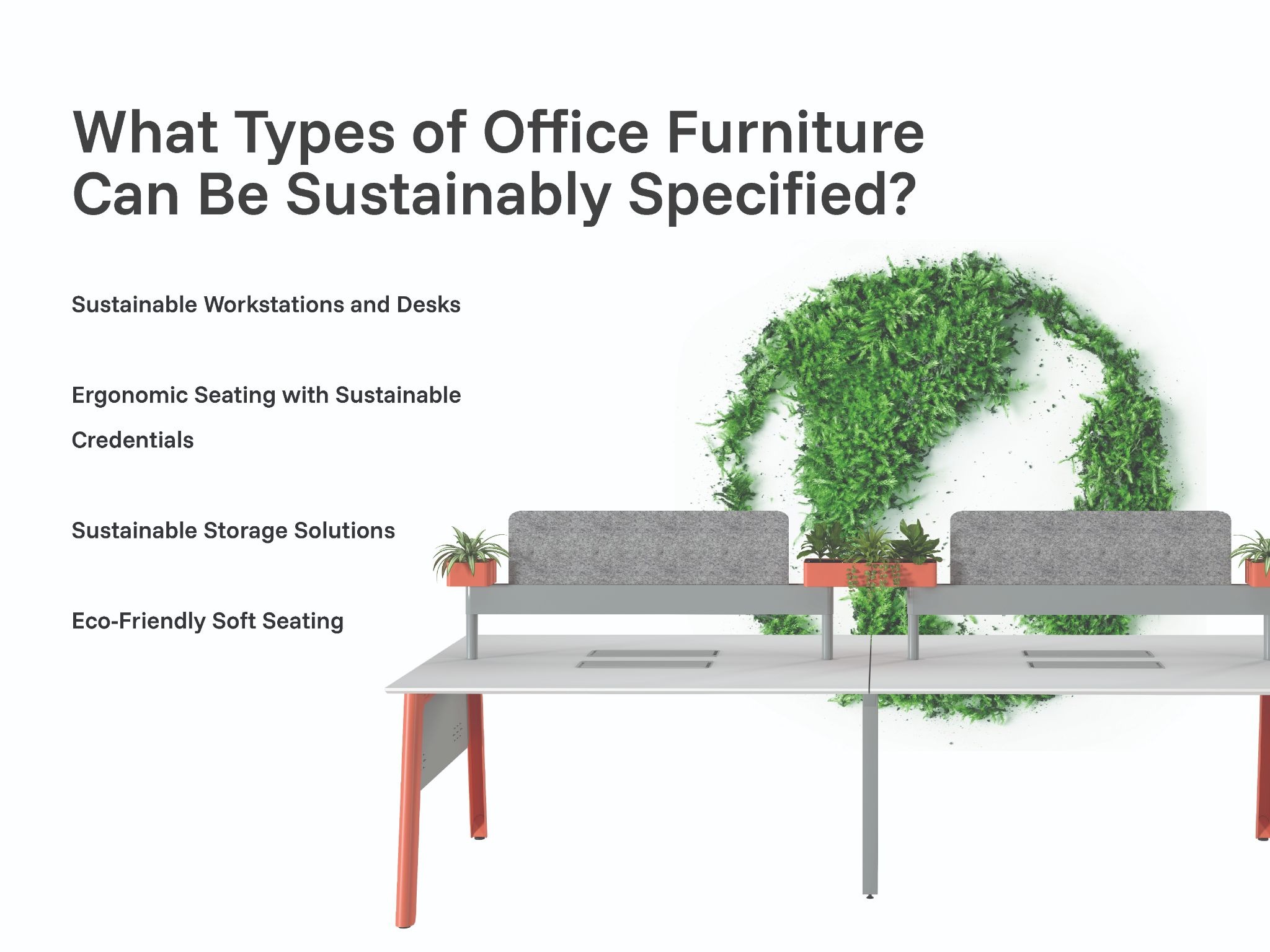
Sustainable Workstations and Desks
Sustainably specified workstations use BWR grade engineered wood worksurfaces with E1 or E0 formaldehyde emission ratings, PVC edge banding on all exposed edges to prevent moisture ingress, and powder-coated steel frames produced under documented environmental management processes.
The AFC Furniture Solutions Desking Series, including the Curvivo, Deskpro, Sleek, Trio, X-Bench, and Fenix models, and the Height Adjustable Adaptable model, are manufactured at the Greater Noida facility under BIFMA Level 3 certified production processes.
Ergonomic Seating with Sustainable Credentials
Sustainably specified office seating uses foam components produced without ozone-depleting blowing agents, upholstery fabrics free from harmful chemical treatments, and frame components with verified recycled steel content where available.
AFC Furniture Solutions' Mesh Chair range, including the Myel, Fluid, Spino, and Breeze models, uses materials specified for both ergonomic performance and environmental responsibility under the BIFMA Level 3 certification framework.
Sustainable Storage Solutions
Metal storage products are among the most straightforwardly sustainable office furniture category because steel frames and panels are fully recyclable at end of service life and have among the longest service lives of any office furniture type.
The AFC Furniture Solutions Metal Storage range, including the Metal Pedestal, Metal Storages, and Heavy Duty Racks, and the Metal Locker from the Locker range, are produced using powder-coated steel that resists corrosion, extends service life, and enters the steel recycling stream cleanly at end of use.
Eco-Friendly Soft Seating
Sustainably specified soft seating uses upholstery fabrics with verified chemical safety credentials, high-density foam that maintains its form across years of use without early replacement, and frame structures that can be disassembled for component-level recycling at end of service life.
The AFC Furniture Solutions Soft Seating range, including the Lounge models such as Accent, Solace, and Arco, and the Sofa range including Como, Armora, and Alonzo, are manufactured to commercial-grade material standards under the BIFMA Level 3 certified production environment.
Explore the full AFC Furniture Solutions Workstations range for sustainably specified desk and workstation options suited to Indian corporate environments.
How AFC Furniture Solutions Approaches Sustainable Office Furniture
What Makes AFC Products Environmentally Responsible?
AFC Furniture Solutions designs and manufactures every product in its range with material specifications appropriate for both the Indian commercial environment and the growing sustainability requirements of Indian corporate procurement.
Worksurface materials across the range use BWR grade engineered wood with PVC edge banding suited to Indian humidity conditions. Frame materials use powder-coated steel produced under processes that minimise solvent emissions compared to conventional paint alternatives.
The production facility in Greater Noida operates under the documented environmental management processes required for BIFMA Level 3 certification, which covers not just the products but the manufacturing environment, energy use, waste management, and social responsibility practices of the facility as a whole.
What Certifications Back AFC's Sustainability Claims?
AFC Furniture Solutions holds BIFMA Level 3 certification, the highest internationally recognised standard for office furniture sustainability and quality. This certification is independently verified by an accredited third-party assessment body and covers the full scope of environmental performance across materials, manufacturing, and end-of-life considerations.
BIFMA Level 3 is the certification that provides the most credible and comprehensive sustainability assurance available in the office furniture category globally. It is the standard that procurement managers, green building assessors, and ESG-focused organisations use to verify that sustainability claims are backed by independent evidence rather than self-reported assertions.
You can also explore the AFC Furniture Solutions Seating range for ergonomic chair options manufactured under the same BIFMA Level 3 certified production standards.
Frequently Asked Questions
Q1. What is the most important sustainability certification to look for in office furniture?
BIFMA Level certification is the most comprehensive and independently verified sustainability standard for office furniture. BIFMA Level 3 is the highest tier and covers materials, manufacturing processes, energy use, waste management, and social responsibility. It is the standard most credibly aligned with ESG reporting requirements and green building certification schemes including LEED and IGBC.
Q2. Does sustainable office furniture cost more than standard alternatives?
The upfront cost per unit is typically higher for sustainably certified furniture. However, the total cost of ownership across a five to ten year horizon, including replacement cycles, installation costs, and health-related productivity impacts, consistently favours the sustainable specification. The environmental benefit is in addition to, not instead of, the financial case.
Q3. How does sustainable furniture contribute to LEED or IGBC certification in India? Furniture specification contributes to material credits in LEED and IGBC scoring frameworks. Products holding BIFMA Level certification, containing verified recycled content, using low-emission materials, and manufactured under documented environmental management processes all contribute to the relevant credit categories in these green building assessment frameworks.
Q4. What is VOC and why does it matter in office furniture?
VOC stands for volatile organic compound. These are chemical gases emitted by certain materials including adhesives, finishes, and engineered wood boards used in standard furniture production. Prolonged exposure to elevated VOC levels in poorly ventilated office spaces is associated with headaches, reduced cognitive performance, and respiratory irritation. Low-emission furniture materials reduce the indoor VOC load, which directly benefits the health and performance of office occupants.
Q5. Is metal storage more sustainable than wooden storage?
For most Indian commercial applications, metal storage is the more sustainable long-term specification. Steel is highly recyclable, resistant to the termite and moisture damage that affects wood-based storage in Indian conditions, and has a longer expected service life under commercial daily use. Both can be sustainably specified, but metal storage typically has a lower lifetime environmental impact in the Indian context.
Q6. How do I verify that a furniture supplier's sustainability claims are genuine?
Ask for the specific certification documents including certificate numbers, issuing body details, and validity dates. Check the issuing body's records to confirm the certification covers the specific products being purchased. Be cautious of suppliers who make sustainability claims verbally or in marketing materials but cannot produce documentation when asked.
Final Thoughts
Sustainable office furniture is not a premium category for organisations with exceptional environmental commitments. It is the direction in which all serious commercial furniture procurement in India is moving, driven by regulatory change, commercial pressure, talent expectations, and the straightforward financial logic of longer service lives and lower total costs.
The organisations that make this transition early build workplaces that are healthier for their people, more credible to their clients and investors, and more economical over the planning horizons that matter in serious business decision-making.
AFC Furniture Solutions has been manufacturing and supplying environmentally responsible office furniture for Indian organisations for over 15 years, with BIFMA Level 3 certification covering both products and production processes, and a complete range suited to every zone of the modern Indian corporate office.
Explore Other Popular Blogs


Let’s build together
Tell us about your project and we’ll help you plan, design, and deliver at scale.
.jpg)
.svg)