.svg)
Why Every Modern Office Needs a Dedicated Training Room Chairs Setup

Discover why every modern Indian office needs quality training room chairs. Expert guidance on types, features, setup, and recommendations from AFC Furniture Solutions.
What Has Changed About Corporate Training in India?
Corporate learning has shifted dramatically across Indian organisations over the past decade. Training is no longer a periodic compliance exercise conducted in a borrowed conference room. It has become a continuous, strategic investment that directly shapes the capability, retention, and performance of professional teams.
India's fastest-growing industries including technology, financial services, pharmaceuticals, and manufacturing now run structured training programmes across multiple disciplines simultaneously. These programmes require dedicated spaces that are physically and functionally designed for learning rather than adapted from spaces designed for something else.
According to research published by the Association for Talent Development, organisations that invest in dedicated, well-equipped training environments see up to 218% higher income per employee than those that do not. The physical quality of the training environment is a measurable contributor to this outcome.
Why Are Training Rooms No Longer Optional?
Growing Indian organisations that rely on shared meeting rooms for training consistently report the same problems. Rooms are unavailable when needed. Furniture is unsuitable for training formats. Session quality suffers because the space cannot be configured for the activity.
A dedicated training room eliminates all three problems simultaneously. It is always available for training. Every piece of furniture serves the specific demands of structured learning. The space communicates to every participant that their development is taken seriously by the organisation.
For organisations onboarding new employees regularly, running skills development programmes quarterly, or delivering compliance training annually, a dedicated training room is not an indulgence. It is an operational requirement that pays for itself in programme quality and participant outcomes.
How Poor Training Room Setup Affects Learning?
Physical discomfort is one of the most consistent and least discussed barriers to effective training. A participant who is uncomfortable in their chair from the first hour of a three-hour session is devoting cognitive bandwidth to managing that discomfort rather than absorbing the content being delivered.
Research consistently shows that learning retention drops significantly after the first ninety minutes of a training session. Correct physical setup, including appropriate seating, adequate working surface, and a room configuration that enables visual engagement with both the facilitator and fellow participants, significantly extends the effective engagement window.
The wrong chair in a training room does not just cause discomfort. It actively undermines the investment the organisation has made in the training content, the facilitator, and the time of every participant in the room.
What Makes a Good Training Room Chair?
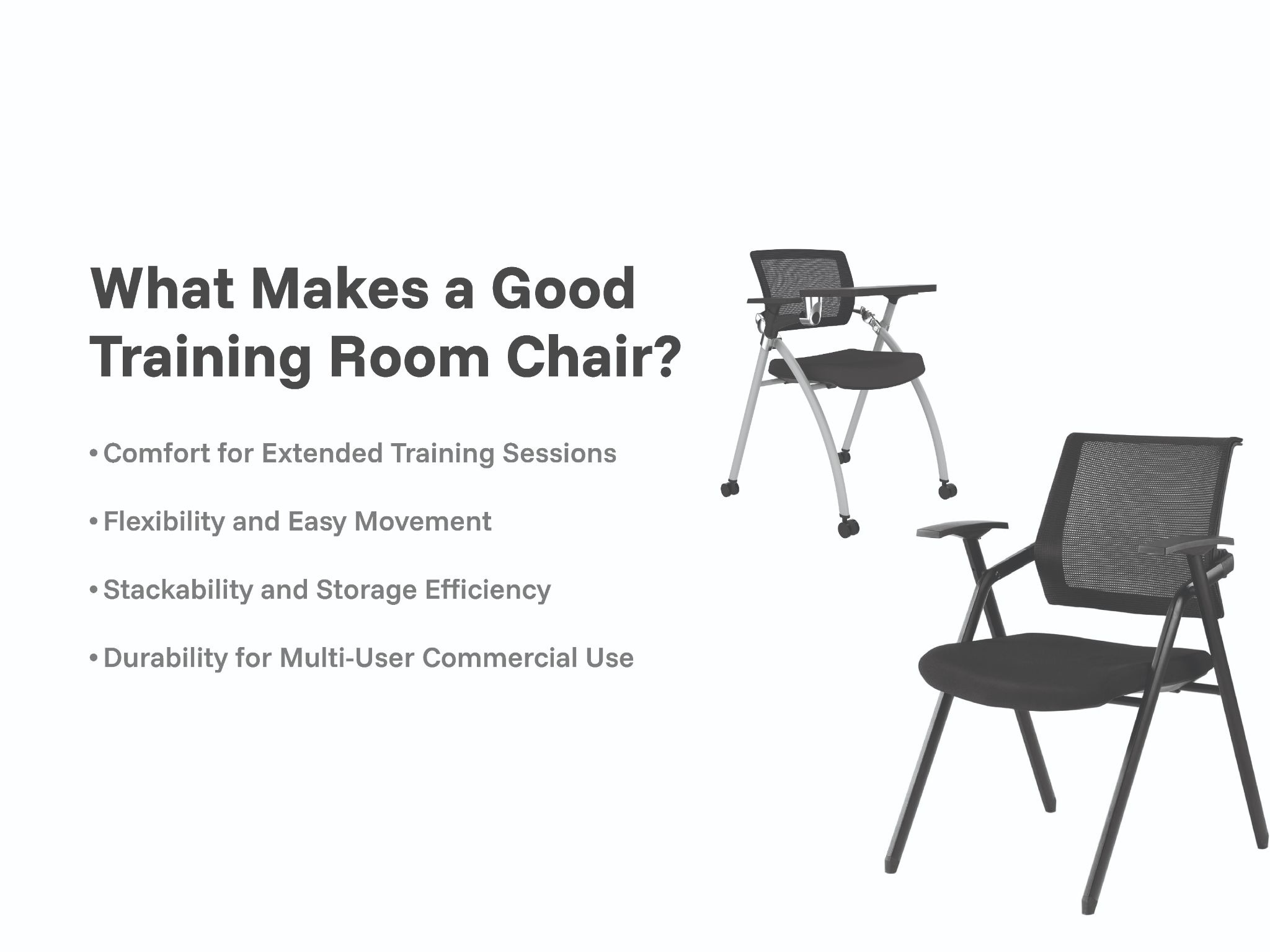
Comfort for Extended Training Sessions
Training sessions in Indian corporate environments typically run for two to four hours. Some full-day development programmes run for six to eight hours. The chair must maintain acceptable physical comfort across the full duration without creating the postural strain that accumulated discomfort causes.
Adequate seat cushioning that maintains its support without compressing to an unsupported surface is the primary comfort requirement. A seat that feels comfortable for thirty minutes but hard and unsupportive after ninety has failed the most important functional test for training room seating.
A backrest with some contouring that provides basic lumbar support is significantly more comfortable for multi-hour sessions than a flat back panel that leaves the lower back entirely unsupported. Training chairs do not require the full adjustability of an ergonomic workstation chair but they must provide basic postural support across extended sitting durations.
Flexibility and Easy Movement
A training room chair must be easy to move. Participants reconfigure the room between sessions, facilitators rearrange layouts for different exercises, and cleaning and maintenance staff reset the room daily. A chair that is heavy or awkward to move creates practical friction at every one of these touchpoints.
Lightweight construction without compromising structural strength is the correct specification for training room seating. A well-designed training chair should be manageable for one person to carry or stack without physical difficulty.
Smooth-gliding feet or castors that allow the chair to be slid across the training room floor without scraping or marking the surface are also important for rooms with polished or tiled floors, which is the most common floor finish in Indian corporate training environments.
Stackability and Storage Efficiency
Training rooms in Indian offices often serve dual purposes. The same room that hosts a twenty-person onboarding session in the morning may need to serve as a presentation space, a product demonstration area, or an assessment centre in the afternoon.
Chairs that stack cleanly to a height of eight to ten units occupy a fraction of the floor area of the same chairs arranged for use. This stackability is what enables rapid room reconfiguration and allows the training room to serve multiple formats across the same working day.
A stacking mechanism that operates cleanly without damage to the chair surface or the chair below it is a quality indicator that distinguishes commercial-grade training chairs from budget alternatives that appear to stack but damage quickly under the repeated stacking cycles of commercial daily use.
Durability for Multi-User Commercial Use
A training room chair is used by a different person in every session. Over a working year, a single training chair in an active corporate training room may be used by hundreds of different individuals of different heights, weights, and sitting habits.
Commercial-grade construction that maintains its structural integrity, surface quality, and functional performance under this intensity of multi-user use is the correct specification. Budget alternatives that perform adequately for a single user in an office context typically deteriorate rapidly under the repeated loading and handling of a high-frequency training room environment.
Tip: When specifying training room chairs, always verify the weight capacity against the full expected user range rather than an assumed average. Corporate training programmes increasingly include participants across a wide physical range. A chair with an inadequate weight rating creates both safety risks and early structural failures that are entirely avoidable with correct specification from the outset.
What Types of Chairs Work Best in a Training Room?
Flip Seat Training Chairs
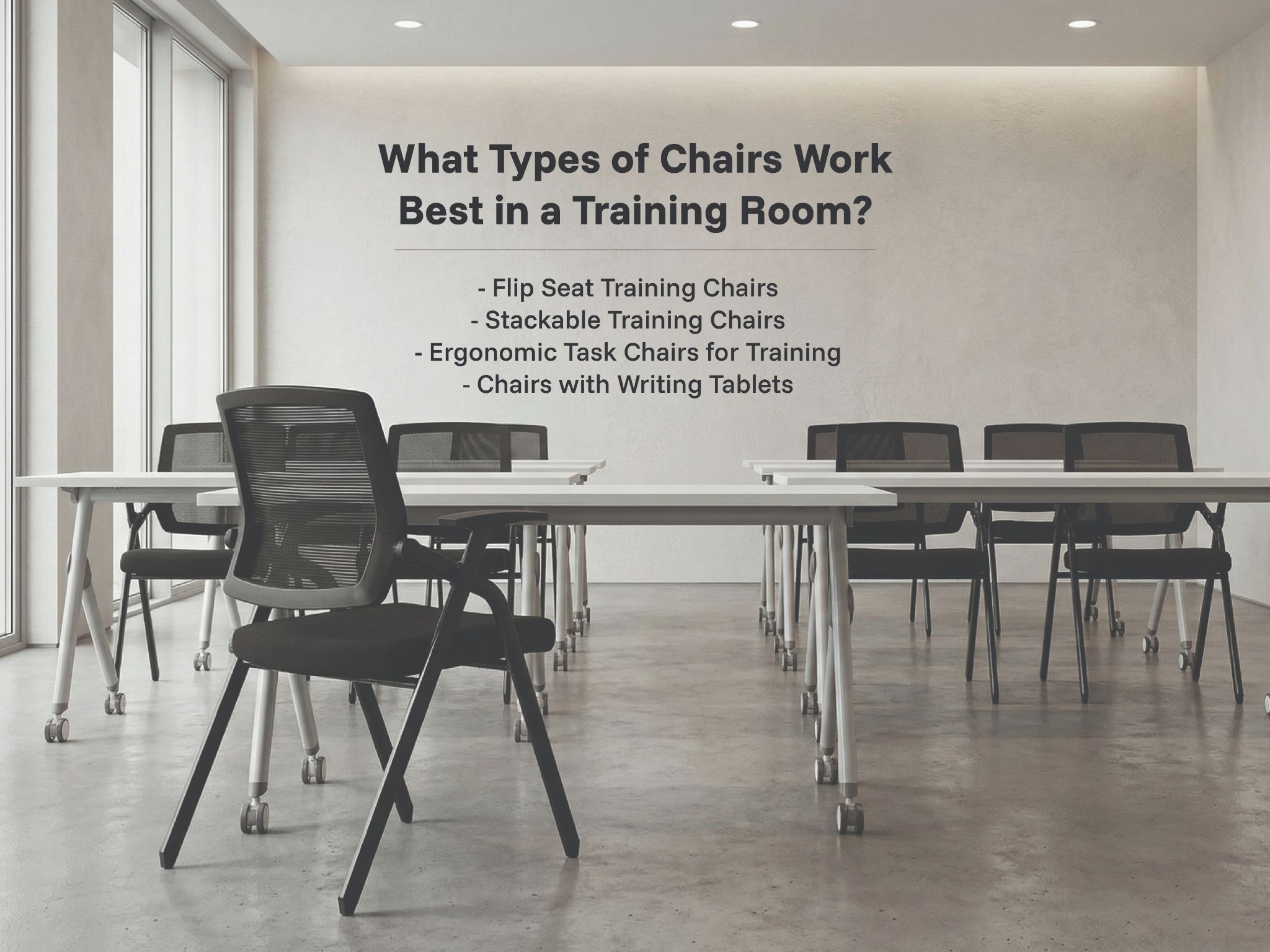
Flip seat training chairs have a seat that folds upward when not in use, reducing the footprint of each chair by approximately 50 percent in the stored position. This makes them the most space-efficient option for training rooms where floor area recovery between sessions is important.
The flip mechanism must operate smoothly and quietly. A noisy or stiff flip mechanism creates disruption during session transitions and signals poor manufacturing quality that will become a maintenance issue under commercial daily use. Test the flip operation specifically on any sample before approving a bulk specification.
Flip seat chairs work best in training rooms with a dedicated storage wall or storage alcove where the chairs can be kept flipped and out of the way when the room is used for non-seating activities.
Stackable Training Chairs
Stackable training chairs are the most widely used training room seating specification in Indian corporate environments. They provide adequate session comfort, stack cleanly for storage, and are available across a wide range of aesthetic specifications suited to different office environments.
The stacking height per chair is the key specification that determines how much floor area the stored chairs occupy. A chair that stacks at 120mm per unit allows ten chairs to be stored in a 1200mm column. A chair that stacks at 200mm per unit requires significantly more storage space for the same quantity.
Quality stackable training chairs use a stacking guide that prevents lateral movement between stacked units, keeping the stack stable and preventing the surface damage that occurs when stacked chairs shift against each other.
Ergonomic Task Chairs for Training
For training programmes involving extended individual computer-based work, assessment exercises, or technical skills development, a basic ergonomic task chair with height adjustment and lumbar support provides meaningfully better participant comfort than a standard training chair.
These are appropriate for training rooms that primarily serve technology onboarding, software training, or any programme where participants work individually at a screen for extended portions of the session. For classroom-style facilitated training, standard training chairs are the more practical and space-efficient specification.
Chairs with Writing Tablets
Chairs with integrated writing tablets attach a small fold-out surface to the armrest, providing each participant with a personal note-taking surface without requiring a dedicated desk for every seat.
They are particularly useful for training rooms with limited floor area where a full table-and-chair configuration cannot accommodate the required participant capacity. The writing tablet allows higher seating density than a desk-and-chair configuration while providing a functional working surface for note-taking and printed material reference.
How Training Room Chair Setup Affects Participant Engagement
How Seating Layout Influences Learning Outcomes?
The physical arrangement of chairs in a training room directly shapes the social and cognitive dynamic of the session. A theatre-style layout with chairs in forward-facing rows creates a passive reception dynamic suited to information delivery but not to discussion, collaboration, or skills practice.
A U-shape or horseshoe layout creates a participatory dynamic where every participant can see every other participant and the facilitator can move through the group freely. Research in educational psychology consistently demonstrates higher engagement, better retention, and more effective skills transfer in U-shape and cluster layouts compared to theatre-style arrangements.
The ability to reconfigure the room quickly between different layout formats is what separates a well-specified training room from a fixed-format meeting room. Chairs that are lightweight, stackable, and easy to move make this reconfiguration practical rather than aspirational.
What Seating Arrangements Work Best for Different Training Formats?
Classroom rows suit large information-delivery sessions where the primary flow is from facilitator to participants. They accommodate the highest participant density but the lowest collaborative engagement.
U-shape suits facilitated discussions, workshops, and skills practice sessions where participant-to-participant interaction is as important as facilitator delivery. It is the most versatile arrangement for corporate training programmes in India.
Cluster or pod layout suits group exercises, case study discussions, and collaborative problem-solving activities. Small groups of four to six participants seated around individual clusters can work independently and reconvene as a full group efficiently.
Assessment layout with chairs spaced and forward-facing suits examination and individual assessment sessions where participant separation is required. The ability to move between these formats within the same working day is the practical test of whether a training room chair specification is genuinely suitable for its intended use.
What to Check Before Buying Training Room Chairs?
Weight Capacity and Frame Quality
Verify the stated weight capacity of any training chair against documentation rather than accepting verbal claims. The frame should be constructed from commercial-grade steel with sufficient gauge to resist the bending and twisting forces of repeated daily use by successive users.
Press firmly on the seat and backrest while the chair is on the floor and assess whether the frame beneath feels completely rigid. Any flex or noise from the frame under moderate hand pressure indicates a structural specification inadequate for commercial training room use.
Seat Cushioning for Long Sessions
Press firmly on the seat cushion and assess the foam density. High-density foam that resists significant hand pressure will maintain its support across a three-hour session. Low-density foam that compresses easily under hand pressure will feel like sitting on a hard surface within ninety minutes of a session.
The upholstery fabric must also be appropriate for shared multi-user commercial use. A Martindale abrasion rating of at least 30,000 cycles is the minimum commercial specification for training room seat fabric. Below this rating, the upholstery surface will show visible wear within months of commercial daily use.
Floor Protection and Mobility
Check the foot or castor specification for the chair and confirm it is appropriate for the training room floor surface. Hard floor rubber feet prevent floor marking on tiled or polished surfaces. Glides or castors must move smoothly without catching or requiring excessive force.
For training rooms with mixed hard floor and carpet areas, confirm that the foot specification is appropriate for both surfaces rather than optimised for one at the expense of the other.
Aesthetic Consistency with Office Environment
Training room chairs are seen by every employee who uses the training facility and by every visitor who passes through the training area. Their visual quality communicates something about the organisation's investment in learning and the care it takes with its physical environment.
Choose a chair colour and finish that is consistent with the broader office interior rather than treating the training room as a space where visual quality is less important. A training room that looks considered and professionally furnished creates a better learning environment and makes a better impression on every person who uses it.
Bonus Point: For organisations running training programmes that regularly include external participants such as client teams, partners, or industry groups, the quality of the training room seating is part of the impression those external visitors take away from the organisation. Investing in quality training room chairs that look and feel professional extends the brand impression benefit beyond the internal development function to every external relationship the training programme touches.
How AFC Furniture Solutions Designs Training Room Chairs for Indian Offices
What Training Chair Options Does AFC Offer?
AFC Furniture Solutions offers purpose-designed training room seating through its dedicated Training Chair range, manufactured at the Greater Noida facility to commercial quality standards appropriate for the high-frequency multi-user demands of Indian corporate training environments.
The Flip provides a clean flip-seat design suited to high-frequency corporate training rooms requiring space-efficient storage between sessions. The seat folds smoothly and silently with a commercial-grade mechanism tested across thousands of flip cycles to verify consistent performance under sustained daily use.
The Snap provides a stackable training chair specification suited to rooms requiring flexible reconfiguration across multiple session formats throughout the working day. Clean stacking geometry and commercial-grade frame construction maintain both the structural integrity and the surface quality of each chair through the repeated stacking and unstacking cycles of active training room use.
Both models are available in upholstery specifications appropriate for extended training sessions, with seat cushioning density specified for commercial multi-user daily use rather than the lighter residential standard that budget alternatives frequently apply.
AFC Furniture Solutions operates a 150,000 square foot manufacturing facility in Greater Noida with production capacity of up to 18,000 chairs per month, ensuring consistent quality and reliable supply for training chair orders of any scale across India.
Explore the full AFC Furniture Solutions Training Chair range to compare flip and snap specifications suited to different training room formats and corporate environments.
What Quality Standards Back AFC Training Chairs?
AFC Furniture Solutions holds BIFMA Level 3 certification, the highest internationally recognised standard for office furniture quality, sustainability, and safety. Every training chair in the range is manufactured at the Greater Noida facility and tested to BIFMA-compliant structural and durability standards covering frame integrity, mechanism performance, and foam quality under sustained commercial daily use.
AFC Furniture Solutions also holds ISO 9001, ISO 14001, and ISO 18001 certifications covering quality management, environmental responsibility, and occupational health and safety standards across the full manufacturing operation.
You can also explore the AFC Furniture Solutions Seating range for the complete chair portfolio covering mesh, leather, training, and cafe categories suited to every seating requirement across the modern Indian corporate office.
Frequently Asked Questions
Q1. What is the most important feature in a training room chair for Indian corporate offices?
Seat cushioning density for extended sessions combined with a lightweight frame for easy reconfiguration are the two most critical features. A chair that maintains comfortable support across a three-hour session and can be moved, stacked, or reconfigured quickly by one person without physical difficulty serves the core demands of Indian corporate training environments.
Q2. How many chairs should a standard corporate training room in India accommodate?
A standard corporate training room of approximately 40 to 50 square metres accommodates 20 to 24 participants in a U-shape configuration or up to 30 in a classroom row layout using appropriately sized training chairs. The correct capacity for a specific room depends on the primary training format and the required circulation space between seats.
Q3. Should training room chairs have armrests?
For training programmes involving extended writing, laptop use, or printed material reference, armrests provide useful support. For highly active training formats involving frequent movement, group exercises, and physical reconfiguration, armrests can restrict movement and are less appropriate. The best specification depends on the primary training activities the room supports.
Q4. Can training room chairs also be used in meeting rooms?
Yes, provided the training chairs are specified in a finish and aesthetic appropriate for meeting room use. AFC Furniture Solutions training chairs are available in specifications suited to formal meeting contexts as well as training environments, making them appropriate for dual-purpose rooms that serve both functions.
Q5. How long should commercial-grade training room chairs last?
Commercial-grade training room chairs from a reputable manufacturer should deliver eight to twelve years of reliable daily institutional use under normal corporate training room conditions. The seat cushioning and the flip or stacking mechanism are the components most likely to require attention over this period.
Q6. Does AFC Furniture Solutions supply training chairs for large corporate training programmes across multiple cities?
Yes. AFC Furniture Solutions serves organisations across India through its pan-India network covering Noida, Gurugram, Mumbai, Pune, Bengaluru, Hyderabad, and Chennai. Large multi-city training room fit-outs can be coordinated through a single account relationship with consistent product specification and installation management across all locations.
Final Thoughts
A dedicated training room setup with quality seating is one of the most practical investments a growing Indian organisation can make in the capability and engagement of its people.
The chair is the piece of equipment every training participant interacts with for the full duration of every session. Getting it right means longer effective engagement, better learning retention, and a physical environment that communicates the organisation's genuine commitment to development.
AFC Furniture Solutions has been designing and supplying corporate training room furniture for Indian organisations for over 15 years, with a complete Training Chair range tested and certified to BIFMA Level 3 standards, manufactured at the Greater Noida facility, and available through experience centres across India.
Explore Other Popular Blogs


Let’s build together
Tell us about your project and we’ll help you plan, design, and deliver at scale.
.jpg)
.svg)