.svg)
Pedestal Drawers vs Filing Cabinets: Which Storage Solution Suits Your Office

Pedestal drawers vs filing cabinets: which storage suits your office best? This guide by AFC Furniture Solutions helps you decide.
The choice between pedestal drawers vs. filing cabinets for offices is one of the most common storage procurement decisions in corporate office fit-outs. Both serve the same broad purpose of providing secure, organised storage for documents and personal items, but they differ significantly in capacity, placement, accessibility, and the roles they are best suited to. This guide by AFC Furniture Solutions helps you choose the right office storage solutions for each area of your corporate workspace.
What Is a Pedestal Drawer?
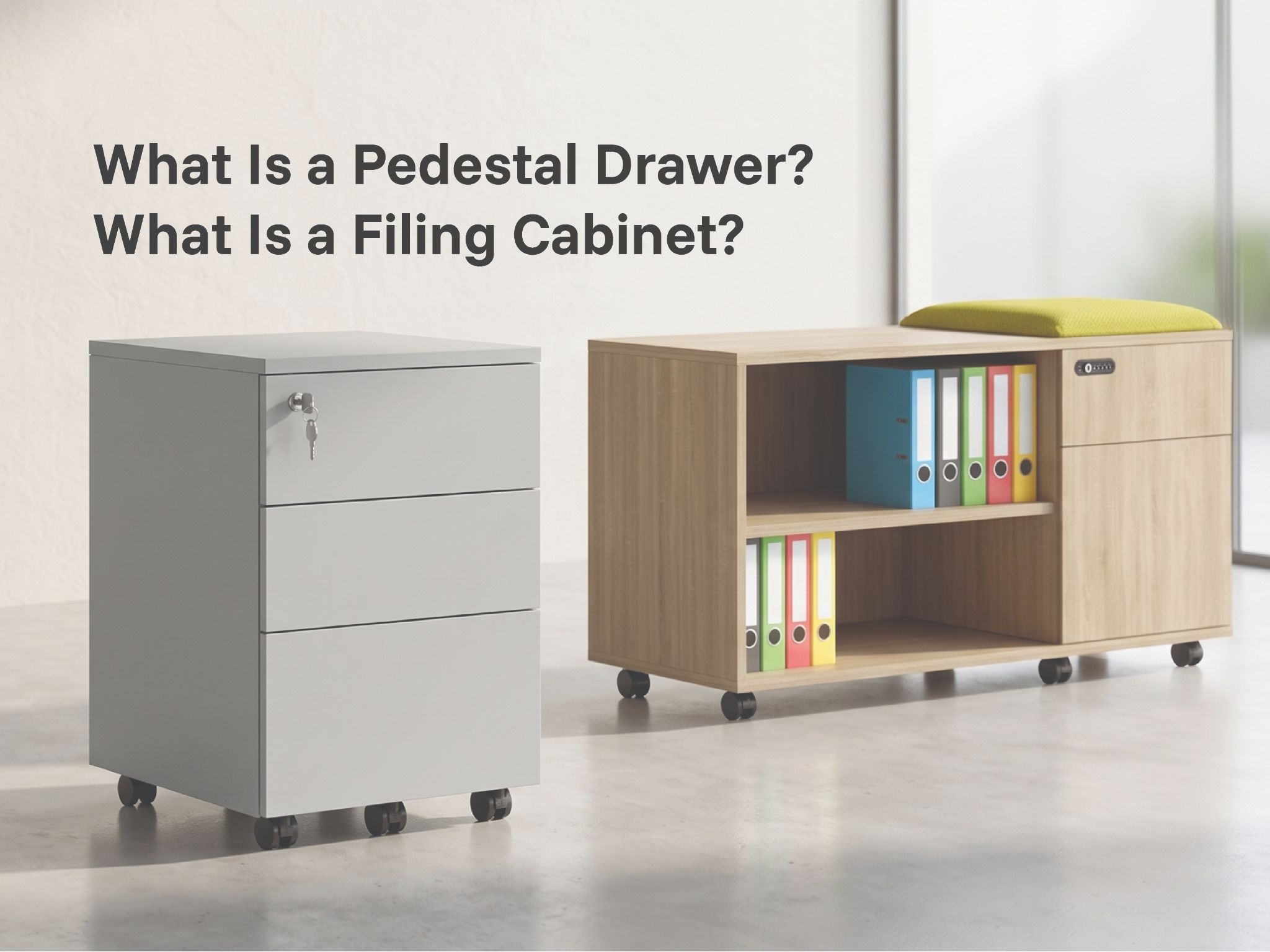
A pedestal drawer is a compact, low-profile storage unit designed to sit beneath or beside a workstation desk. It typically contains two to three drawers in a combination of a shallow box drawer for stationery, a deeper box drawer for files or personal items, and a lockable cupboard section.
Pedestals are available in two configurations. A mobile pedestal sits on castors and can be moved away from the workstation when additional legroom is needed or repositioned when the office layout changes. A fixed pedestal is built into a permanent position under one end of the desk and provides more robust storage with a more stable profile.
AFC Furniture Solutions manufactures the Metal Pedestal as part of its Metal Storage range, available in mobile and fixed configurations with lockable drawers and a powder-coated steel finish suited to Indian commercial environments.
What Is a Filing Cabinet?
A filing cabinet is a purpose-built storage unit designed specifically for storing hanging files and physical documents in an organised format that allows quick retrieval. It is taller and larger than a pedestal and is placed as a standalone unit in a team area, corridor, or dedicated document storage zone rather than beneath a workstation.
Filing cabinets are available in vertical configurations, where files are stored front-to-back in drawers that open toward the user, and lateral configurations, where files are stored side-by-side in drawers that extend the full width of the unit. Standard vertical filing cabinets come in two-drawer, three-drawer, and four-drawer heights.
Lateral filing cabinets are wider and lower than vertical models and allow multiple people to access files from the same unit simultaneously, making them better suited to shared team filing in high-document environments.
Pedestal Drawers vs Filing Cabinets: Key Differences at a Glance
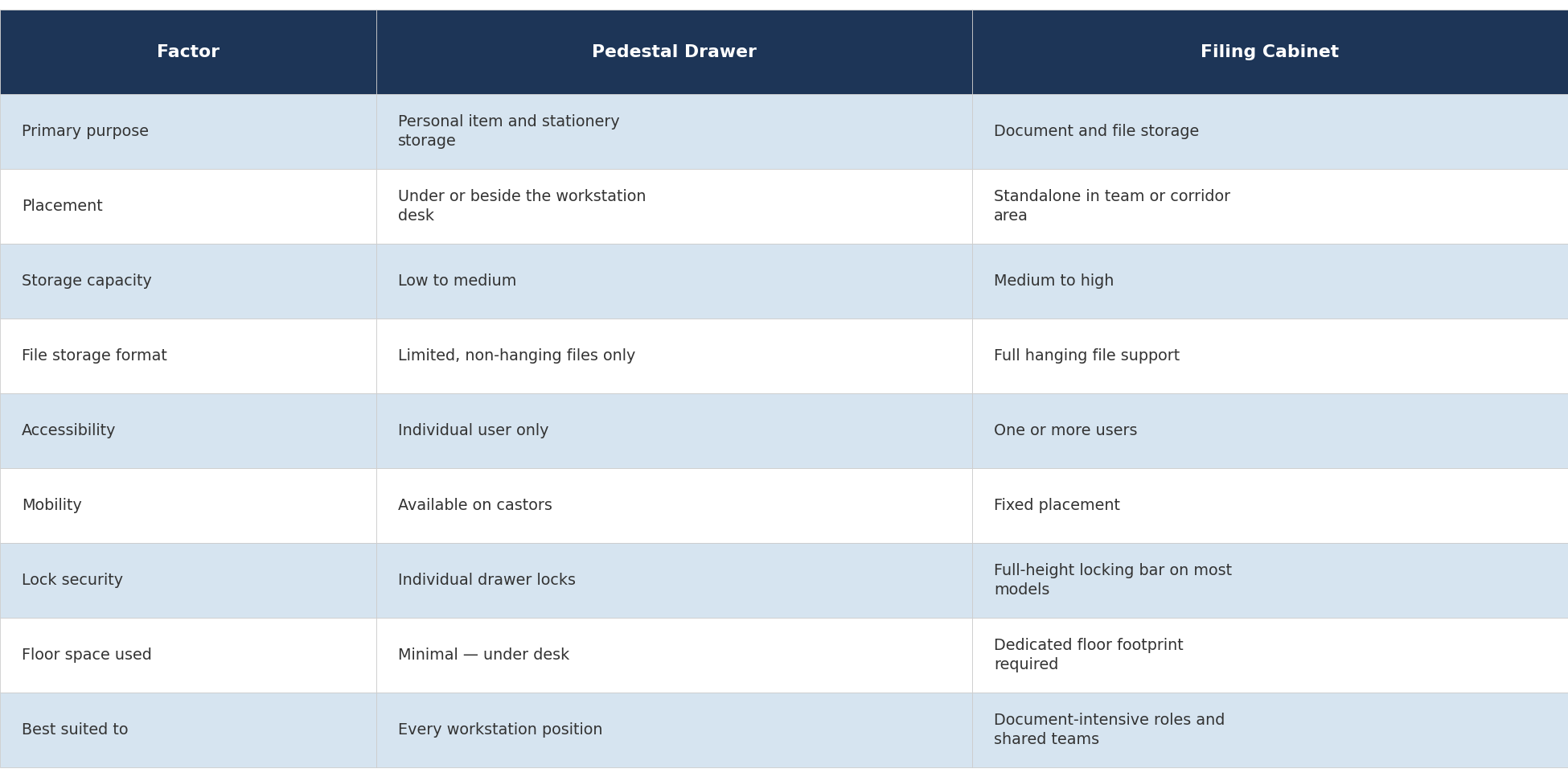
When to Choose Pedestal Drawers
Pedestal drawers are the correct choice when personal, at-workstation storage is the primary need. Every employee working at a fixed workstation benefits from having a pedestal that keeps stationery, personal items, and immediate-access documents within arm's reach without cluttering the desk surface.
Mobile pedestals are particularly well-suited to open plan offices with flexible layouts. They move easily when the arrangement changes and can serve as informal visitor seating with a cushion top in some configurations, adding functional versatility to a compact form.
For organisations operating hot-desking or activity-based working arrangements, pedestals with individual combination locks provide personal secure storage that travels with the employee across different workstation positions, which is not possible with a filing cabinet fixed to one location.
When to Choose Filing Cabinets
Filing cabinets are the correct choice when volume document storage is the primary need. Roles that handle large quantities of physical documents on a daily basis — legal, finance, HR, procurement, and compliance functions — require filing capacity that a pedestal drawer cannot provide.
A four-drawer vertical filing cabinet holds approximately 2,000 to 2,500 A4 hanging files in standard configurations. A pedestal with a filing drawer typically holds 40 to 60 files. For document-intensive roles, a pedestal alone is not an adequate storage specification.
Shared team filing is another clear use case for filing cabinets. When documents need to be accessible to multiple team members, a centrally positioned filing cabinet in the team area is far more efficient than distributing files across individual pedestals where they are harder to find and less accessible to colleagues.
Which Roles Need Which Storage Solution?
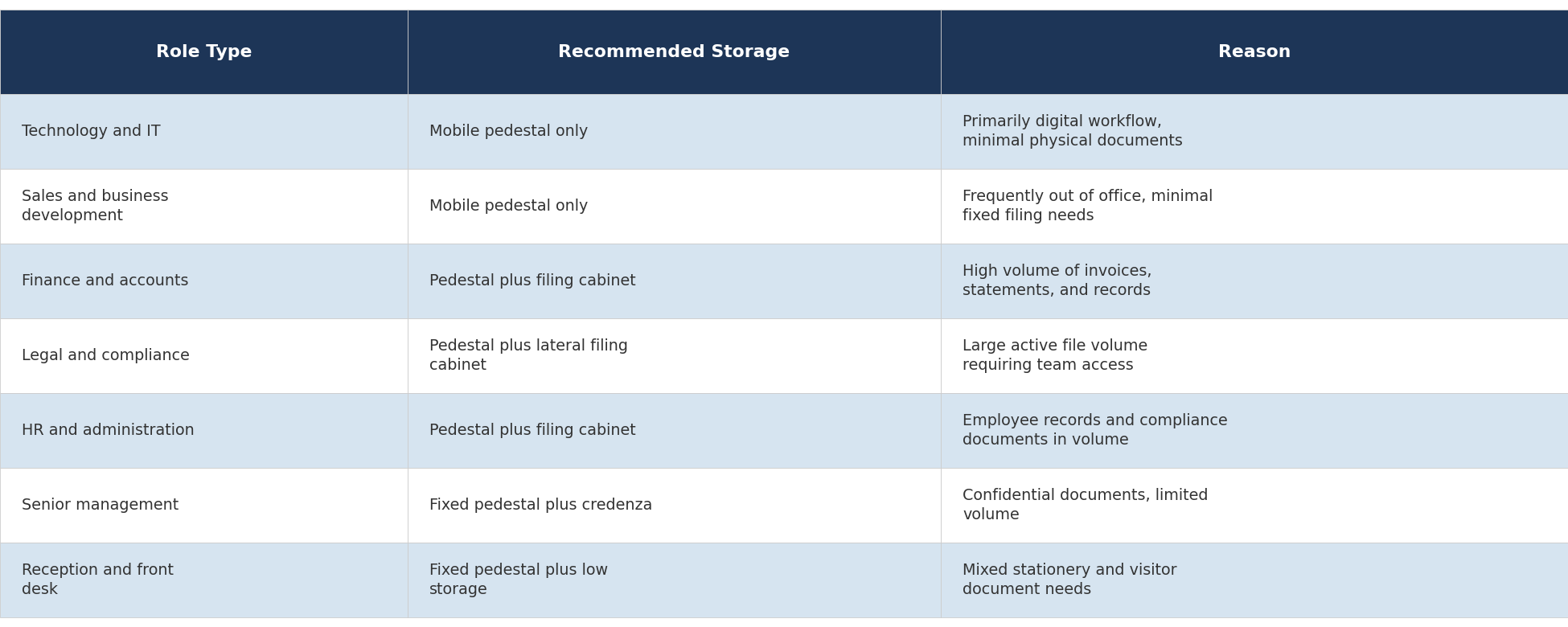
Can You Use Both in the Same Office?
Yes, and in most well-specified corporate offices, both are present simultaneously serving different purposes. The standard approach is to specify one mobile pedestal per workstation for personal at-desk storage across the entire office, and then add filing cabinets in the specific team areas where document volume justifies them.
This combination approach optimises both the individual workstation experience and the team filing function without overloading either. Each employee has immediate personal storage at their desk via the pedestal, while document-intensive teams have the filing capacity they need in a shared unit close to their office workstations without creating storage at every individual desk that most employees do not need.
When specifying both products, confirm that the finish colours coordinate. AFC Furniture Solutions metal storage products are available in a range of powder-coated finishes that can be matched across pedestals, filing cabinets, and tall storage units for visual consistency across the floor.
How to Plan Storage Quantities for Your Office
Pedestal quantity is straightforward. One mobile pedestal per workstation position is the standard specification for corporate open plan offices. For hot-desking environments, the ratio drops to approximately 0.7 pedestals per employee to reflect the fact that not all employees are present simultaneously.
Filing cabinet quantity requires a simple document volume calculation. Count the number of active physical files currently held by each team. Divide the total active file count by the capacity per filing cabinet for your chosen model (typically 2,000 to 2,500 files per four-drawer vertical cabinet). Add 20 percent buffer for growth. The result is the minimum number of filing cabinets required for that team.
This calculation is worth doing before procurement because the difference between a team that needs one filing cabinet and a team that needs four is not always obvious from headcount alone. Document volume varies dramatically between roles and industries.
Common Storage Mistakes in Corporate Offices
Specifying only pedestals for document-intensive teams: Finance, legal, and HR teams that receive only pedestals at their workstations will fill them within weeks and begin storing overflow documents on desk surfaces, windowsills, and floor areas. Always assess actual document volume before confirming the storage specification for these teams.
Placing filing cabinets in inconvenient locations: A filing cabinet positioned far from the team that uses it becomes a point of friction that reduces filing compliance and creates desk clutter. Filing cabinets should be within five to ten steps of the team they serve.
Buying pedestals that block legroom: Pedestals that are positioned incorrectly under the desk restrict chair movement and legroom, forcing the user to adopt a compromised seated posture. Confirm pedestal dimensions against desk and chair specifications before ordering to ensure clearance.
Ignoring lock quality: In offices where sensitive documents or personal valuables are stored, lock quality on both pedestals and filing cabinets matters. Confirm that all locking storage comes with a minimum of two keys per unit and that replacement keys can be sourced from the manufacturer.
Frequently Asked Questions (FAQs)
These are the most common questions asked when choosing between pedestal drawers and filing cabinets for a corporate office.
Q1. How many files can a mobile pedestal hold?
A standard mobile pedestal with one filing drawer can hold approximately 40 to 60 A4 hanging files in the filing drawer section. This is sufficient for employees who maintain a small active file set at their workstation but is not adequate for roles that handle large volumes of physical documents daily.
For high-volume filing needs, a four-drawer vertical filing cabinet holding 2,000 to 2,500 files is the correct specification, either alongside or in place of the individual workstation pedestal.
Q2. What is the difference between a mobile and a fixed pedestal?
A mobile pedestal sits on castors and can be moved freely around the office. This makes it suitable for flexible working arrangements, hot-desking, and layouts that change frequently. A fixed pedestal is built into a permanent position under one end of the workstation desk and cannot be moved without tools.
Fixed pedestals provide more robust storage and a cleaner visual integration with the workstation. Mobile pedestals provide flexibility and can double as informal seating with a cushion top in some configurations.
Q3. Which is more secure: a pedestal or a filing cabinet?
Both pedestal drawers and filing cabinets are available with locking mechanisms. The security level depends on the lock type rather than the product category. Filing cabinets with a three-point locking bar that secures all drawers simultaneously provide higher security than individual drawer locks on a standard pedestal.
For offices storing sensitive HR, legal, or financial documents, a filing cabinet with a full-height locking bar mechanism is the more secure specification.
Q4. Can pedestal drawers be used without a desk?
Yes. Mobile pedestals are self-contained units that can be placed anywhere in the office, including in corridor storage areas, breakout zones, or personal locker areas in hot-desking offices. They do not require a desk to function effectively.
When used as standalone storage rather than under-desk storage, ensure the mobile pedestal is positioned on a flat surface and that the castors are locked when the unit is in a permanent position to prevent unintended movement.
Q5. Does AFC Furniture Solutions supply both pedestals and filing cabinets for corporate offices?
Yes. AFC Furniture Solutions manufactures both the Metal Pedestal, available in mobile and fixed configurations, and a range of filing and storage cabinets as part of the Metal Storage range. All products are available in coordinating powder-coated finishes for visual consistency across the office.
Contact AFC Furniture Solutions at +91 9999006933 or visit afcindia.in to discuss your storage requirements and request a product recommendation for your specific office layout and team structure.
Tips for Choosing Between Pedestals and Filing Cabinets
- Tip 1: Start with one mobile pedestal per workstation as a baseline specification for the entire office, then add filing cabinets specifically for teams with high physical document volumes. This prevents both over-specification and under-specification in one planning step.
- Tip 2: Always confirm pedestal dimensions against your desk and chair specification before ordering. A pedestal that is too tall or too wide for the space under the desk creates legroom and chair movement problems that affect daily ergonomic comfort.
- Tip 3: Order all storage products in the same finish from a single manufacturer. Mismatched finishes between pedestals, filing cabinets, and tall storage units create visual inconsistency that is immediately apparent and difficult to correct after installation.
- Tip 4: Confirm key supply before finalising any storage order. Each lockable unit should come with a minimum of two keys, and the manufacturer should be able to supply replacement keys against a unit serial number if keys are lost.
Bonus Points
- Bonus 1: AFC Furniture Solutions metal storage products including pedestals, filing cabinets, and tall storage units are manufactured under BIFMA Level 3 certified production processes and carry a warranty of up to 10 years on structural components.
- Bonus 2: The AFC Furniture Solutions Metal Pedestal is available in both mobile and fixed configurations and in a range of powder-coated finishes that coordinate with the full AFC workstation and storage range for a visually consistent office environment.
- Bonus 3: AFC Furniture Solutions provides pan-India delivery and installation for all storage orders. Contact our team at +91 9999006933 to discuss your office storage requirements and request a layout recommendation.
Conclusion
The choice between pedestal drawers and filing cabinets for offices is not an either-or decision for most corporate environments. Pedestals provide essential personal at-desk storage for every employee, while filing cabinets serve the document storage needs of teams that handle physical files in volume. Specifying both, correctly sized and positioned relative to the workstations they serve, creates a storage system that keeps the office organised, documents accessible, and desk surfaces clear.
AFC Furniture Solutions offers a complete metal storage range covering pedestals, filing cabinets, tall almirahs, and lockers, all manufactured to BIFMA Level 3 standards and available in coordinating finishes for seamless visual integration across the entire office.
Explore Other Popular Blogs



Let’s build together
Tell us about your project and we’ll help you plan, design, and deliver at scale.
.jpg)
.svg)