.svg)
Office Storage Solutions: How to Organise a Growing Office

Struggling with office storage as your team grows? This practical guide covers types, planning tips, and expert guidance from AFC Furniture Solutions for Indian offices.
Why Does Office Storage Become a Problem as Organisations Grow?
Storage problems in growing Indian offices rarely announce themselves dramatically. They creep in gradually. A few extra files placed on top of a cabinet. A box of archived documents left in the corner. Personal items spreading from under-desk space onto neighbouring surfaces. Each compromise seems minor in isolation. Together they create the cluttered, disorganised working environment that affects every person who works in it every day.
According to a FICCI-ANAROCK report "Workplaces 2025: India Commercial Real Estate Reimagined", office leasing across India's top seven cities reached approximately 80.5 million square feet in 2025, with Grade A office stock touching nearly 800 million square feet. This unprecedented expansion means more Indian organisations than ever are managing larger, denser offices where storage planning is a genuine operational requirement rather than an afterthought.
How Poor Storage Affects Daily Office Operations
Poor office storage creates a chain of daily operational problems. Documents without a defined location end up on desks. Shared reference materials become impossible to locate reliably. Personal items overflow from workstations onto adjacent surfaces. Filing disciplines collapse because there is nowhere structured to put new materials.
The cumulative effect is a working environment where a meaningful portion of every professional's day is consumed by the low-grade friction of locating materials, managing physical disorder, and working around the limitations of a storage system that never had the capacity to serve the team that uses it.
Why Standard Storage Runs Out Faster Than Expected
Most Indian offices are specified for storage at the time of initial fit-out based on the current team size. No growth provision is built into the specification. Within twelve to eighteen months of a significant team expansion, the storage system is at capacity and the overflow problem begins.
The difficulty is that storage capacity is invisible until it is exhausted. A storage system at 90% capacity looks and functions identically to one at 50% capacity. There is no visual warning before the system becomes inadequate. Planning for growth from the outset is the only reliable way to prevent the disruption and cost of retrofitting storage into an occupied office that has run out of space.
What Are the Different Types of Office Storage Solutions?
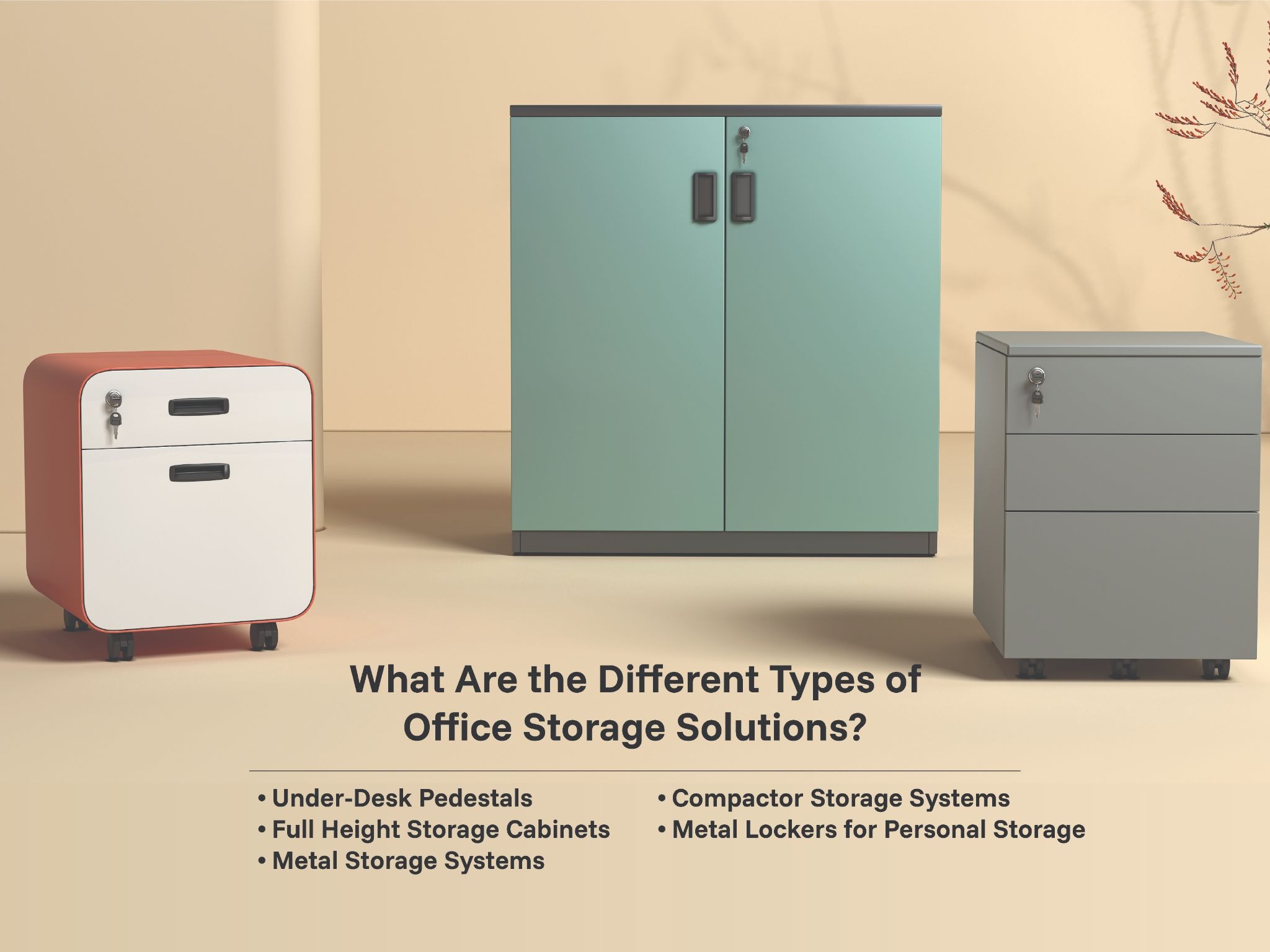
Under-Desk Pedestals
Under-desk pedestals are compact storage units that fit beneath the workstation surface, typically providing two or three drawers of personal document and stationery storage within the individual workstation footprint. They are the most space-efficient personal storage option available and the correct specification for any open-plan floor where individual working materials need to be secured within each workstation position.
Prelam pedestals in coordinated worksurface finishes maintain visual consistency with the workstation system. Metal pedestals provide higher security through lockable drawer mechanisms appropriate for positions handling sensitive documents. Both types are available with castor bases that allow the pedestal to be pulled out and repositioned as required during the working day.
Full Height Storage Cabinets
Full height storage cabinets extend from the floor to a height of 1800mm to 2100mm, using the full available wall height to maximise storage volume per unit of floor area. A single full height cabinet typically provides two to three times the storage volume of a standard low cabinet occupying the same floor footprint.
For growing Indian offices where floor space is a premium, full height cabinets along perimeter walls deliver the maximum storage capacity from the minimum floor area. They are available in metal construction for maximum security and durability and in prelam construction for environments where aesthetic quality is a priority alongside function.
Metal Storage Systems
Metal storage systems built from powder-coated steel frames and panels provide the highest structural durability and physical security of any commercial storage type. They resist the termite damage and moisture degradation that affects wood-based storage in Indian environments, particularly in coastal and high-humidity regions.
They are the appropriate specification for document-heavy departments including HR, legal, finance, and compliance where the materials being stored are both heavy and confidential. The fire resistance of steel construction also makes metal storage the preferred specification for document archives where fire protection is a genuine operational consideration.
Compactor Storage Systems
Compactor storage systems mount shelving units on wheeled carriages running along floor tracks, allowing units to be pushed together to close gaps between rows and pulled apart to create a single access aisle wherever needed. This mechanism eliminates the permanent fixed aisles between rows that conventional shelving requires, recovering 40 to 50% of the floor area for additional storage capacity.
For organisations managing large document volumes in fixed floor areas, a compactor system can deliver the same storage capacity as conventional shelving in approximately half the floor area. This efficiency makes compactor storage the most appropriate specification for dedicated archive rooms and storage areas where floor space recovery is the primary objective.
Metal Lockers for Personal Storage
Metal lockers provide individual lockable personal storage compartments suited to open-plan offices and organisations adopting hot-desking or activity-based working arrangements. They give every team member a secure personal space for bags, personal valuables, and daily essentials that keeps personal items completely off the working desk surface.
Full height locker banks positioned along corridor walls or at the perimeter of open-plan floors organise personal storage without consuming productive floor space. They are the correct storage specification for any organisation where clean desk policies are in place or where the mobile working patterns of a hybrid workforce mean that personal items cannot remain at a fixed workstation throughout the working day.
Tip: When planning office storage for a new fit-out or expansion, always calculate storage provision per person rather than per room. A standard provision of 0.5 to 0.8 linear metres of filing storage per person is the minimum appropriate for most knowledge worker roles. For document-heavy roles including legal, HR, and finance, 1.5 to 2 linear metres per person is more appropriate. Calculating against actual role requirements rather than generic assumptions prevents the underprovision that causes the overflow problem within the first year of occupancy.
How to Match Office Storage to Your Team's Specific Needs?
Storage for Document-Heavy Teams
Legal teams, HR departments, finance functions, and compliance teams maintain large volumes of physical documents that require both adequate volume and physical security. Full height lockable metal cabinets and compactor systems provide the volume and security combination that these teams require.
The confidential nature of their materials makes locking mechanisms a non-negotiable specification element rather than an optional security feature. Individual drawer locks, full-height cabinet locks, and compactor system access controls collectively provide the layered physical security that data protection obligations increasingly require organisations to demonstrate.
Storage for Technology and IT Teams
Technology and IT professionals typically have lower paper document volumes than legal or finance teams but higher volumes of equipment, accessories, cables, and physical media that need organised storage. Under-desk pedestals for personal items combined with open-shelf metal storage for shared equipment and consumables is the most practical combination for technology team storage zones.
Lockable storage for sensitive equipment and licensed software media is appropriate in environments where physical security of technology assets is a documented operational requirement.
Storage for Hot Desking and Hybrid Offices
Hot-desking and activity-based working environments remove personal storage from the workstation entirely. Each team member requires a dedicated personal storage position, typically a locker, that travels with them to whichever desk they use on a given day.
Metal locker banks provide this personal storage infrastructure in a compact, organised, and secure form. The correct specification matches the number of lockers to the peak daily occupancy of the office rather than the total team headcount, because in a genuine hot-desking environment not all team members will be in the office simultaneously on any given day.
What Key Features Should Office Storage Furniture Have?
Load Capacity and Shelf Strength
Every shelf in an office storage system has a specified safe working load that must be matched to the actual weight of the materials being stored. Lever arch files filled with documents weigh two to three kilograms each. A shelf holding fifteen to twenty such files carries a significant sustained load that a shelf specified only for light document storage will not support without flex and eventual failure.
Always request shelf load ratings in kilograms per shelf rather than accepting general descriptions of heavy-duty capability. A verified load rating is the only meaningful basis for comparing storage products across different suppliers for a specific application.
Locking and Security Features
For any storage holding confidential or sensitive materials, the locking mechanism quality determines whether the security claim the cabinet makes is genuine. Test the locking mechanism physically on any sample before approving any bulk specification. A lock that engages smoothly and positively on a sample unit demonstrates manufacturing quality. A lock that requires force or operates loosely signals a mechanism quality that will create problems in daily commercial use within months.
Individual drawer locks, full-height single-point locks, and multi-point locking systems provide different levels of security appropriate to different document sensitivity levels. Match the lock specification to the sensitivity classification of the materials being stored rather than applying the highest or lowest specification uniformly across all storage types.
Material Quality for Indian Conditions
For metal storage, confirm that powder-coat finishing is applied to both interior and exterior surfaces and that the steel gauge in panels and frames is appropriate for commercial daily use. For prelam storage, confirm that the board grade is BWR standard with PVC edge banding on all exposed edges.
Standard MR grade board is not appropriate for Indian commercial storage environments. In coastal regions, monsoon-affected areas, and any location with significant seasonal humidity variation, MR grade board swells, delaminates, and deteriorates within two to three years of installation. The replacement cost consistently exceeds the initial cost difference between MR and BWR specification.
Modular and Expandable Design
A storage system that can be extended with matching units in the same finish and configuration as the organisation grows protects the initial investment and maintains visual consistency across the storage environment as additional capacity is added.
Confirm with any supplier before purchase that matching units will be available in the same finish and dimensions for extension orders over the next three to five years. A supplier who cannot commit to product range continuity for future extensions is asking you to accept a storage specification that cannot grow with the organisation that uses it.
Bonus Point: For organisations planning a major office fit-out or expansion, designate a specific storage planning meeting as a separate agenda item from the broader furniture specification process. Storage requirements are consistently underestimated when discussed as a single line item within a larger furniture procurement conversation. A dedicated storage audit meeting that maps each team's specific document volume, security requirements, and access frequency against available floor area produces a more accurate and more appropriate storage specification than any approach that treats storage as a secondary consideration.
How to Plan an Office Storage Layout That Scales With Your Team?
Step 1: Audit What You Currently Store
Before specifying any storage, conduct a physical audit of everything currently stored across the office. Classify every item into one of three categories: active items accessed daily, semi-active items accessed occasionally, and inactive items retained for compliance but rarely accessed.
This classification is the foundation of a storage specification that actually serves the organisation. Active items require immediately accessible storage near the workstation. Semi-active items can be stored further from the primary working area. Inactive items are the best candidates for compactor storage or dedicated archive rooms where density and volume matter more than speed of access.
Step 2: Zone Storage by Access Frequency
Place active storage as close as possible to the point of use. Under-desk pedestals and low open shelving at the workstation provide the fastest access for daily working materials. Mid-distance storage including full height cabinets along the team zone perimeter provides quick access for semi-active reference materials. Remote storage in dedicated archive rooms provides organised capacity for inactive compliance materials.
This three-tier zoning approach ensures that every material is stored at the distance from the point of use that matches its actual access frequency. It prevents the common problem of high-frequency materials being stored in inconvenient locations because those were the only positions with available capacity.
Step 3: Plan for Growth
Specify a total storage capacity that accommodates current holdings plus a realistic projection for the next three to five years. For a team growing at 20% annually, current capacity plus 60 to 100% additional provision is an appropriate starting point for a three to five year planning horizon.
Reserve physical floor space adjacent to each storage zone for the additional units the organisation will need as it grows. A reserved floor area that appears underutilised at installation is not wasted space. It is the growth capacity that prevents a complete storage reconfiguration within eighteen months.
For comprehensive guidance on maximising vertical storage efficiency in a growing office, explore our detailed guide on Full Height Storage Solutions: Why Every Growing Office Needs One.
How AFC Furniture Solutions Designs Office Storage for Indian Offices
What Storage Options Does AFC Offer?
AFC Furniture Solutions offers a complete office storage range covering every storage requirement in the modern Indian corporate office, manufactured at the Greater Noida facility to consistent BIFMA Level 3 certified quality standards.
The Metal Storages range provides powder-coated steel full height cabinets and mid-height units designed for heavy-duty commercial daily use across document-intensive departments. Every unit is manufactured with commercial-grade steel panels and frames appropriate for the sustained load and access intensity of Indian professional environments.
The Prelam Storage range provides full height and mid-height units in pre-laminated board finishes suited to client-facing areas, executive zones, and any storage context where aesthetic quality is a priority alongside functional performance. BWR grade board with PVC edge banding ensures moisture resistance appropriate for Indian commercial conditions.
The Metal Pedestal and Prelam Pedestal provide under-desk personal storage in metal and prelam finishes respectively, integrating cleanly with the AFC Furniture Solutions Desking Series workstations within a single floor specification.
The Compactor from the Compactor Storage range provides mobile roller-track storage delivering 40 to 50% floor area savings compared to equivalent conventional shelving, suited to dedicated archive rooms and storage areas where density and security are the primary requirements.
The Heavy Duty Racks provide open full height shelving for maximum load capacity in stock rooms, archive areas, and high-volume storage environments where visual inventory access and rapid retrieval are priorities alongside storage capacity.
The Metal Locker provides full height personal storage in lockable individual compartments, available in single, double, and multi-tier configurations suited to different personal storage volume requirements across hot-desking and hybrid working environments.
AFC Furniture Solutions operates a 150,000 square foot manufacturing facility in Greater Noida with the production capacity to support storage orders at any scale across India. The workspace consulting team provides scaled floor plans showing proposed storage configurations in the actual room dimensions before any order is placed.
Explore the full AFC Furniture Solutions Storage range to compare metal, prelam, compactor, pedestal, and locker options suited to every office storage requirement across Indian corporate, institutional, and government environments.
What Quality Standards Back AFC Storage Products?
AFC Furniture Solutions holds BIFMA Level 3 certification, the highest internationally recognised standard for office furniture quality, sustainability, and safety. Every storage product in the range is manufactured at the Greater Noida facility and tested to BIFMA-compliant structural and durability standards appropriate for sustained institutional daily use.
AFC Furniture Solutions also holds ISO 9001, ISO 14001, and ISO 18001 certifications covering quality management, environmental responsibility, and occupational health and safety across the full manufacturing operation. Named institutional clients including Tata Consultancy Services, Air India, Maruti Suzuki, and DXC Technology confirm the quality consistency and scale capability of AFC Furniture Solutions across India's most demanding corporate environments.
Frequently Asked Questions
Q1. What is the most important thing to get right when planning office storage for a growing team?
Planning for growth from the outset is the most important single decision in any office storage specification. A storage system that is adequate for the current team but has no growth capacity will be at its limits within twelve to eighteen months of a significant hiring phase. Specifying a system that accommodates both current holdings and a realistic three to five year growth projection eliminates the disruption and cost of retrofitting storage into an occupied office.
Q2. What type of storage is best for an open plan hot-desking office?
Metal locker banks for personal storage combined with centralised full height storage for shared documents and materials is the most appropriate specification for hot-desking environments. The locker provides each team member with a secure personal storage position that travels with their working pattern. Centralised shared storage ensures that team reference materials are always accessible from any desk position on the floor.
Q3. How much storage space does each employee typically need in an Indian office?
A minimum of 0.5 to 0.8 linear metres of filing storage per person is appropriate for most knowledge worker roles. For document-heavy roles including legal, HR, and finance, 1.5 to 2 linear metres per person is more realistic. These are minimum starting points. Conducting an actual audit of each team's current document volumes produces a more accurate specification than any assumed average.
Q4. Is metal storage better than prelam storage for Indian offices?
Both serve different needs. Metal storage provides higher durability, security, and moisture resistance making it the better choice for document-heavy departments and any environment with significant humidity variation. Prelam storage provides a warmer, more aesthetically considered appearance suited to client-facing areas and executive zones. Most well-specified Indian offices use both types across different zones matched to the specific requirements of each area.
Q5. How can I increase office storage capacity without adding floor area?
Use the full available wall height with full height storage units rather than low cabinets that waste the wall space above them. Install under-desk pedestals to bring personal storage within the workstation footprint rather than consuming separate floor area. Consider a compactor storage system for dedicated archive areas where floor space recovery is the primary objective.
Q6. Does AFC Furniture Solutions supply office storage for large corporate fit-outs across multiple cities?
Yes. AFC Furniture Solutions manages large multi-city corporate storage installations through a single account relationship with consistent product specification, delivery coordination, and installation management across all locations. The pan-India network covering Noida, Gurugram, Mumbai, Pune, Bengaluru, Hyderabad, and Chennai supports storage projects at any scale across India.
Final Thoughts
Organised office storage is not a finishing detail in a well-designed Indian workplace. It is a foundational operational requirement that determines whether the physical environment can support the team working in it across the months and years of the organisation's growth.
Getting the specification right, from storage type and material quality through to zoning by access frequency and planning for team growth, protects the investment and creates the organised, professional environment that makes daily work easier for every person in the office.
AFC Furniture Solutions has been designing and supplying office storage solutions for Indian organisations for over 15 years, with a complete range from metal and prelam cabinets to compactor systems, pedestals, and lockers, all manufactured to BIFMA Level 3 and ISO certified quality standards at the Greater Noida facility and available through experience centres across India.
Explore Other Popular Blogs


Let’s build together
Tell us about your project and we’ll help you plan, design, and deliver at scale.
.jpg)
.svg)