.svg)
Library Study Table: How to Choose the Right One for Schools and Colleges

Choosing the right library study table for your school or college? This practical guide covers types, features, age-appropriate sizing, and expert guidance from AFC Furniture Solutions.
Why Does the Right Library Study Table Matter?
A school or college library is one of the most important learning spaces in any educational institution. It is where students develop independent study habits, conduct research, read for pleasure, and build the self-directed learning skills that shape academic outcomes across their entire educational journey.
The furniture in this space either supports this learning or quietly works against it. A library study table that is too small, too high, poorly surfaced, or structurally inadequate creates physical and practical friction that reduces the time students voluntarily spend in the library and the quality of work they produce while there.
Getting the library furniture right is one of the most practical and lasting investments an Indian school or college can make in the academic engagement of its students.
How Does Library Furniture Affect Student Engagement?
According to the Association of College and Research Libraries, research across more than 200 campuses in the ACRL Assessment in Action programme confirmed that use of library space relates positively to student learning and success across multiple academic outcome measures, including retention, GPA, and graduation rates.
The physical quality of the library environment is a direct determinant of how frequently students choose to use it and how long they remain engaged during each visit. A library with comfortable, well-proportioned study tables that provide adequate working space for the tasks students bring to the library invite extended use. A library with inadequate furniture is used briefly and reluctantly.
Every additional hour a student spends productively engaged in a well-equipped library is an hour that directly contributes to the academic outcomes the institution exists to deliver.
What Happens When the Wrong Table Is Specified?
A table that is too high for the intended age group forces students to raise their shoulders to write, creating the muscular tension that makes sustained studying physically uncomfortable within thirty to forty minutes.
A table surface that is too small forces students to keep reference books on the floor, use their lap as a secondary working surface, or restrict the materials they bring to the library. Each of these workarounds reduces the quality and duration of the study session.
A library furnished with incorrect, inadequate, or poorly maintained tables communicates something specific and damaging to every student who uses it: that the institution does not consider their independent study experience worth a serious investment.
What Makes a Good Library Study Table?
Surface Area and Working Space
A quality library study table must provide sufficient surface area for the actual working pattern of a student engaged in research or study. At the secondary school and college level, this means accommodating an open textbook, a notebook, a laptop or tablet, a pencil case, and any printed reference materials simultaneously without crowding.
A minimum individual working width of 600mm per seated position is required for basic library use. For positions intended for extended research sessions with multiple references open simultaneously, 750mm to 900mm per position is the more practical specification.
Insufficient surface area is the single most common practical complaint about library furniture across Indian schools and colleges. A student who cannot comfortably spread their materials is a student who will leave the library earlier than they would otherwise.
Height for Different Age Groups
Table height must be matched to the body proportions of the intended student group. A table at the correct height allows the student to sit with forearms roughly horizontal on the surface, feet flat on the floor or on the chair footrest, and eyes at a comfortable reading angle without neck flexion.
For primary school students, this corresponds to a table height of approximately 500mm to 580mm. Secondary school students typically require 650mm to 720mm. College and university students use standard adult table heights of 720mm to 760mm.
Specifying a single table height across all age groups is one of the most common and most damaging library furniture procurement mistakes in Indian educational institutions. A table that fits one age group correctly fits every other poorly.
Material Quality for Indian Conditions
BWR-grade engineered wood with PVC edge banding on all exposed edges is the correct worksurface specification for Indian school and college library environments. It resists the humidity cycling of Indian seasonal conditions, withstands the daily wear of institutional use, and maintains a clean, professional surface appearance across many years of service.
A standard MR grade board is not appropriate for Indian educational environments. In coastal regions, monsoon-affected areas, and any location with significant seasonal humidity variation, MR-grade board swells, delaminates, and deteriorates visibly within two to three years of installation. The replacement cost far exceeds the initial cost difference between MR and BWR specifications.
Powder-coated steel frames or solid hardwood frames are the correct structural specifications for library tables. Both provide the rigidity and long service life that institutional daily use requires.
Privacy and Focus Features
Individual study positions in a library benefit from partial privacy screens that reduce visual distraction from adjacent positions without creating complete enclosure. A low divider of 200mm to 300mm above the table surface provides psychological separation between positions that meaningfully extends the effective focus duration of students studying in proximity.
Shared tables without any privacy provision work well for brief reference use but struggle to serve students engaged in sustained individual study, because the visual activity of adjacent positions creates a continuous low-level distraction that compounds across the session.
Durability for Institutional Use
A library study table in an Indian school or college is used by dozens of different students every day across an academic year running nine to ten months. Over a ten-year service life, a single table may be used by thousands of individual students.
Commercial-grade construction with tested load ratings, durable surface finishes, and robust structural joints is the appropriate specification for this intensity of institutional use. Residential-grade furniture specified to reduce procurement cost typically requires replacement within three to four years and delivers a significantly higher total cost of ownership than a quality commercial specification over any ten-year planning horizon.
Tip: When specifying library study tables for a new or refurbished school library, always visit a comparable library that has been furnished by your shortlisted supplier for at least three years before placing any order. Seeing how the furniture has held up under three years of daily institutional use by students of the relevant age group is the most reliable quality assessment available and consistently reveals durability issues that showroom evaluation cannot.
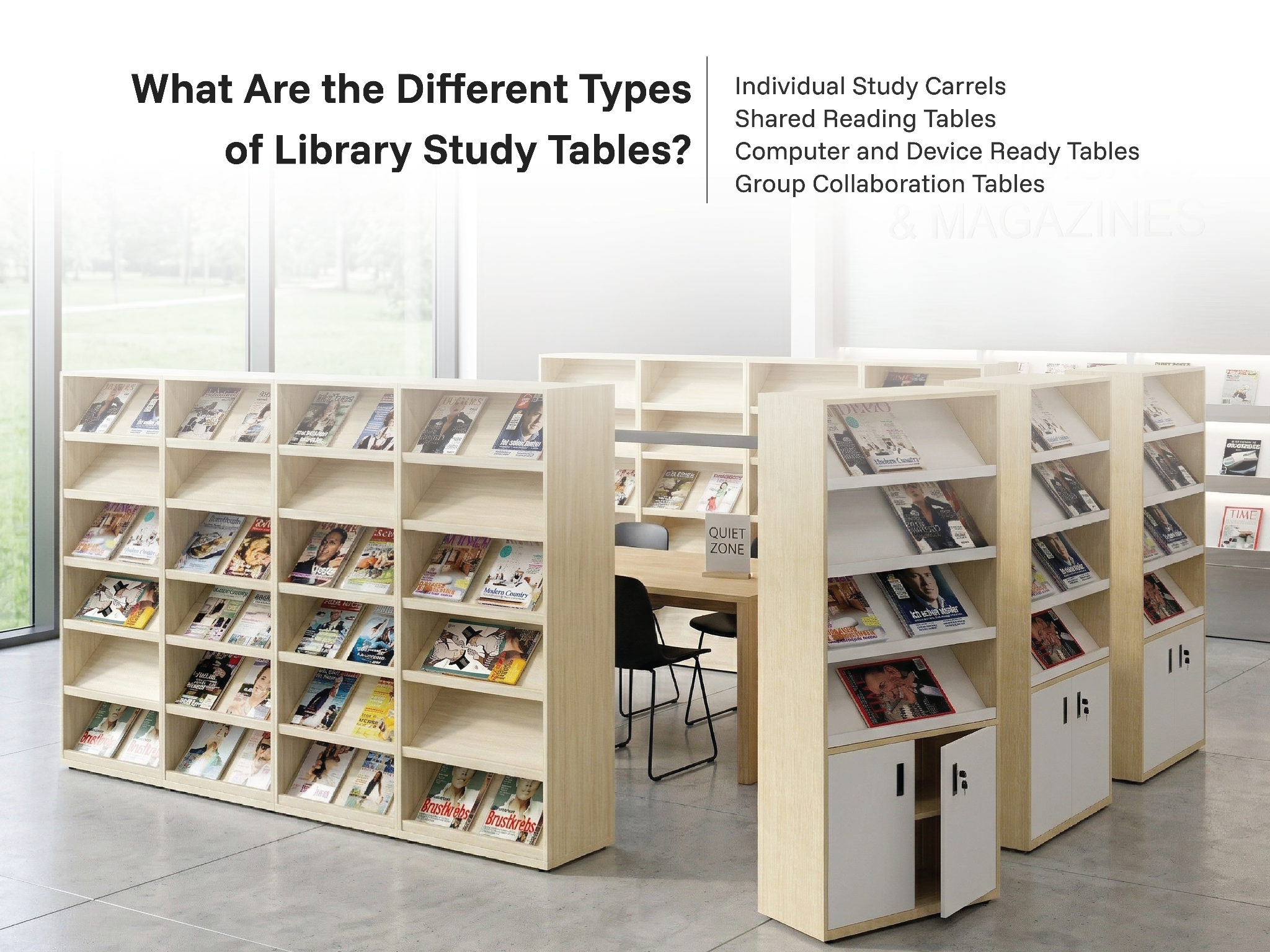
What Are the Different Types of Library Study Tables?
Individual Study Carrels
An individual study carrel is a single-position workstation with panel screens on two or three sides, creating a defined personal study enclosure that provides visual and partial acoustic separation from adjacent positions.
Study carrels are the most effective library furniture configuration for students engaged in sustained individual research, examination preparation, or any study activity requiring extended uninterrupted concentration. The enclosure creates a focused personal space that the open shared table cannot provide.
For secondary school and university libraries that serve significant examination preparation activity, a proportion of individual study carrels alongside shared tables creates the mix of study environments that serves the full range of student use patterns effectively.
Shared Reading Tables
Shared reading tables accommodate four to eight students simultaneously at a single large table surface. They are the most space-efficient library furniture configuration and the most appropriate for casual reading, brief reference use, and collaborative group work.
For primary school libraries, large shared tables with colourful, welcoming aesthetics create the social, inviting environment that encourages young students to experience the library as a pleasant place to spend time rather than a formal study hall.
Table shape influences the social dynamic of shared use. Rectangular tables create a formal, hierarchical dynamic suited to structured reference work. Round or oval tables create a more egalitarian, conversational dynamic suited to group research and collaborative activities.
Computer and Device Ready Tables
India's push toward smart schools and digital campuses means that library tables in many Indian educational institutions now need to accommodate devices as a standard requirement rather than a provision for a minority of users.
Device-ready library tables include power access points built into or near the table surface, cable management grommets for routing charging cables, and a tablet or laptop groove along the front edge that holds devices at a comfortable viewing angle without occupying primary working space.
These features are the difference between a library that genuinely supports the working patterns of contemporary Indian students and one that forces them to manage power and device access as a daily practical problem.
Group Collaboration Tables
Group collaboration tables are sized and shaped to serve four to six students working together on a research project, group assignment, or collaborative learning activity. They typically feature a round or oval form that allows every participant to see every other participant without hierarchical positioning.
For college and university libraries where group project work is a significant proportion of library activity, dedicated collaboration table zones with appropriate seating create spaces that serve this working pattern directly rather than forcing group work to adapt to individual study furniture.
How to Match Library Tables to Different Educational Levels?
Primary School Libraries (Ages 5 to 10)
Primary school library tables must prioritise age-appropriate sizing above all other considerations. A table at the correct height for a seven-year-old makes library use physically comfortable and inviting. A table designed for older students forces young children into awkward postures that make sustained reading physically tiring within minutes.
Safety is the second priority. All edges must be fully rounded with no exposed sharp corners or metal protrusions. Table surfaces must be smooth, easy to clean, and resistant to the inevitable marking and spillage of a space used by young children.
Bright, welcoming colours and simple, approachable aesthetics contribute positively to the primary library experience. Research in educational psychology supports the use of colour in primary learning spaces as a contributor to engagement and positive association with learning.
Secondary School Libraries (Ages 11 to 17)
Secondary school students use the library for a wider range of activities than primary students, including examination revision, research assignments, extended reading, and increasingly device-based study. The library furniture must accommodate all of these activities comfortably.
The physical size range of secondary students is significantly wider than at primary level. A Year 7 student and a Year 12 student may differ by 30 centimetres in height. Where possible, a mix of table heights or height-adjustable tables provides the most inclusive specification for secondary libraries serving the full secondary age range.
Technology readiness is a genuine specification requirement at secondary level. Power access and cable management provision at library tables is increasingly expected by secondary students who bring devices to study sessions as a matter of course.
College and University Libraries (Ages 18 and Above)
University and college students use the library for the most intensive and sustained study sessions of any educational level. Examination periods bring students to the library for sessions of four to six hours. Research dissertation periods bring students for longer.
The ergonomic requirements of this level of use are equivalent to professional office work. Adequate surface area for multiple simultaneous references, correct table height for adult proportions, power access for device charging, and seating that supports extended sitting comfortably are all genuine functional requirements rather than preferences.
Individual study carrels with privacy screens are particularly valued at university level where the concentration demands of advanced academic work benefit most directly from the visual isolation that a carrel provides compared to an open shared table.
What Should You Check Before Buying a Library Study Table?
Load Capacity and Shelf Strength
Verify that the table surface and any integrated shelving can support the realistic combined weight of the materials a student brings to the library. A table loaded with multiple textbooks, a laptop, and reference materials carries a significant distributed load. A surface that flexes under moderate hand pressure will degrade quickly under this sustained institutional load.
Ask the supplier to specify the surface load rating in kilograms per square metre rather than accepting a general description of durability. A verified load rating provides a meaningful basis for procurement comparison that subjective quality descriptions cannot.
Edge Finishing and Safety
All edges must be finished with PVC edge banding that covers the full thickness of the board on every exposed edge. The banding must be applied consistently with no gaps, lifting, or rough sections. Exposed board edges absorb moisture, chip under daily institutional use, and present a physical safety hazard for younger students.
Run your hand along every edge of any sample table you are evaluating. Any roughness, irregularity, or exposed board indicates a manufacturing quality that will deteriorate further under commercial institutional use.
Stability and Anti-Tip Design
A library study table must remain completely stable when a student leans on one edge, places a heavy bag on one corner, or applies the asymmetric loads that occur naturally during active study. Press down firmly on each corner of the table and assess whether any flex or movement occurs in the frame beneath the surface.
Four-leg tables must have levelling feet that allow the table to sit completely flat on uneven institutional floor surfaces. An uneven table rocks under use, creating a constant low-level distraction and a surface quality that makes writing difficult.
Cable Management for Device Use
For any library table specified with power access or device charging provision, verify that the cable management system routes cables completely out of the visible and accessible surface area. Visible cables create clutter, present tripping hazards, and undermine the clean, organised aesthetic that a well-maintained library depends on.
Cable management grommets at the table surface and an under-surface cable tray routing to the building floor box are the minimum infrastructure for a well-specified, device-ready library table.
How to Plan a Library Furniture Layout for Maximum Use?
Step 1: Assess Student Numbers and Space
Begin with the actual dimensions of the library space and the number of students the library needs to serve in its peak usage periods. For most Indian schools, peak library use occurs during examination preparation periods when multiple year groups may use the library simultaneously.
Specify seating capacity for the realistic peak rather than the average. A library that cannot accommodate demand during peak periods becomes a source of student frustration rather than a genuine learning resource during the periods when it matters most.
Step 2: Define Primary Library Activities
Identify the primary activities the library needs to support: individual silent study, group research, device-based work, casual reading, or reference consultation. Different activities require different furniture configurations and the proportions of each type should reflect the realistic activity profile of the student population.
For Indian secondary schools where examination preparation is a dominant library activity, individual study positions or carrels should constitute a higher proportion of the total seating than in a primary school library where group reading and casual browsing are the primary uses.
Step 3: Zone the Library by Use Type
Divide the library floor into zones based on the activity profile analysis: a quiet individual study zone with carrels or divided tables, a group work zone with round or oval shared tables, a casual reading zone with lower seating, and a reference and browsing zone near the collection shelving.
This zoning approach allows different student needs to be served simultaneously without one use pattern disrupting others. A student engaged in silent examination revision should not be disturbed by a group discussion happening at an adjacent table.
Step 4: Plan for Future Growth
Specify a furniture layout that accommodates the current student population plus a realistic growth projection for the next five years. A library that is at capacity in year one of a new building will be overcrowded in year three without a growth buffer built into the initial specification.
Confirm with the supplier that matching tables can be ordered in the same finish and dimensions in future years to extend the capacity of each zone as student numbers grow.
Bonus Point: For college and university libraries undergoing refurbishment, consult directly with student representatives before finalising the furniture specification. Students who use the library regularly have direct knowledge of the most common practical frustrations with the current furniture, whether insufficient power access, inadequate surface area, or uncomfortable seating for long sessions. This consultation takes one meeting and consistently produces insights that improve the final specification more effectively than any procurement checklist alone.
How AFC Furniture Solutions Designs Library Furniture for Indian Institutions
What Library Table Options Does AFC Offer?
AFC Furniture Solutions offers a dedicated Library furniture range designed specifically for the institutional demands and age-appropriate requirements of Indian schools, colleges, and universities.
The Connecta provides a versatile library table configuration suited to shared reading and group work zones across secondary and higher education libraries. Its clean design and commercial-grade surface specification accommodate both traditional reference work and device-based study patterns.
The Forma provides a structured individual study configuration suited to focused study zones in secondary school and college libraries where the concentration demands of examination preparation and advanced research benefit from a defined personal study position.
Both models are manufactured using BWR grade engineered wood with PVC edge banding appropriate for Indian institutional conditions, on powder-coated steel or solid frame constructions tested for sustained commercial institutional daily use across many student cohorts.
AFC Furniture Solutions operates a 150,000 square foot manufacturing facility in Greater Noida with a production capacity that ensures consistent quality and reliable supply for library furniture orders of any scale across India.
Explore the full AFC Furniture Solutions Library range to compare library table and shelving configurations suited to different educational levels and library use profiles.
What Quality Standards Back AFC Library Furniture?
AFC Furniture Solutions holds BIFMA Level 3 certification, the highest internationally recognised standard for furniture quality, sustainability, and safety. Every product in the Library range is manufactured at the Greater Noida facility and tested to BIFMA-compliant structural and durability standards appropriate for sustained institutional daily use.
AFC Furniture Solutions also holds ISO 9001, ISO 14001, and ISO 18001 certifications covering quality management, environmental responsibility, and occupational health and safety standards across the full manufacturing operation.
You can also explore the full AFC Furniture Solutions Educational furniture range covering classroom, library, hostel, and auditorium solutions for schools and colleges across India.
Frequently Asked Questions
Q1. What is the standard height for a library study table in Indian schools?
Standard heights vary by age group. Primary school libraries require tables at approximately 500mm to 580mm. Secondary school libraries require 650mm to 720mm. College and university libraries use a standard adult height of 720 mm to 760 mm. Specifying the correct height for the intended student age group is the single most important library table procurement decision.
Q2. How much surface area does each student need at a library study table?
A minimum individual working width of 600mm per seated position is required for basic library use. For positions intended for extended research with multiple references, 750mm to 900mm per position is the more appropriate specification. Always verify this against the actual working pattern of the students who will use the library rather than assuming a minimum provision is adequate.
Q3. Should school library tables have power access?
For secondary school and college libraries serving students who regularly bring devices, yes. Power access at the table surface is increasingly a standard expectation rather than a premium feature. For primary school libraries, power access is less critical because device use in primary library sessions is less frequent and typically managed differently.
Q4. What is the difference between a study carrel and a shared reading table?
A study carrel is an individual enclosed position with privacy screens on two or three sides, designed for sustained, individual, focused study. A shared reading table accommodates four to eight students simultaneously in an open shared format. Both serve important but different library use patterns, and most well-specified libraries include proportions of both types.
Q5. How long should commercial-grade library furniture last in an Indian school? Commercial-grade library furniture from a reputable manufacturer should deliver twelve to fifteen years of reliable institutional daily use under normal conditions. BWR grade board, PVC edge banding, and commercial-grade frame construction are the material specifications that achieve this service life in Indian conditions. A standard MR grade board typically requires replacement within three to four years.
Q6. Can AFC Furniture Solutions supply complete library furniture fit-outs, including shelving and seating?
Yes. AFC Furniture Solutions offers a complete educational furniture range covering library tables; library shelving, including the magazine rack; and educational seating across the Classroom and Library ranges. Complete library fit-outs can be supplied, delivered, and installed through the AFC Furniture Solutions pan-India network covering Noida, Gurugram, Mumbai, Pune, Bengaluru, Hyderabad, and Chennai.
Final Thoughts
The right library study table creates a physical environment where students choose to spend time, can work effectively across extended sessions, and develop the independent study habits that shape academic outcomes across their entire educational journey.
Getting the specification right, from surface area and age-appropriate height through to material quality suited to Indian conditions and durability for institutional use, is one of the most lasting investments an Indian school or college can make in the daily experience of its students.
AFC Furniture Solutions has been designing and supplying educational furniture for Indian institutions for over 15 years, with a dedicated Library range manufactured to BIFMA Level 3 and ISO certified quality standards at the Greater Noida facility and available through experience centres across India.
Explore Other Popular Blogs

Let’s build together
Help us get in touch with you
.svg)


