.svg)
L-Shaped Office Desks for Small Corporate Spaces: Advantages and Options

Explore L-shaped office desks for small corporate spaces. Advantages, sizing, and buying tips from AFC Furniture Solutions.
An L-shaped office desk for small office use maximises usable work surface within a limited floor footprint by extending the desk around a corner rather than along a single straight line. For small corporate offices, cabins, and compact workstation zones, this configuration solves a problem that straight desks cannot: providing a genuine dual-purpose work surface without consuming proportionally more floor area. This guide by AFC Furniture Solutions covers the advantages, sizing options, and buying considerations for L-shaped office desks in Indian corporate settings.
What Is an L-Shaped Office Desk?
An L-shaped office desk consists of a primary desktop surface and a perpendicular return surface that together form an L configuration. The primary surface typically faces the main working direction, while the return provides additional surface area at a right angle, commonly used for a secondary monitor, printer, or document workspace.
Unlike a straight desk that requires proportionally more linear wall or floor space to provide additional surface area, an L-shaped desk uses a corner of the room to add surface area without extending further along any single wall. This makes it particularly well suited to cabins, corner workstation positions, and compact offices where floor area is the primary constraint.
AFC Furniture Solutions manufactures L-shaped desk configurations as part of its Desking Series, designed for both open-plan corner positions and individual cabin setups in small corporate offices across India.
Why L-Shaped Desks Work Well for Small Offices
Small corporate offices and compact cabins face a recurring specification challenge: providing enough desk surface for modern multi-screen, multi-document workflows without consuming disproportionate floor area. A straight desk wide enough to support this workflow can require 1800mm or more of unbroken wall space, which many small offices simply do not have.
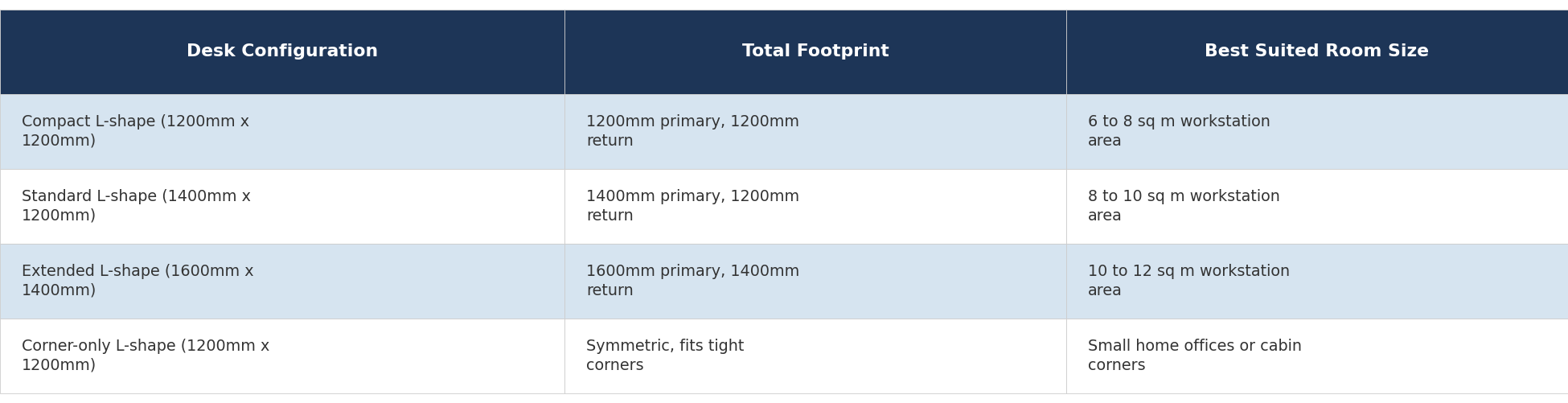
An L-shaped desk resolves this issue by using two walls or a single corner instead of one long wall. A compact L-shaped configuration of 1200 mm by 1200 mm provides nearly the same total surface area as a 1800 mm straight desk while occupying a corner that would otherwise be underused floor space in many small office layouts.
This efficiency makes L-shaped desks a frequent specification choice for small offices, home-office-style corporate setups, satellite offices, and any workstation position where the available floor footprint is the binding constraint on desk size.
Key Advantages of an L-Shaped Desk
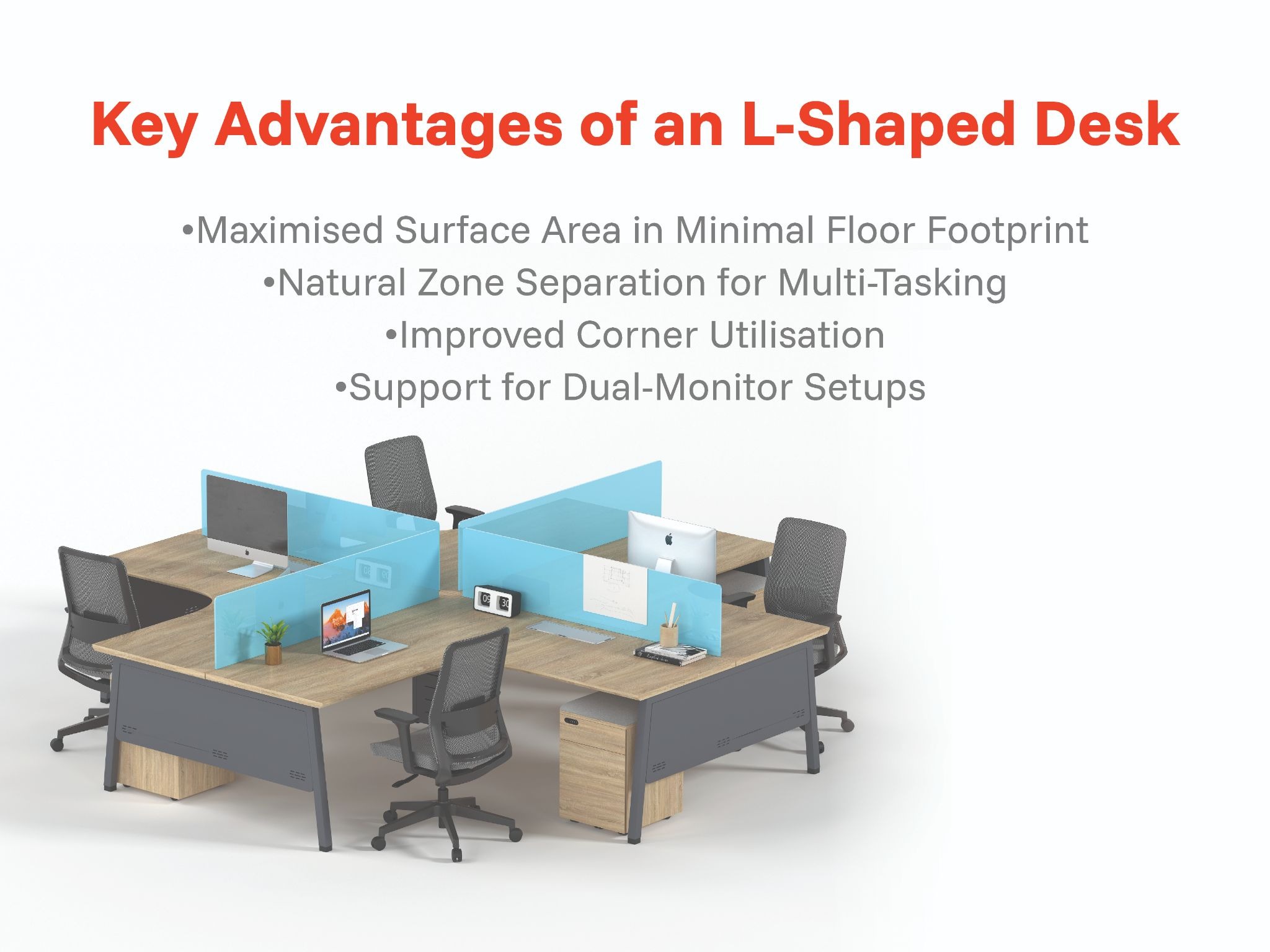
Maximised Surface Area in Minimal Floor Footprint
The defining advantage of an L-shaped desk is surface area efficiency. By extending into a corner rather than along a single wall, the desk provides two usable work zones — typically a primary zone for the main monitor and keyboard, and a return zone for a secondary monitor, documents, or a printer — within a footprint that a straight desk of equivalent surface area cannot match.
Natural Zone Separation for Multi-Tasking
The right-angle configuration creates a natural separation between work zones without requiring any additional partition or divider. Many users find this layout intuitive for separating focused screen work on the primary surface from reference material, secondary devices, or administrative tasks on the return surface.
Improved Corner Utilisation
Room corners are frequently underused in small office layouts because straight furniture cannot follow the wall angle efficiently. An L-shaped desk converts an otherwise wasted corner into a fully functional, high-capacity workstation, improving the overall space efficiency of the room.
Support for Dual-Monitor Setups
Modern corporate roles increasingly require dual-monitor setups for productivity. An L-shaped desk accommodates this naturally, with one monitor on the primary surface directly in front of the user and a second monitor on the return surface at a comfortable side angle, without requiring an unusually wide straight desk to fit both screens side by side.
L-Shaped Desk Size Guide for Small Spaces
Left-Return vs Right-Return Configuration
L-shaped desks are available with the return surface positioned on either the left or right side of the primary desktop, depending on the user's dominant hand, monitor placement preference, and the position of the desk relative to the room's entry point and window.
A right-handed user who writes frequently on physical documents often prefers a left-return configuration, keeping the primary writing surface clear on the right while reference material sits on the return to the left. The reverse applies for left-handed users.
Room layout is equally important. The return should generally face away from the room's main walking path so the user is not interrupted by foot traffic passing directly behind their secondary working zone. When specifying L-shaped desks for a cabin or corner position, always confirm the return orientation against the actual room layout before finalising the order, as changing the configuration after manufacturing is not possible with most fixed L-shaped frames.
Material and Build Quality Considerations
The worksurface for an L-shaped desk should be specified in BWR-grade engineered wood with E1 or E0 formaldehyde emission rating and PVC edge banding on all exposed edges, consistent with the specification appropriate for Indian commercial environments and corporate worksurfaces generally.
The corner join between the primary and return surfaces is the most structurally demanding point on an L-shaped desk. Confirm that the corner bracket or support leg at the join is rated for the combined load of both surfaces, including monitor arms, equipment, and any items placed at the corner junction. A weak corner join is the most common point of structural failure in lower-quality L-shaped desk products.
Frame material should be powder-coated steel for durability under daily commercial use. Confirm that the frame includes adequate support legs at both the primary and return ends, not just at the corner, to prevent flex or sag at the desk's outer edges under sustained load.
Pairing an L-Shaped Desk with the Right Chair
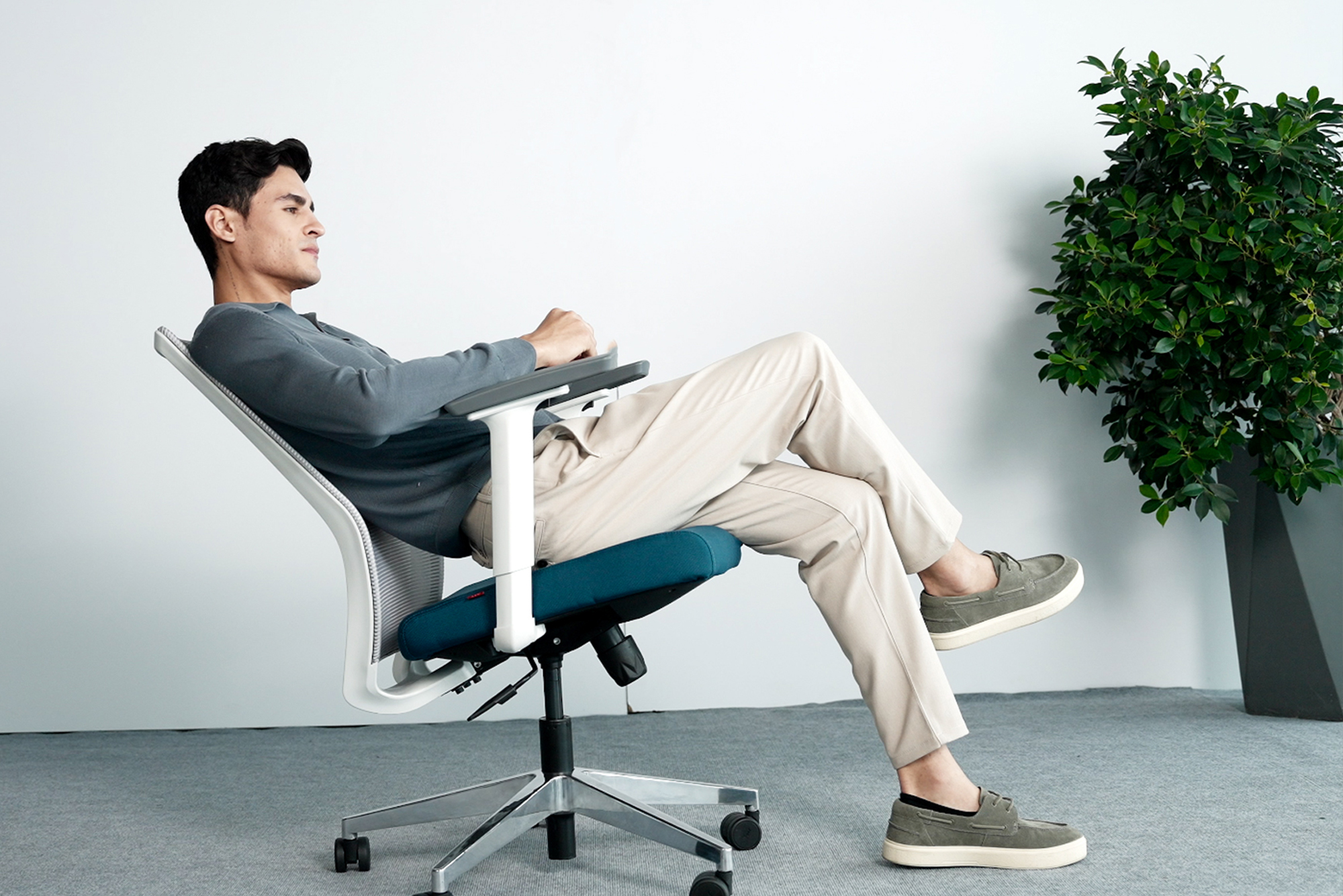
An L-shaped desk works best when paired with an ergonomic mesh chair that provides sufficient swivel range and seat mobility to move comfortably between the primary and return work zones. A chair with a limited swivel range or a fixed-position base can make it awkward to shift attention from the main monitor to the return surface, reducing the practical benefit of the L-shaped configuration.
A five-star base with smooth-rolling castors allows the user to glide between the two work zones of an L-shaped desk without needing to stand or reposition the chair manually. This mobility is a meaningful ergonomic consideration that is sometimes overlooked when specifying seating for L-shaped workstations.
Confirm that the chair's armrests do not catch on the underside of the return surface when the user rotates toward it. Some chair and desk height combinations create a clearance conflict at the corner junction that is only apparent once both pieces are in place, so checking armrest height against the desk's underside clearance before finalising both orders is a worthwhile precaution.
Common Mistakes When Buying L-Shaped Desks
Not confirming room orientation before ordering: Left-return and right-return configurations are typically fixed at the point of manufacture for most commercial L-shaped desks. Confirm the room layout and required orientation before placing the order, as reconfiguring after delivery is rarely possible.
Underestimating the floor footprint required: While an L-shaped desk is more space-efficient than an equivalent straight desk, it still requires a genuine corner with clearance on both sides. Measure the actual corner footprint, including chair clearance and circulation space, before confirming the desk dimensions.
Ignoring corner join quality: A weak structural connection at the corner of the L is the most common failure point in lower-quality products. Always confirm the corner bracket specification and weight rating before bulk ordering.
Specifying the wrong chair: A chair without adequate swivel range and mobility reduces the practical benefit of having two distinct work zones on the desk. Pair the L-shaped desk with a chair specified for the mobility the configuration requires.
Frequently Asked Questions (FAQs)
These are the most common questions asked when specifying L-shaped office desks for small corporate spaces.
Q1. How much floor space does an L-shaped desk need compared to a straight desk?
A compact L-shaped desk at 1200 mm by 1200 mm requires a corner footprint of approximately 1.44 square metres including both the primary and return surfaces. A straight desk providing similar total surface area, such as a 2000mm straight desk, would require approximately 2 square metres of linear wall space.
The L-shaped configuration is generally more floor-efficient for small offices because it uses two walls of a corner rather than extending further along a single wall, which is often the binding constraint in compact rooms.
Q2. Can I choose between a left-return and right-return L-shaped desk?
Yes. Most commercial L-shaped desk manufacturers offer both left-return and right-return configurations. The choice should be based on the user's working preference, hand dominance, and the room layout relative to the entry point and walking paths.
Confirm the required configuration before placing the order, as most fixed-frame L-shaped desks cannot be reconfigured from left-return to right-return after manufacturing.
Q3. Is an L-shaped desk suitable for a dual-monitor setup?
Yes. An L-shaped desk is one of the most practical configurations for dual-monitor setups in a compact footprint. The primary surface holds the main monitor directly in front of the user, while the return surface comfortably accommodates a second monitor at a natural side angle, without requiring an unusually wide straight desk.
For dual-monitor setups, confirm that the return surface depth is at least 600mm to comfortably support a monitor arm or stand without overhang at the desk edge.
Q4. What is the minimum room size for an L-shaped desk?
A compact L-shaped desk configuration can fit comfortably in a corner workstation area of 6 to 8 square metres, including adequate circulation space for the chair and user movement. This makes L-shaped desks suitable for small cabins, compact corner workstations, and space-constrained satellite offices.
Always measure the actual available corner area, including clearance for chair movement and any adjacent furniture, before confirming the desk size to ensure a comfortable working environment rather than a cramped one.
Q5. Does AFC Furniture Solutions supply L-shaped desks for corporate offices across India?
Yes. AFC Furniture Solutions manufactures L-shaped desk configurations as part of the Desking Series, available in left-return and right-return options for corporate procurement across India. All desks use BWR grade worksurfaces with PVC edge banding and powder-coated steel frames suited to Indian commercial environments.
Contact AFC Furniture Solutions at +91 9999006933 or visit afcindia. in to discuss your L-shaped desk requirements and request a configuration recommendation for your space.
Tips for Choosing an L-Shaped Office Desk
- Tip 1: Always measure the actual corner footprint available, including chair clearance, before finalising the desk dimensions. A desk that is too large for the corner creates a cramped working environment that undermines the space efficiency the configuration is meant to provide.
- Tip 2: Confirm the left-return or right-return orientation against the room layout before ordering. This decision is generally fixed after manufacturing and cannot be easily reconfigured later.
- Tip 3: Check the corner join weight rating before bulk ordering. This is the most structurally demanding point on the desk and the most common failure point in lower-quality products.
- Tip 4: Pair the desk with a chair that has a five-star base and smooth-rolling castors to allow comfortable movement between the primary and return work zones.
Bonus Points
- Bonus 1: AFC Furniture Solutions L-shaped desks use BWR-grade engineered wood with E1 or E0 formaldehyde emission ratings, suited to Indian humidity and commercial use conditions.
- Bonus 2: All AFC Furniture Solutions workstation products, including L-shaped desk configurations, are manufactured under BIFMA Level 3 certified production processes with a warranty of up to 10 years on structural components.
- Bonus 3: AFC Furniture Solutions provides pan-India delivery and installation support for L-shaped desk orders. Contact our team at +91 9999006933 to discuss your space and configuration requirements.
Conclusion
An L-shaped office desk is one of the most practical solutions for small corporate spaces that need a genuine multi-zone work surface without the floor footprint a straight desk of equivalent capacity would require. By choosing the right size, confirming the correct return orientation, and pairing the desk with a chair specified for the mobility the configuration demands, small offices can create efficient, productive workstations even in limited floor area.
AFC Furniture Solutions offers L-shaped desk configurations as part of its Desking Series, manufactured to BIFMA Level 3 standards with full installation support across India.
Explore Other Popular Blogs

Let’s build together
Tell us about your project and we’ll help you plan, design, and deliver at scale.
.jpg)
.svg)