.svg)
How to Furnish a Corporate Boardroom: Conference Tables and Chairs Guide
.jpg)
Learn how to furnish a corporate boardroom with the right conference tables and chairs. A complete guide by AFC Furniture Solutions for Indian offices.
The quality of conference room furniture for corporate offices directly shapes how an organisation is perceived by the clients, partners, and senior stakeholders who use the boardroom. A well-furnished boardroom communicates professionalism and institutional confidence from the moment a visitor enters. This guide by AFC Furniture Solutions covers every key decision involved in specifying conference table for a corporate boardroom, from table selection and chair specification to technology integration and layout planning.
What Makes a Corporate Boardroom Different from a Meeting Room?
A corporate boardroom is a dedicated, high-specification space designed for the most formal and consequential meetings an organisation holds. Board meetings, senior leadership reviews, client presentations, and major negotiations all take place in the boardroom. The furniture must reflect the seriousness and status of these events.
A standard meeting room, by contrast, is a general-purpose space used for daily team meetings, internal reviews, and working sessions. It requires practical, durable furniture at a specification appropriate for frequent everyday use.
The difference in specification between a boardroom and a standard meeting room is significant. Boardroom furniture is specified at a higher material quality, with greater attention to finish, detail, and the visual impression it creates on every person who enters the room.
Why Boardroom Furniture Matters
Every client, investor, or senior stakeholder who enters a corporate boardroom forms an immediate impression of the organisation based on the quality of the space. A boardroom furnished with poorly matched, low-specification, or worn furniture communicates carelessness at exactly the moment when the organisation needs to project confidence and credibility.
AFC Furniture Solutions has furnished boardrooms for organisations including Tata Consultancy Services, Air India, Maruti Suzuki, and DXC Technology. Across all of these projects, the consistent feedback has been that a well-specified boardroom changes the dynamic of high-stakes meetings. People sit differently, engage differently, and carry themselves differently in a space that has been furnished with clear intent.
Beyond impression management, the right boardroom furniture also has practical performance benefits. A conference table with integrated power access eliminates the cable management problem that derails extended working meetings. Chairs with proper lumbar support allow participants to remain focused and comfortable across a two-or three-hour board session without the distraction of physical discomfort.
The Conference Table: The Centrepiece of the Boardroom
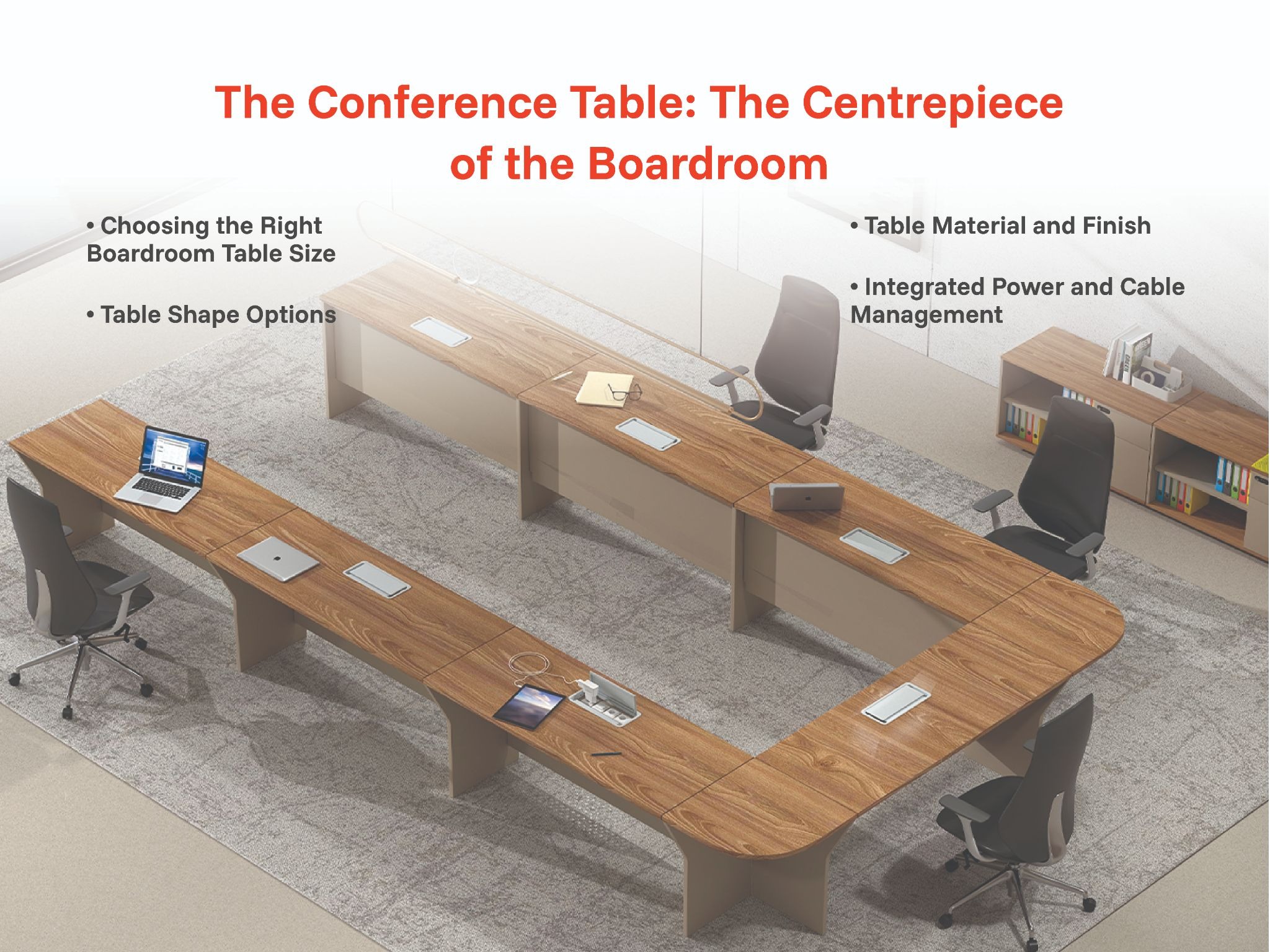
The conference table is the defining piece of furniture in any boardroom. Its size, shape, material, and finish set the tone for the entire space and determine how many people the room can seat effectively.
Choosing the Right Boardroom Table Size
Boardroom table size should be determined by the maximum number of participants the room needs to seat, not by the room dimensions alone. As a planning benchmark, each seat at a conference table requires 600mm to 750mm of table edge length for comfortable seating with working space for a laptop and documents.
A ten-person boardroom table, therefore, requires a minimum of 6,000 mm of perimeter seating length. This is typically achieved with a rectangular table measuring 3000mm to 3600mm in length and 1200mm to 1500mm in width, providing five seats per long side.
For larger boardrooms seating 14 to 20 people, gable-end-based rectangular tables in lengths from 4300 mm to 5400 mm are the standard specification. AFC Furniture Solutions manufactures the Convesso conference table in boardroom configurations up to 5400mm in length, with widths of 1200mm and 1500mm.
Table Shape Options
Rectangular tables are the most common boardroom specification. They create a clear hierarchy with a defined head of table position, which is appropriate for formal board meetings and presentations.
Boat-shaped tables — rectangular with a curved barrel profile along the long edges — are a common premium variant. The curved edge creates more comfortable seating positions than a straight edge and reduces the visual formality of the rectangular layout slightly, making the space feel more collaborative while retaining the clear long-table structure.
Round and oval tables are suited to smaller boardrooms seating six to eight people where an equal-hierarchy format is preferred. They are not practical for rooms seating more than eight as the table diameter required becomes too large for most boardroom footprints.
Table Material and Finish
Boardroom conference tables are available in high-pressure laminate, veneer, and solid wood finishes. For the majority of corporate boardrooms in India, high-quality laminate with a premium edge profile is the most practical specification. It provides the visual richness appropriate for a boardroom environment with the durability required for daily commercial use.
Veneer finishes carry a genuinely higher visual quality and are appropriate for top-tier boardrooms where the table will be seen by the most senior external stakeholders. The cost premium over laminate is significant, but for organisations where the boardroom is a direct expression of brand quality, the investment is justified.
Integrated Power and Cable Management
Integrated power access in the conference table is now a standard requirement for any corporate boardroom, not an optional upgrade. Board sessions involving laptops, presentations, and video calls require power at every seat position for sessions lasting longer than 90 minutes.
In-table power modules with standard power sockets, USB-A, and USB-C ports are specified flush into the table surface. Cable management channels within the table body route power cables from the in-table modules to the floor box or wall sockets, keeping the table surface completely clear of exposed cables at all times.
Boardroom Chairs: Comfort and Credibility
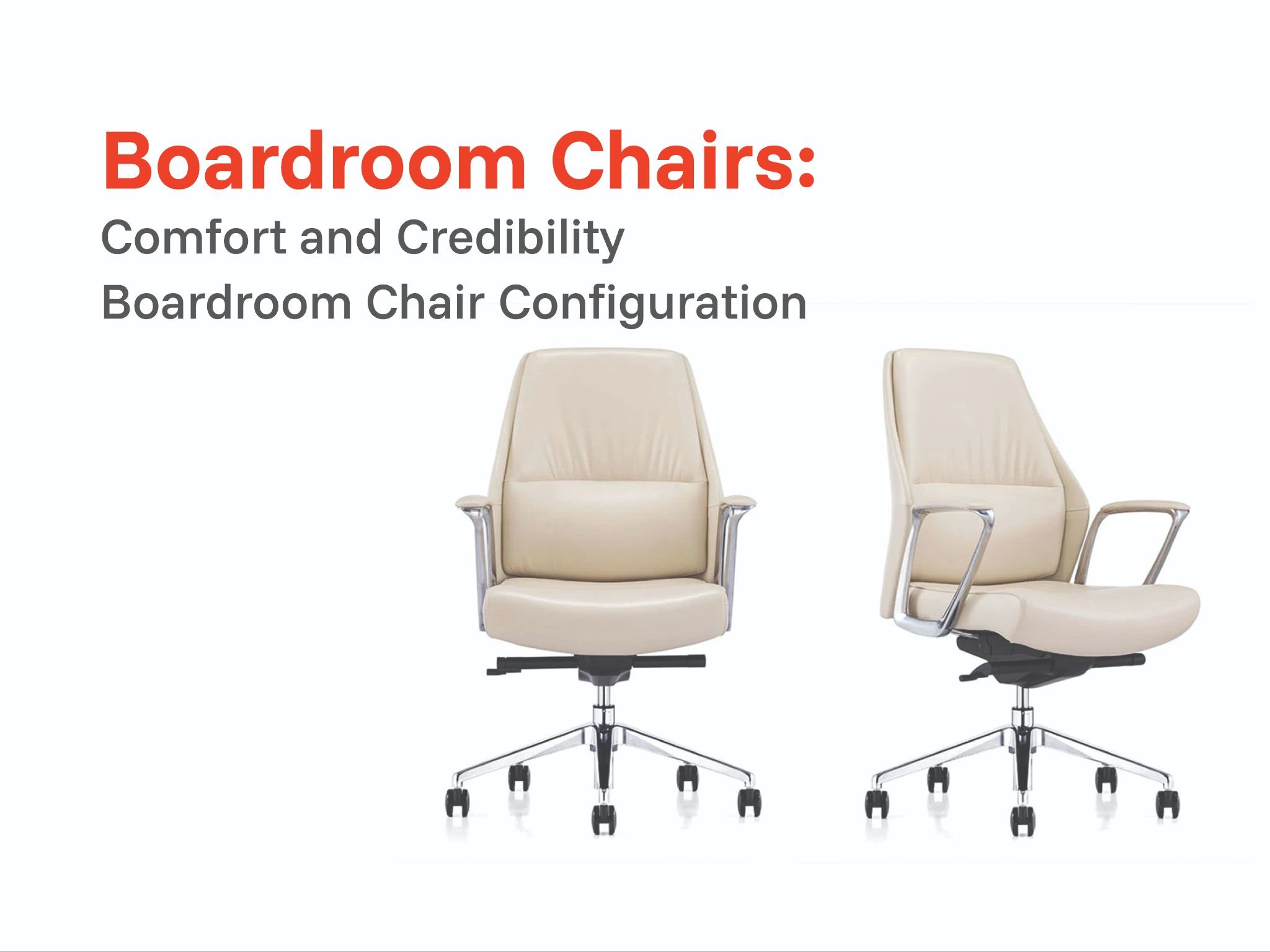
The office chairs must achieve two things simultaneously: they must be comfortable enough to support participants through long formal meetings, and they must have a visual presence appropriate for the seniority of the people who will sit in them. Neither requirement can be sacrificed for the other.
High-back executive chairs in leather or PU leather upholstery are the standard specification for corporate boardrooms. The high backrest supports the full spine and creates a strong visual profile. Leather upholstery communicates premium quality and is the expected material in a formal boardroom environment.
Ergonomic specification is important even in boardroom chairs. Adjustable lumbar support, seat height adjustment, and a recline mechanism with tilt tension control are the minimum functional requirements for a chair that will be used in sessions lasting two to three hours. A visually impressive boardroom chair that cannot be adjusted to the individual sitting in it is not serving its full purpose.
Boardroom Chair Configuration
All boardroom chairs should be specified to the same model and finish to create a visually consistent environment. Mixed chair specifications in a boardroom, whether through replacement purchases or ad hoc additions, create a fragmented look that immediately undermines the quality impression the room is intended to create.
For boardrooms where a presenter's position is distinguished from participant positions, the chair at the head of the table can be specified in a slightly different configuration, such as a higher backrest or a different armrest style, to visually identify the leadership position without disrupting the overall aesthetic coherence of the room.
Acoustic and Lighting Considerations
Furniture alone does not define the boardroom environment. Acoustic and lighting conditions directly affect how meetings feel and perform, and furniture specification should be planned with both factors in mind.
Hard-surfaced boardrooms with no acoustic treatment create echo and noise amplification that disrupts conversations, particularly during video calls where microphone pickup is affected by room acoustics. Fabric-upholstered boardroom chairs contribute meaningfully to acoustic absorption. For rooms with hard floors and minimal soft furnishing, specifying chairs with fabric seat and back panels rather than hard leather or PU-leather reduces reflected sound significantly.
Natural light is desirable in a boardroom but needs to be managed to prevent screen glare during presentations. Table orientation relative to windows should ensure that the presentation screen is not positioned opposite a window face. Blinds or film on window glass are a standard fit-out requirement for any boardroom used for screen-based presentations.
Technology Integration in Modern Boardrooms
Modern corporate boardrooms are required to support hybrid meetings where some participants are in the room and others join remotely. This changes the furniture specification requirements in ways that were not relevant even five years ago.
The conference table should be positioned to allow a camera at one end of the room to capture all in-room participants clearly. This typically means avoiding circular or oval table layouts for rooms used frequently for hybrid meetings, as the camera cannot simultaneously capture all seats at a round table without a wide-angle distortion that affects the professional quality of the video feed.
Screen mounting positions on the boardroom wall should be planned before the table is positioned, as the table orientation is directly determined by where participants need to face the screen. This coordination between AV planning and furniture planning is frequently overlooked and leads to rooms where the table layout makes screen visibility poor for some seats.
Common Boardroom Furniture Mistakes
Undersizing the table: Specifying a table that seats the current typical meeting size rather than the maximum requirement. Boardrooms that are full to capacity with no room for additional participants present a poor impression and create practical problems for larger sessions.
Ignoring power integration: Ordering a conference table without integrated power access and adding trailing cables as an afterthought. Exposed cables on a boardroom table are the single most common detail that undermines the professional quality of the space.
Mixing chair specifications: Replacing individual boardroom chairs over time with different models creates a visually inconsistent room. Always maintain a stock of identical replacement chairs so the full set remains uniform.
Neglecting acoustic quality: Hard-surfaced boardrooms with leather chairs and no soft furnishing create poor acoustic conditions for both in-person and hybrid meetings. Include at least one acoustic element in the furniture specification, such as fabric-backed chairs or a wall-mounted acoustic panel.
Frequently Asked Questions (FAQs)
These are the most common questions corporate buyers ask when specifying conference room furniture for a boardroom.
Q1. What is the standard size of a corporate boardroom conference table?
For a ten-person boardroom, the standard conference table size is 3000mm to 3600mm in length and 1200mm to 1500mm in width. This provides five seats per long side at 600mm to 750mm per person.
For larger boardrooms seating 14 to 20 people, tables from 4300mm to 5400mm in length are standard. AFC Furniture Solutions manufactures the Convesso boardroom table in these configurations with gable-end based construction for structural stability at large spans.
Q2. Should boardroom chairs be leather or fabric?
Leather or PU leather is the standard specification for boardroom chairs in corporate environments. It communicates the appropriate level of quality for a formal, client-facing space and is easier to maintain than fabric in occasional-use environments.
Fabric boardroom chairs are an appropriate choice where acoustic performance is a priority, as fabric surfaces absorb sound more effectively than leather. For hybrid-meeting boardrooms with significant video call usage, fabric-backed chairs reduce echo and microphone noise pickup.
Q3. Is integrated power access necessary in a conference table?
Yes, for any corporate boardroom used for meetings involving laptops, presentations, or video calls. Board sessions lasting two to three hours require continuous power for laptop users. Trailing cables from wall sockets across or under the table are both a safety hazard and a visual problem that immediately undermines the quality impression of the room.
In-table power modules with standard sockets and USB ports are a standard specification component for corporate conference tables and should be included at the initial order stage, not added retrospectively.
Q4. How do I choose between a rectangular and a round boardroom table?
Rectangular tables are the correct specification for most corporate boardrooms. They create a clear meeting hierarchy, support presentations effectively, and can be scaled to seat large numbers without requiring an impractical room footprint.
Round or oval tables are appropriate for smaller, six to eight person boardrooms where an equal-hierarchy format is preferred and the room is not used for formal presentations. They are not practical for rooms seating more than eight people.
Q5. Does AFC Furniture Solutions supply complete boardroom furniture sets for corporate offices?
Yes. AFC Furniture Solutions supplies complete boardroom furniture sets including conference tables, boardroom chairs, and credenzas for corporate clients across India. Our conference table range includes the Convesso series in configurations from compact six-person meeting tables to large boardroom tables seating up to 20 people.
All AFC Furniture Solutions conference furniture carries BIFMA Level 3 certification and a warranty of up to 10 years. Contact our team at +91 9999006933 or visit afcindia.in to discuss your boardroom requirements.
Tips for Furnishing a Corporate Boardroom
- Tip 1: Plan the table size based on the maximum number of participants the boardroom needs to seat, not the typical meeting size. A boardroom at full capacity with no spare seats creates a poor impression and a practical problem.
- Tip 2: Specify integrated power access in the conference table at the initial order stage. Retrofitting in-table power modules after delivery is significantly more expensive and creates visible disruption to the table surface finish.
- Tip 3: Order two to four additional boardroom chairs beyond the table capacity at the initial purchase. This maintains a matching set for future replacement without the risk of finish discontinuation from the manufacturer.
- Tip 4: Plan the table orientation relative to the presentation screen and windows before confirming the room layout. Table position determines sightlines, natural light management, and camera angles for hybrid meetings.
Bonus Points
- Bonus 1: AFC Furniture Solutions has supplied conference room furniture to organisations including Tata Consultancy Services, Air India, Maruti Suzuki, and DXC Technology, demonstrating the scale and quality standard required for India's most demanding corporate environments.
- Bonus 2: All AFC Furniture Solutions conference tables and boardroom chairs carry BIFMA Level 3 certification — the highest internationally recognised standard for furniture quality, sustainability, and safety performance.
- Bonus 3: AFC Furniture Solutions provides boardroom layout planning and scaled floor plans as part of the furniture specification process. Contact our team at +91 9999006933 to discuss your boardroom requirements.
Conclusion
Furnishing a corporate boardroom with the right conference room furniture is one of the most visible investments a business makes in its professional environment. From the conference table size and power integration to the specification of boardroom chairs and the acoustic quality of the space, every decision contributes to the impression the room makes on every person who enters it.
AFC Furniture Solutions offers a complete range of conference room furniture for corporate boardrooms across India, manufactured to BIFMA Level 3 standards and backed by a warranty of up to 10 years. Our team provides layout planning, scaled floor plans, and full installation support for boardroom projects of every scale.
Explore Other Popular Blogs

Let’s build together
Tell us about your project and we’ll help you plan, design, and deliver at scale.
.jpg)
.svg)