.svg)
How to Choose the Right Chair for Long-Duration Working Hour

Sitting for long hours? This complete guide helps you choose the right chair for long-duration working hours in India, covering health risks, key features, and expert recommendations.
Why the Chair You Sit in for Long Hours Matters More Than Anything Else
Most professionals who work long desk hours focus on their laptop, their monitor, or their internet speed when thinking about productivity. Very few give serious thought to the chair beneath them, yet it is the one piece of equipment that is in direct physical contact with their body for every minute of every working session.
The cumulative physical impact of sitting in an inadequate chair for eight to ten hours daily is one of the most significant and most consistently overlooked occupational health risks in Indian workplaces today.
A properly specified chair for long duration working hour does not just make you more comfortable. It actively protects your spine, supports your circulation, and removes the physical distractions that quietly reduce your daily output hour by hour.
What Does Sitting for Long Hours Actually Do to Your Body?
According to the World Health Organisation, musculoskeletal conditions affect more than 1.71 billion people globally and lower back pain is the single leading cause of disability in most countries. Prolonged sitting in poorly designed seating is among the primary contributing factors to this global health burden.
When you sit for extended periods, the natural inward curve of the lower spine gradually flattens under the weight of the upper body. The intervertebral discs absorb increasing compressive load. The hip flexor muscles shorten and tighten. Blood flow to the lower limbs slows progressively, creating the leg heaviness and foot tingling that many desk workers experience by mid-afternoon.
Each of these effects begins within the first thirty to sixty minutes of sustained sitting in an unsupported position. Across a full working day, across five working days a week, across months and years, they compound into the chronic conditions that account for significant sick leave and reduced long-term working capacity among Indian professionals.
How Does the Right Chair Change the Outcome?
A well-specified ergonomic chair for extended sitting addresses each of these physical risks directly. Adjustable lumbar support maintains the spine's natural inward curve, preventing the progressive flattening that causes disc compression. Correct seat height keeps the circulation in the thighs unobstructed. Adjustable armrests eliminate the shoulder and neck tension that builds from incorrect arm positioning.
Research from Cornell University's Human Factors and Ergonomics Laboratory found that employees using properly adjusted ergonomic seating reduced musculoskeletal discomfort by up to 40% and improved work performance by approximately 17.5% compared to those using standard unadjusted chairs.
The chair does not eliminate the risks of sustained sitting entirely. But it reduces them to a level where the body can manage a full professional working day without accumulating the damage that inadequate seating allows.
What Makes a Chair Suitable for Long Duration Sitting?
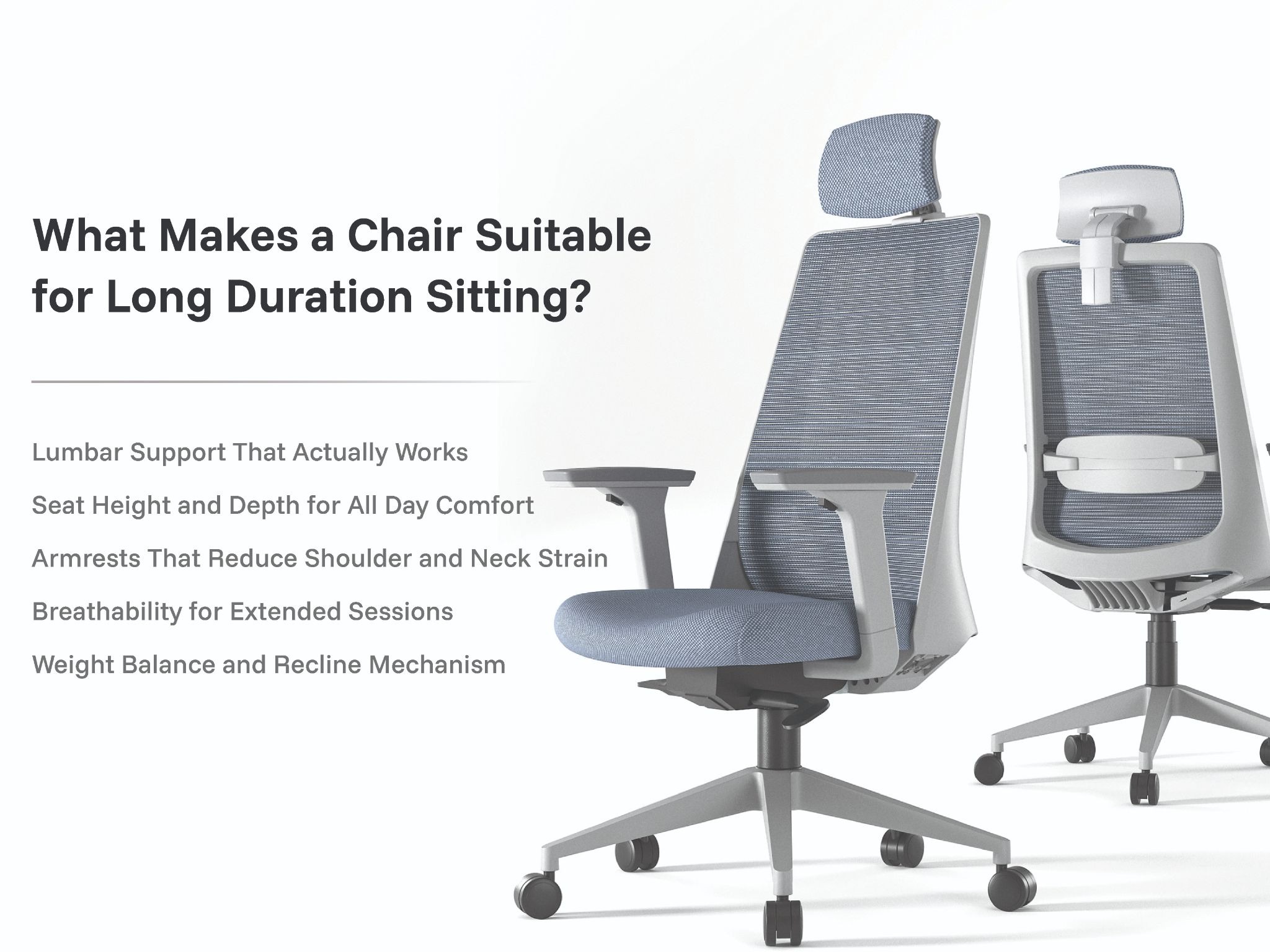
Lumbar Support That Actually Works
Lumbar support is the most important single feature in any chair intended for extended professional use. The lower back requires active, precisely positioned support to maintain its natural curve under the sustained load of the upper body weight during prolonged sitting.
A fixed lumbar insert positioned for an assumed generic anatomy suits almost no one correctly. Genuinely effective lumbar support must be adjustable in height so it can be aligned with each individual user's specific spinal anatomy. Depth adjustability adds an additional dimension of personalisation that makes the support feel natural rather than forced.
When the lumbar support is correctly positioned, sitting for long periods feels significantly less physically demanding because the supporting muscles of the lower back are no longer working as hard to maintain the spinal curve independently.
Seat Height and Depth for All Day Comfort
The correct seat height places both feet completely flat on the floor with the knees at approximately 90 degrees and the thighs roughly horizontal. This alignment maintains unobstructed circulation in the thighs and keeps the pelvis in the neutral position that allows the lumbar support to function correctly.
Seat depth must leave a two to three finger gap between the front seat edge and the back of the knees. A seat that is too deep forces the user to either slide forward away from the lumbar support or accept pressure behind the knees that progressively restricts circulation across long sessions.
Both dimensions must be verified against the actual body proportions of each user. A chair that fits one person correctly will not fit a significantly taller or shorter person to the same standard without adjustment.
Armrests That Reduce Shoulder and Neck Strain
Incorrectly positioned armrests are one of the most common causes of the upper back and neck tension that desk workers experience during long working sessions. Too high and the shoulders are forced into a permanently elevated position. Too low and the user leans sideways to find support, disrupting spinal alignment throughout the session.
Height adjustable armrests that position the forearms at keyboard height with the shoulders completely relaxed and dropped are the correct specification. For professionals typing for six or more hours daily, 3D adjustable armrests that also adjust in lateral position and angle allow the most precise fit and the greatest sustained comfort.
Breathability for Extended Sessions
In Indian office conditions, where ambient temperatures are higher than in many international markets even with air conditioning, the breathability of the chair's contact surfaces becomes a meaningful daily comfort factor during long sessions.
Mesh upholstery allows continuous air circulation across the back and seat surfaces, preventing the heat buildup that makes solid-back chairs progressively less comfortable as the working day extends. The difference is most noticeable in the afternoon hours when temperatures peak and physical discomfort most directly reduces cognitive performance.
For professionals sitting six or more hours daily, breathable mesh upholstery is not a preference. It is a practical daily requirement in Indian working conditions.
Weight Balance and Recline Mechanism
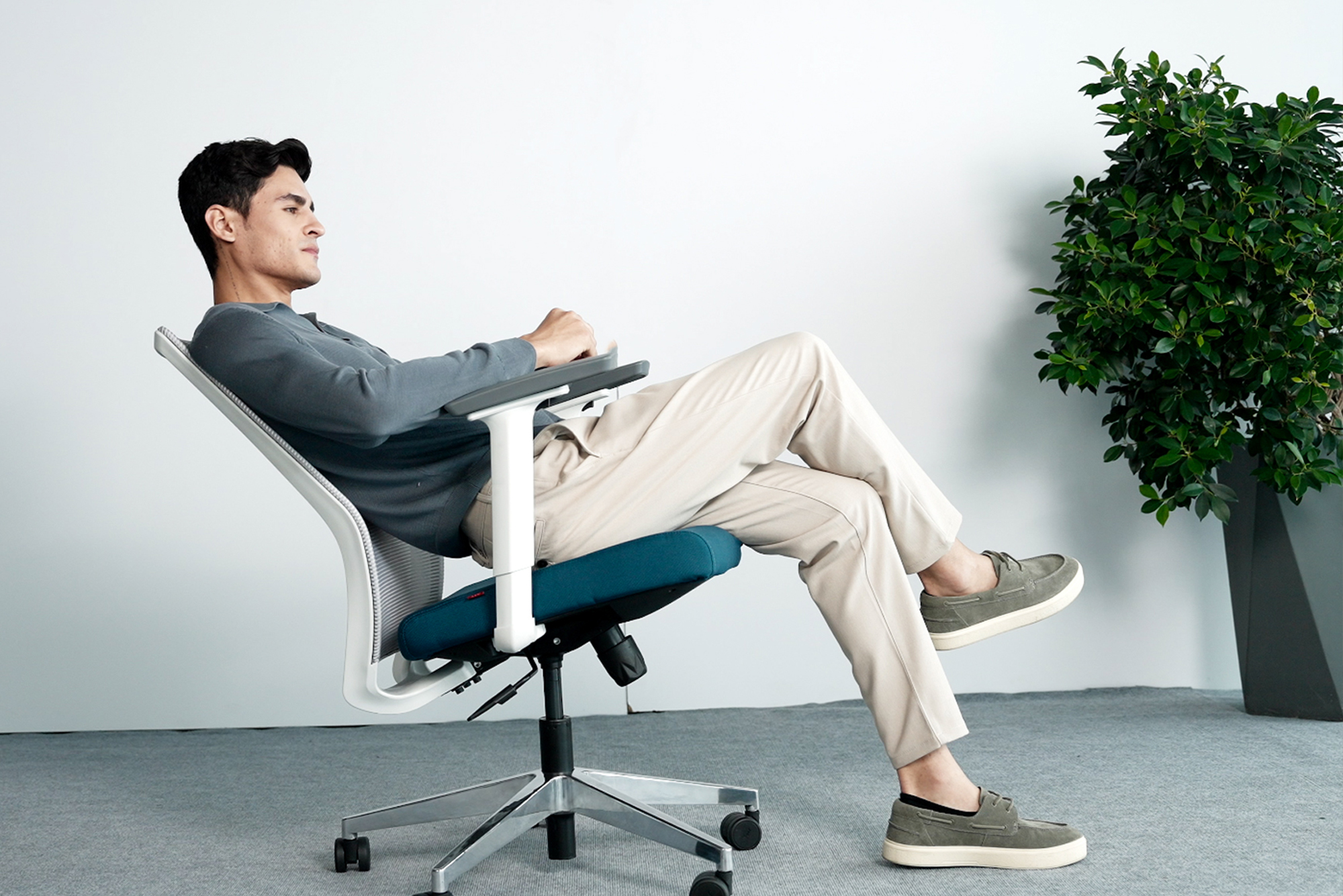
A quality tilt mechanism with adjustable tension control allows the chair to recline smoothly against a resistance matched to the user's body weight. This controlled dynamic recline reduces the compressive load on the intervertebral discs by shifting the body into a slight backward lean that redistributes the weight of the upper body more favourably.
Sitting rigidly upright at 90 degrees for extended periods is actually harder on the spine than a slight recline of 100 to 110 degrees. A tilt lock that holds the preferred working angle rounds out the specification for a chair used across varied activities including typing, reading, and video calling throughout the working day.
Tip: When testing any chair intended for long working hours, sit in it for a minimum of thirty minutes with all adjustments correctly configured before forming any opinion about its comfort quality. The physical support quality of any chair only becomes apparent after the initial softness impression fades and the underlying structural support is all that remains. A chair that feels excellent for two minutes but causes discomfort after thirty is not suitable for a full working day regardless of its specification sheet.
What Type of Chair Works Best for Long Working Hours?
Mesh Chairs vs Foam Back Chairs
For Indian office conditions and extended sitting durations, mesh chairs consistently outperform foam back alternatives in sustained comfort. The breathability advantage of mesh maintains a more comfortable contact surface temperature across long sessions, which translates directly into lower physical fatigue by afternoon.
Foam back chairs provide a softer initial impression that many people associate with comfort, but the absence of air circulation creates heat buildup that becomes increasingly noticeable after two to three hours of continuous sitting. In Indian offices, this limitation is more pronounced than in cooler climates.
Commercial-grade mesh also maintains its structural support properties across years of daily use without the gradual compression that causes foam back chairs to lose their support quality over time.
High Back vs Mid Back Chairs
For professionals sitting six or more hours daily, a high back chair that supports the full length of the spine including the upper back and cervical region is the more appropriate specification than a mid back alternative.
A mid back chair leaves the upper spine and neck unsupported, which increases the muscular effort required to maintain correct head and neck position during long sessions. This sustained muscular effort is a primary cause of the neck stiffness and headaches that many professionals experience after extended desk work.
A high back chair with an adjustable headrest provides the cervical support that makes a full working day significantly less physically demanding on the neck and upper back.
Ergonomic Task Chairs vs Executive Chairs
Ergonomic task chairs are designed specifically for extended daily professional use. They prioritise multi-point adjustability, lumbar support precision, and breathable materials over the aesthetic authority of executive seating.
Executive chairs prioritise visual presence and professional impression, which makes them appropriate for client-facing cabins and boardrooms. For roles involving six or more hours of continuous focused desk work, a fully adjustable ergonomic task chair delivers meaningfully better health and comfort outcomes than an executive chair of equivalent price.
Key Health Risks of Sitting in the Wrong Chair for Long Hours
Lower Back and Spinal Disorders
Chronic lower back pain is the most common occupational health complaint among Indian desk workers and the primary reason professionals seek physiotherapy and medical intervention related to their working conditions.
A chair without adequate lumbar support allows the lumbar spine to flatten progressively during extended sitting. This flattening increases the compressive load on the intervertebral discs, accelerates disc degeneration, and creates the chronic pain that becomes increasingly difficult to reverse once established.
The majority of lower back pain cases among desk workers are directly preventable with correct seating specification and proper chair setup. Addressing the chair is almost always more effective than managing the symptom.
Poor Circulation and Leg Fatigue
Sustained sitting restricts blood flow to the lower limbs. A seat that is too high for the user compresses the underside of the thighs against the front seat edge, further restricting venous return from the legs. The result is the progressive leg heaviness and foot tingling that many professionals experience as the working day extends.
Over time, chronic circulatory restriction during sitting is associated with an increased risk of deep vein thrombosis in sedentary desk workers. For professionals sitting six or more hours daily without adequate breaks, correct seat height is not just a comfort specification. It is a cardiovascular health requirement.
Neck and Shoulder Tension
The head weighs approximately 4.5 to 5 kilograms. In a neutral position, the neck muscles manage this load comfortably. For every degree the head tilts forward from neutral, the effective load on the cervical spine increases significantly. A head tilted 30 degrees forward places approximately 18 kilograms of effective load on the cervical spine.
Desk workers looking slightly downward at a monitor positioned below eye level sustain this increased load across every hour of the working day. A high back chair with a headrest that supports the neutral head position, combined with a monitor at the correct height, eliminates most of this sustained cervical load.
Reduced Focus and Mental Fatigue
Physical discomfort is a continuous low-level cognitive distraction. Every moment the body is managing pain, restricted circulation, or muscular tension is a moment mental bandwidth is being allocated to physical management rather than to the work in front of the professional.
The cumulative cognitive cost of physical discomfort across a long working day is significant and largely invisible because it does not feel like distraction. It feels like tiredness, which is typically blamed on the volume of work rather than the quality of the seating environment.
How AFC Furniture Solutions Chairs Compare for Long Duration Use
AFC Chairs vs Standard Market Alternatives
The following comparison covers the key features that determine whether a chair genuinely supports long duration sitting or simply appears to do so.
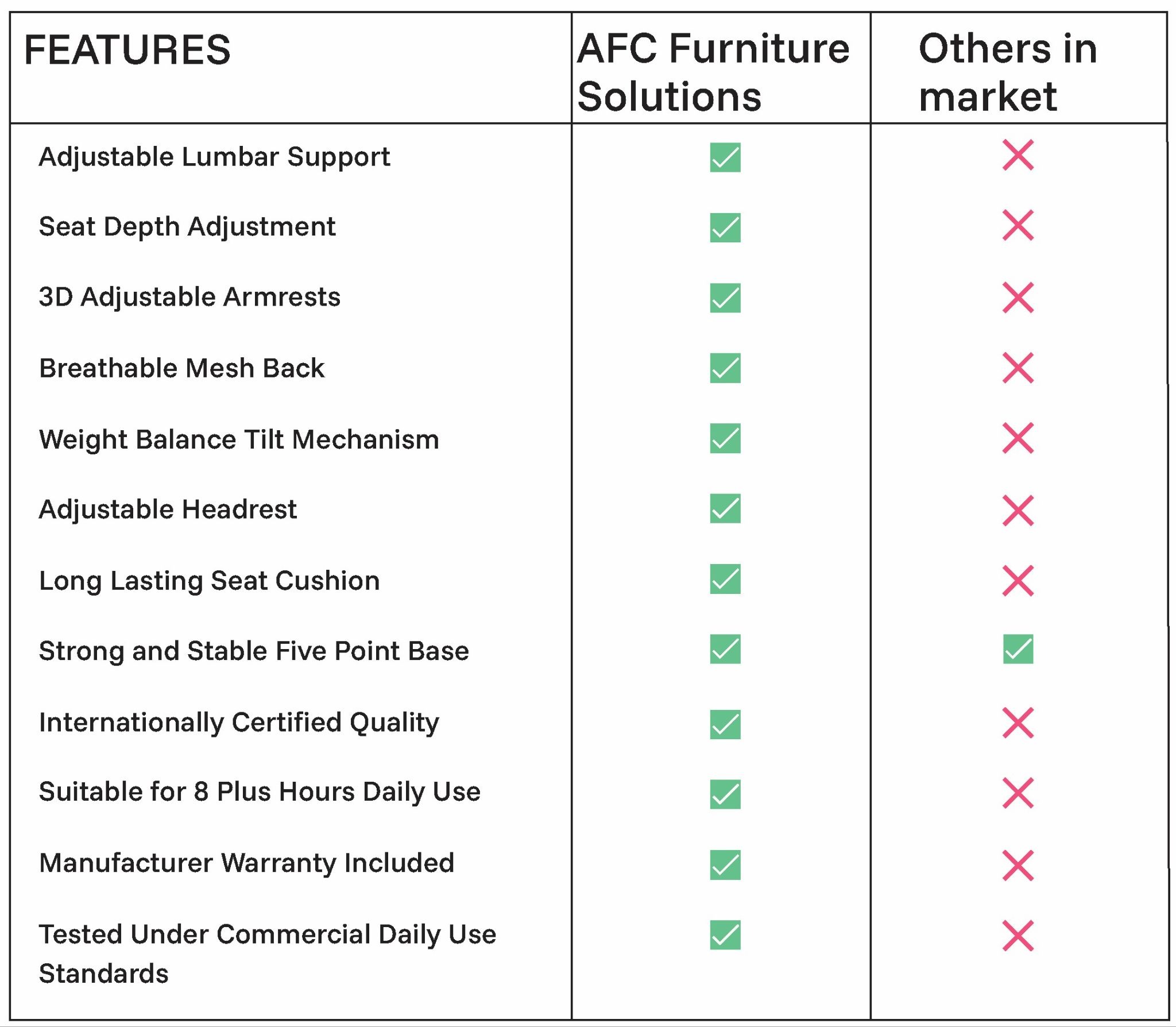
Others in Market reflects typical standard and budget chair specifications commonly available in India. This comparison does not refer to any specific brand.
Bonus Point: When placing a large office chair order for a team that works extended hours, request sample units of two or three shortlisted models and ask five to six team members of different heights and body types to use each sample for a complete working day before the bulk order is placed. The feedback from a real full-day trial across different body types is the most reliable procurement tool available and consistently reveals comfort and adjustability issues that a brief showroom test never captures.
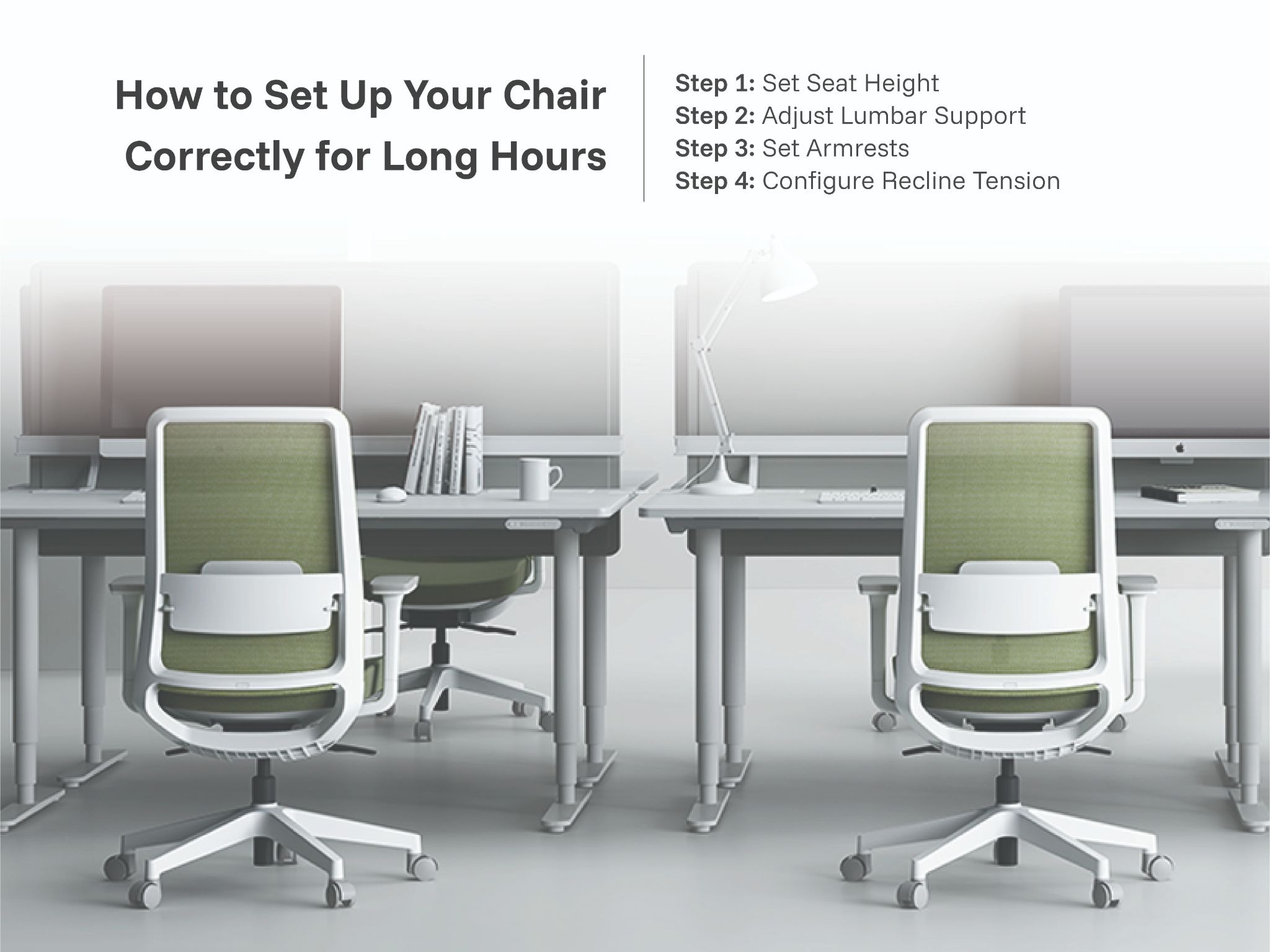
How to Set Up Your Chair Correctly for Long Hours
Step 1: Set Seat Height
Raise or lower the seat until both feet rest completely flat on the floor with the knees at 90 degrees. If your feet do not reach the floor at the height required for your desk, use a footrest rather than raising the chair and leaving your feet unsupported.
Verify the alignment by checking that the thighs are approximately horizontal and that there is no pressure from the front seat edge against the underside of the thighs. This check eliminates the primary cause of circulatory restriction during long sitting sessions.
Step 2: Adjust Lumbar Support
Move the lumbar support up or down until it makes consistent, gentle contact with the inward curve of your lower back in your natural seated posture. The support should feel like a quiet, continuous presence rather than a point of pressure pushing you forward.
If depth adjustment is available, set it to follow the contour of your lower back without pushing the pelvis forward or causing any discomfort at the contact zone. Recheck this setting after fifteen minutes of sitting as the body settles into position and the optimal support height may shift slightly.
Step 3: Set Armrests
Lower or raise the armrests until the elbows rest at approximately 90 degrees with the shoulders completely dropped and relaxed. The forearms should rest lightly on the armrests without bearing significant weight and without requiring any shoulder elevation to reach them.
If lateral adjustment is available, bring the armrests inward until they sit close to the sides of the body. Armrests set too far apart encourage a widened posture that places sustained strain on the outer shoulders and upper trapezius muscles across long sessions.
Step 4: Configure Recline Tension
Set the tilt tension control so the chair reclines smoothly against a resistance that requires gentle deliberate pressure from your back rather than either snapping backward freely or requiring significant effort to recline.
The correct tension feels balanced and controlled. It should allow you to lean back naturally during reading or phone calls and return upright easily for active keyboard work without jarring transitions between positions.
Additional Tips to Stay Comfortable During Long Working Hours
The 20-8-2 Movement Rule
No chair, regardless of how well it is specified and adjusted, eliminates the risks of sustained static sitting entirely. The most effective complement to a quality chair is regular postural variation throughout the working day.
The 20-8-2 rule provides a simple structure for this. For every thirty minutes of working time, sit for twenty minutes, stand or work at a height-adjustable desk for eight minutes, and move or stretch briefly for two minutes. This pattern maintains circulation, reduces static muscular load, and significantly extends the effective comfortable working duration of any seating specification.
Monitor and Keyboard Alignment
The ergonomic benefit of a correctly specified and adjusted chair is substantially reduced if the monitor and keyboard are not also correctly positioned. The top of the monitor should be at approximately eye level. The keyboard should allow the forearms to remain roughly horizontal with the wrists level during typing.
A monitor that is too low creates the forward head posture that causes cervical strain regardless of how good the headrest and backrest support are. Correct monitor height is the ergonomic complement to correct chair setup that many professionals overlook.
Footrest and Floor Contact
If the desk height and body proportions make it impossible to achieve correct seat height with both feet flat on the floor, a footrest that provides a firm, level surface for the feet is the correct solution.
Leaving the feet unsupported by raising the chair to the necessary height for the desk creates sustained compression of the underside of the thighs against the front seat edge, restricting circulation and causing the progressive leg fatigue that undermines the afternoon working session.
How AFC Furniture Solutions Designs Chairs for Long Duration Use
What Options Does AFC Offer for Extended Sitting?
AFC Furniture Solutions offers a comprehensive range of ergonomic seating specifically designed for the extended daily use demands of Indian professional environments.
The Mesh Chair range includes the Myel, designed specifically for eight-plus hour working sessions with full multi-point adjustability and commercial-grade breathable mesh. The Fluid and Fluid X provide complete ergonomic support in configurations suited to open-plan corporate floors and home offices. The Spino features an adjustable headrest making it particularly suited to professionals who remain seated for extended continuous sessions. The Sullion and Logica provide additional options across different back heights and ergonomic configurations suited to varied professional contexts.
AFC Furniture Solutions operates a 150,000 square foot manufacturing facility in Greater Noida with a production capacity of up to 18,000 chairs per month, ensuring consistent quality and reliable supply for orders of any scale across India.
Explore the full AFC Furniture Solutions Mesh Chair range to compare ergonomic specifications, back heights, and adjustability options suited to different long-duration professional working contexts.
What Quality Standards Back AFC Chairs?
AFC Furniture Solutions holds BIFMA Level 3 certification, the highest internationally recognised standard for office furniture quality, safety, and sustainability. Every chair in the range is manufactured at the Greater Noida facility and tested to BIFMA-compliant structural, ergonomic, and durability standards before leaving production.
AFC Furniture Solutions also holds ISO 9001, ISO 14001, and ISO 18001 certifications, reflecting consistent quality management, environmental responsibility, and occupational health and safety standards across the entire manufacturing operation.
These certifications collectively provide procurement managers and HR teams with independent verification that AFC chairs are built and tested to the standards required for sustained commercial daily use in professional environments.
You can also explore the full AFC Furniture Solutions Seating range for the complete chair range across mesh, leather, training, and cafe categories suited to every zone of the modern Indian corporate office.
Frequently Asked Questions
Q1. What is the most important feature in a chair for long duration sitting?
Adjustable lumbar support is the single most important feature. Without it, the lower back gradually loses its natural inward curve during extended sitting, placing increasing compressive stress on the intervertebral discs. This is the primary mechanism through which prolonged desk work in an inadequate chair causes the chronic lower back pain that is the most common occupational health complaint among Indian professionals.
Q2. How many hours is considered long duration sitting for chair specification purposes?
Any sitting duration of four or more continuous hours qualifies as extended sitting for chair specification purposes. For professionals sitting six or more hours daily, a fully adjustable commercial-grade ergonomic chair is a functional health requirement rather than a comfort preference.
Q3. Is a high back chair always better than a mid back chair for long hours?
For most professionals sitting six or more hours daily, yes. A high back chair supports the full length of the spine including the upper back and neck, reducing the muscular effort required to maintain correct head and neck position throughout the session. For shorter sessions of two to four hours, a well-specified mid back chair may be adequate.
Q4. Can the right chair eliminate back pain from long sitting?
A correctly specified and adjusted ergonomic chair significantly reduces the rate at which back pain develops from extended sitting and meaningfully reduces existing discomfort for many users. It does not eliminate the risks of sustained static sitting entirely, which is why regular movement using the 20-8-2 rule is recommended as a complement to quality seating.
Q5. How do I know if my current chair is causing my back pain?
If back pain is most pronounced during or immediately after extended sitting and eases with movement, lying down, or walking, the chair is almost certainly a contributing factor. Switching to a correctly configured ergonomic chair will usually clarify the connection within the first week of consistent use.
Q6. How long should a quality chair for long working hours last?
A commercial-grade ergonomic chair from a reputable manufacturer should deliver seven to twelve years of reliable daily professional use under normal commercial conditions. The gas lift mechanism and tilt mechanism are the components most likely to require attention over this period. A manufacturer warranty of at least three years covering these components is a minimum quality indicator for any serious long-duration seating purchase.
Final Thoughts
The chair for long duration working hour is the piece of equipment that has the greatest daily physical impact on every professional who spends significant time at a desk. It deserves more careful selection than almost any other item in the office.
Getting it right means protecting your spine, maintaining your circulation, eliminating the physical distractions that quietly reduce your output, and ending the working day with energy rather than accumulated pain.
AFC Furniture Solutions has been designing and supplying ergonomic seating for Indian professionals for over 15 years, with a complete range of chairs tested and certified to BIFMA Level 3 standards for extended commercial daily use.
Explore Other Popular Blogs

Let’s build together
Tell us about your project and we’ll help you plan, design, and deliver at scale.
.jpg)
.svg)