.svg)
High-Back vs Mid-Back Office Seating Chairs: Which One Is Right for You?

Confused between high back and mid back office seating chairs? This complete guide covers key differences, use cases, and expert guidance from AFC Furniture Solutions.
Why Does Back Height Matter More Than Most People Think?
When most professionals buy an office chair, they focus on seat cushioning, price, and how the chair looks. The backrest height rarely enters the conversation deliberately. Yet it is one of the most consequential specifications in any chair used for sustained professional work.
The backrest height determines how much of the spine receives active support during the working day. More support means less muscular effort from the back and neck to maintain posture. Less support means the body compensates through sustained muscular tension that accumulates into the fatigue and pain that desk workers accept as a normal part of professional life.
It is not normal. It is preventable. And the right chair specification for the right role and working duration is where prevention begins.
How Backrest Height Affects Posture and Comfort
An article issued by the National Spine Health Foundation, says that poor posture and inadequate workplace ergonomics significantly compromise spine health and contribute to musculoskeletal conditions. With over 80% of jobs being predominantly sedentary, back and neck pain from inadequate seating is now one of the most prevalent occupational health issues in modern workplaces.
The backrest height determines which portions of the spine receive support throughout the sitting session. A chair whose backrest ends at the mid-spine leaves the thoracic spine, the shoulder blades, the upper back, and the cervical spine entirely unsupported. The muscles of the upper back and neck must then work continuously to maintain head and shoulder position across the full working day.
A chair whose backrest extends to support the full spine including the upper back and neck removes this sustained muscular load. The difference in physical fatigue by end of day is not subtle. It is one of the most immediately noticeable improvements available to any professional who upgrades from a mid-back to a high-back specification for their primary working hours.
What Happens When You Choose the Wrong Back Height?
Choosing a high-back chair for a role that involves frequent movement and short seated sessions creates unnecessary bulk and expense without delivering proportional benefit. The additional back support is underused because sessions are too short for the upper back load to accumulate meaningfully.
Choosing a mid-back chair for a role involving eight or more hours of sustained desk work leaves the upper spine unsupported for the majority of the professional working day. The accumulated muscular tension in the upper back and neck manifests as the end-of-day stiffness, headaches, and shoulder tightness that many Indian desk professionals have come to accept as inevitable.
Neither outcome is correct. The right back height matched to the right role and working pattern eliminates both problems simultaneously.
What Is a High Back Office Chair?
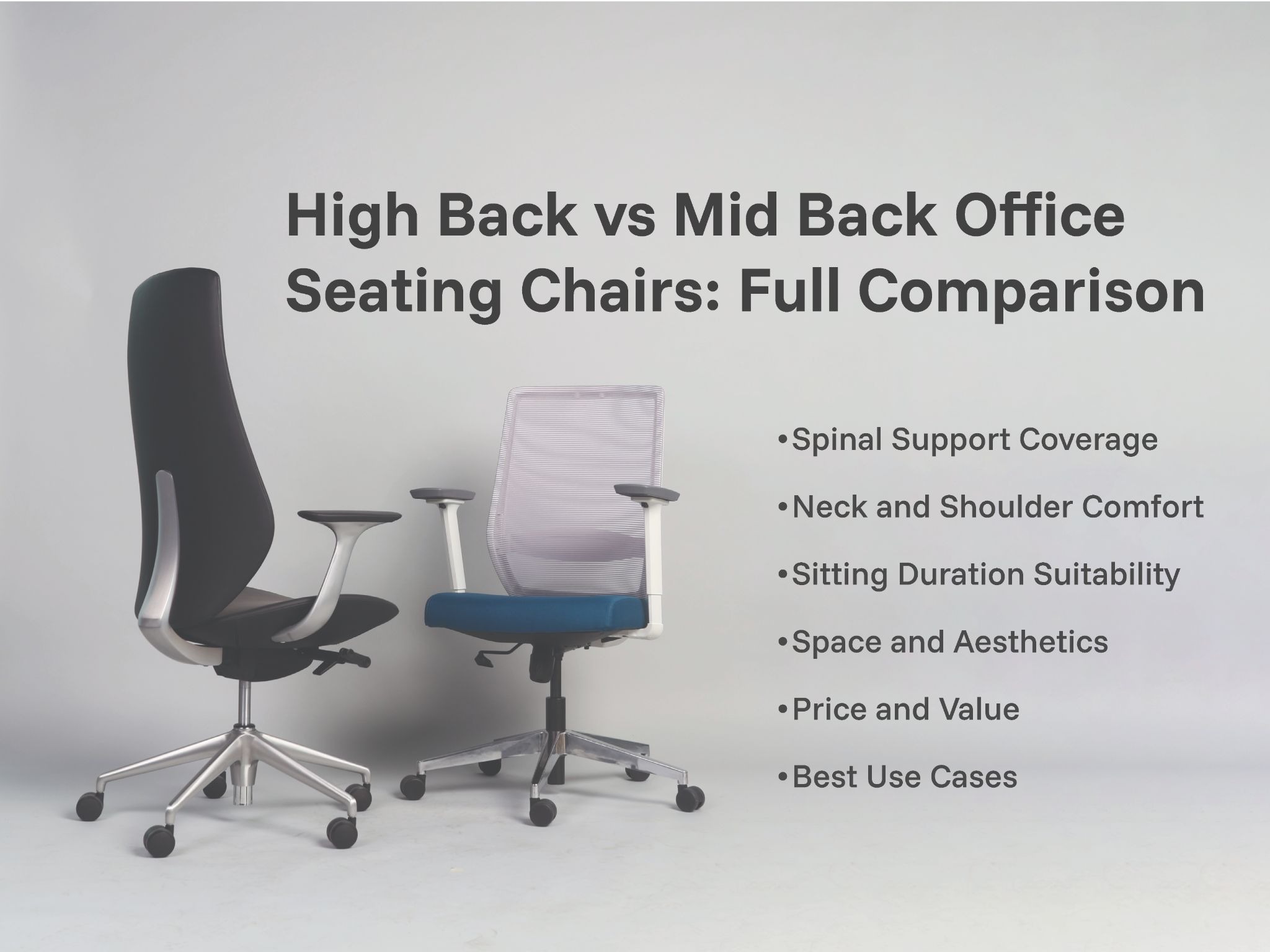
A high back office chair features a backrest that extends from the lumbar region through the thoracic spine and typically to the cervical region, providing support across the full length of the back including the upper back and neck. Many high-back models include an adjustable headrest that extends the support coverage to the base of the skull.
The defining characteristic is comprehensive spinal coverage. Every major region of the back and neck is either directly supported or significantly relieved of independent muscular load during extended sitting sessions.
How Is a High Back Chair Designed?
High back chairs are engineered with an extended backrest frame that reaches to a height of approximately 800mm to 900mm or more from the seat surface. This height ensures coverage of the full thoracic spine and positions the headrest, where included, at the correct cervical support height for most adult body proportions.
The backrest profile is contoured to follow the natural curves of the spine rather than presenting a flat surface. This contouring maintains the lumbar inward curve, supports the neutral thoracic curve, and positions the headrest to contact the cervical spine without forcing the head forward from its neutral position.
Who Is a High Back Chair Built For?
High back chairs are built for professionals who sit for extended periods of four or more continuous hours, who work in roles requiring sustained concentration and limited physical movement, and who are at elevated risk of upper back and neck strain from the nature of their working pattern.
They are the appropriate specification for technology professionals, financial analysts, writers, designers, lawyers, senior managers, and any professional whose working day is predominantly seated at a desk with sustained screen or document focus.
What Is a Mid Back Office Chair?
A mid back office chair features a backrest that extends from the lumbar region to approximately the middle of the thoracic spine, typically reaching to a height of 450mm to 550mm from the seat surface. It supports the lower and middle back but leaves the upper thoracic spine, shoulder region, and cervical spine unsupported.
The defining characteristic is focused lumbar and mid-spine support without the full upper body coverage of a high-back specification. This focused support is adequate for shorter sessions and roles where the working posture involves more movement and less sustained seated concentration.
How Is a Mid Back Chair Designed?
Mid back chairs are built with a shorter backrest frame that covers the lumbar and mid-thoracic regions. They are physically lighter and more compact than high-back alternatives, making them easier to move and more suited to environments where chair mobility and space efficiency are priorities.
The shorter backrest also allows greater freedom of upper body movement, which suits roles involving frequent reaching, turning, and physical interaction with the environment around the workstation.
Who Is a Mid Back Chair Built For?
Mid back chairs are built for professionals in roles involving shorter seated sessions, frequent physical movement throughout the working day, or shared-use environments where different users access the same chair across the day.
They suit reception and front-of-house roles, team meeting room seating, administrative roles with frequent physical tasks, and any environment where the chair needs to serve a range of different users without complex individual adjustment.
High Back vs Mid Back Office Seating Chairs: Full Comparison
Spinal Support Coverage
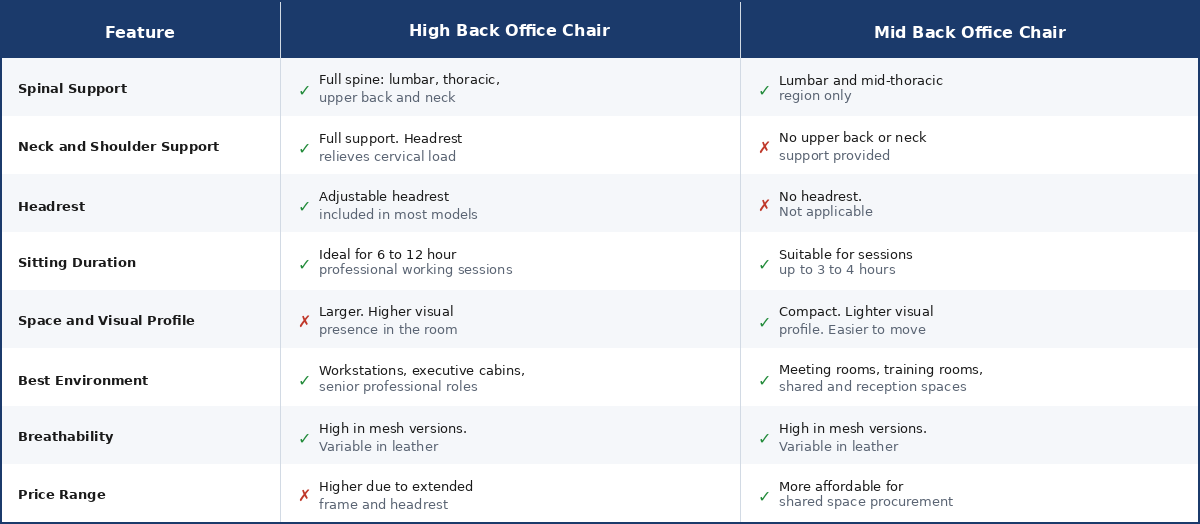
A high back chair supports the lumbar spine, thoracic spine, upper back, and cervical region across the full seated session. This comprehensive coverage is what makes it appropriate for sustained professional use of six or more hours daily.
A mid back chair supports the lumbar and mid-thoracic regions. The upper back, shoulders, and neck are unsupported. For sessions under three to four hours, this is manageable for most users. For longer sessions, the unsupported upper spine creates accumulating muscular tension that becomes progressively more noticeable as the session extends.
Neck and Shoulder Comfort
The neck and shoulder region bears a disproportionate share of the physical cost of inadequate upper back support. When the upper thoracic spine is unsupported, the shoulder and neck muscles work harder to maintain head position. This sustained effort is the primary cause of the neck stiffness and shoulder tension that many Indian desk workers experience daily.
A high back chair with a correctly adjusted headrest eliminates this sustained load by providing the structural support that the muscles no longer need to supply independently. For professionals already experiencing neck and shoulder discomfort from prolonged desk work, switching to a correctly specified high-back chair often produces immediate and noticeable relief.
Sitting Duration Suitability
For sessions up to three to four hours, a well-specified mid back chair with good lumbar support is adequate for most users without significant upper body discomfort. For sessions of four to six hours, the mid-back limitation begins to be felt by most users as upper back and neck fatigue. For sessions of six or more hours, a high back chair is the correct specification without exception.
Space and Aesthetics
Mid back chairs are physically smaller and lighter. They occupy less visual space in the room and are easier to move, stack, or store in environments where chair mobility is a regular operational requirement.
High back chairs command more visual presence. In executive cabins and senior professional spaces, this visual authority is appropriate and intentional. In open-plan environments, meeting rooms, and high-density floors, the additional visual mass of a high-back chair may be less well suited to the spatial character of the room.
Price and Value
High back chairs cost more than mid back alternatives of equivalent build quality due to the additional frame material, backrest height, and headrest mechanism included in the specification. The relevant comparison is not upfront cost but total cost measured against the physical benefit delivered per working hour.
For a professional sitting six or more hours daily, the additional cost of a high-back specification is recovered in reduced discomfort, better sustained concentration, and lower long-term health risk within months of daily use. For a shared meeting room chair used for sessions of one to two hours, the additional cost of a high-back specification delivers no proportional benefit.
Best Use Cases
A high back chair is the correct specification for primary workstation seating across any role involving extended daily desk work, for executive and senior professional cabins, and for any professional already experiencing back or neck strain from their working posture.
A mid back chair is the correct specification for meeting room and training room seating, for reception and hospitality roles, for shared-use environments, and for any role where frequent movement and short seated sessions characterise the working pattern.
Tip: When deciding between high back and mid back for a large open-plan floor order, survey your team's typical continuous sitting duration before specifying. A simple question asking how many hours they sit without getting up produces the most reliable data for the specification decision and consistently reveals that most knowledge workers in Indian corporate offices sit for longer continuous periods than the 90-minute ergonomic guideline recommends.
When Should You Choose a High Back Chair?
Long Duration Desk Work
Any professional role where the typical continuous sitting session exceeds four hours requires a high back chair. Technology professionals, lawyers, analysts, accountants, architects, content professionals, and any knowledge worker in sustained screen-based work fall into this category.
The physical case for high back seating in these roles is clear and consistent. The upper back and neck support provided by a correctly specified high-back chair directly reduces the physical strain that accumulates across long sessions and directly improves the sustained cognitive performance that these roles require.
Executive and Senior Professional Roles
Executive and senior professional cabins combine the functional requirement for long-hour ergonomic support with the aesthetic requirement for professional authority and visual quality. A high-back executive chair in leather or premium leatherette delivers both requirements simultaneously.
The tall backrest of a high-back executive chair also communicates seniority and presence in the cabin environment, reinforcing the professional impression the executive space is designed to create for visitors and team members who interact with the occupant throughout the working day.
Professionals with Neck or Back Issues
For professionals already managing chronic neck pain, upper back discomfort, or diagnosed cervical or thoracic conditions, a high-back chair with adjustable headrest is not a preference but a functional health requirement.
The structural support provided by the extended backrest reduces the muscular compensation that aggravates existing conditions. Many professionals who have managed chronic neck and upper back pain for years report significant improvement within the first weeks of switching to a correctly specified and adjusted high-back chair.
When Should You Choose a Mid Back Chair?
Meeting Rooms and Shared Spaces
Meeting room sessions in most Indian corporate offices run for one to two hours. This duration is within the comfortable range of a well-specified mid back chair for most users without significant upper body discomfort.
The compact profile of a mid-back chair also makes it more appropriate for meeting room environments where multiple chairs must fit comfortably around a table without dominating the visual character of the space. A room full of high-back executive chairs creates a different visual dynamic than the same room with well-chosen mid-back meeting chairs.
Roles with Frequent Movement
Sales roles, facilities managers, HR professionals, front-desk staff, and any professional whose working day involves frequent standing, walking, and physical engagement with their environment spend less continuous time seated than knowledge workers in focused desk roles.
For these professionals, the additional upper back support of a high-back chair provides less benefit because sessions are shorter and the upper back muscular load does not accumulate to the levels that make the additional support meaningful. A well-specified mid-back chair with good lumbar support is the more appropriate and more cost-effective specification for this working pattern.
Compact Office Environments
Startups, co-working spaces, and growing SMEs in Indian cities frequently operate in compact office environments where floor space per workstation is limited. The smaller physical footprint of a mid-back chair allows more working positions to be fitted comfortably into the available floor area without the visual crowding that full-height chairs create in tight configurations.
What Other Factors Should You Consider Before Buying?
User Height and Body Proportion
The benefit of a high-back chair is only realised if the backrest height is appropriate for the specific user's spinal length. A high-back chair that is too short for a tall user provides mid-back coverage rather than full-spine coverage, effectively functioning as a mid-back chair regardless of its specification.
Always verify the backrest height against the actual body proportions of the primary user. For teams with a wide height range, an adjustable headrest that can be positioned correctly for different users is the specification that ensures the chair delivers its intended benefit regardless of user height variation.
Adjustability Range
Full ergonomic benefit from either chair type depends on correct individual adjustment. Seat height, lumbar support position, armrest height, and tilt tension must all be set specifically for each user's body dimensions and working pattern.
A high-back chair that cannot be correctly adjusted for the individual user delivers less benefit than a correctly adjusted mid-back alternative. Adjustability range is therefore as important as back height in determining whether the chair will actually deliver the physical support it is specified and purchased to provide.
Upholstery and Breathability
For Indian office conditions, mesh upholstery maintains consistent breathability across extended sessions regardless of ambient temperature. Leather and leatherette provide premium visual quality appropriate for executive and client-facing spaces with reliable air conditioning.
For open-plan floors where temperature varies across the day and across seasons, mesh is the more practical specification for both high-back and mid-back chairs. The breathability advantage of mesh becomes progressively more important as session duration increases, which is another reason why high-back chairs in Indian open-plan environments are most commonly specified in mesh rather than leather.
To understand the full ergonomic differences between chair specifications and how they affect daily professional performance, read our detailed guide on How to Choose the Right Ergonomic Office Chair for Long Working Hours.
Bonus Point: For organisations furnishing both workstation floors and meeting rooms in the same office, choose mid-back and high-back chairs from the same manufacturer and the same product family wherever possible. Matching the design language and finish across chair types creates visual coherence across the full office environment. A meeting room chair that visually coordinates with the workstation chair communicates considered, professional procurement and elevates the overall impression of the workspace.
How AFC Furniture Solutions Designs Office Seating Chairs for Indian Offices
What High Back Options Does AFC Offer?
AFC Furniture Solutions offers a comprehensive high-back chair range designed specifically for the extended daily use demands of Indian professional environments, manufactured at the Greater Noida facility to consistent commercial quality standards.
The Myel delivers full multi-point adjustability including 3D armrests, adjustable lumbar depth and height, seat depth adjustment, and weight-balance tilt mechanism in a high-back mesh configuration designed for eight-plus hour professional working sessions.
The Spino features a high-back configuration with adjustable headrest, making it particularly suited to professionals in sustained continuous seated roles who require cervical support across extended sessions. The Fluid and Fluid X provide complete high-back ergonomic adjustability in configurations balancing ergonomic performance with a clean professional aesthetic.
The Sullion, Logica, Rock, and Toro provide additional high-back mesh configurations suited to different working contexts, body proportions, and corporate environments across the full range of Indian professional settings.
What Mid Back Options Does AFC Offer?
The AFC Furniture Solutions mesh range includes mid-back configurations suited to meeting rooms, shared spaces, and roles with shorter seated sessions. The Sway, Revoq, Flex, Nuvic, Breeze, X-Mesh, and Orbit provide mid-back ergonomic seating across different adjustment profiles and aesthetic specifications suited to different corporate environments.
For meeting room and training room applications, the AFC Training Chair range including the Flip and Snap provides purpose-designed shared-use seating appropriate for sessions of one to three hours.
AFC Furniture Solutions operates a 150,000 square foot manufacturing facility in Greater Noida with a production capacity of up to 18,000 chairs per month, ensuring consistent quality and reliable supply for office seating chair orders of any scale across India.
Explore the full AFC Furniture Solutions Seating range to compare high-back and mid-back mesh chair options across the complete product family.
What Quality Standards Back AFC Chairs?
AFC Furniture Solutions holds BIFMA Level 3 certification, the highest internationally recognised standard for office furniture quality, sustainability, and safety. Every chair in the range is manufactured at the Greater Noida facility and tested to BIFMA-compliant structural, ergonomic, and mechanism durability standards.
AFC Furniture Solutions also holds ISO 9001, ISO 14001, and ISO 18001 certifications covering quality management, environmental responsibility, and occupational health and safety across the full manufacturing operation. Named institutional clients including Tata Consultancy Services, Air India, Maruti Suzuki, and DXC Technology confirm the scale capability and quality consistency of AFC Furniture Solutions across India's most demanding corporate environments.
Frequently Asked Questions
Q1. Is a high back chair always better than a mid back chair?
Not always. A high back chair is better for professionals sitting six or more hours daily in sustained desk-based roles. A mid back chair is more appropriate for meeting rooms, shared spaces, and roles involving frequent movement and shorter seated sessions. The correct specification depends on the actual working pattern and session duration of the intended user.
Q2. Can a mid back chair cause neck pain?
A mid back chair does not directly cause neck pain but it does not prevent the upper back and neck muscular load that accumulates during extended sitting. For professionals sitting six or more hours daily, the unsupported upper spine in a mid-back chair creates the sustained muscular tension that leads to the neck stiffness and shoulder pain common among Indian desk workers. A high-back chair with a headrest directly reduces this load.
Q3. What is the correct backrest height for a high back office chair?
A high back chair backrest should extend to a height of approximately 800mm to 900mm from the seat surface to provide coverage of the full thoracic spine. With a headrest, the total coverage extends to the cervical spine. The headrest must be adjustable in height to accommodate different users' spinal lengths correctly.
Q4. Are high back chairs suitable for meeting rooms?
High back chairs can be used in meeting rooms but mid back chairs are generally more appropriate for session durations of one to two hours and for environments where multiple chairs must fit around a table without dominating the visual character of the space. For boardrooms where senior leadership meetings run for three or more hours, high-back seating is the more appropriate specification.
Q5. How do I choose between high back and mid back for an open plan floor?
Assess the typical continuous sitting duration of the team. For roles involving four or more continuous hours of desk work, specify high-back chairs. For roles with frequent movement and shorter sessions, mid-back chairs are adequate. When in doubt, specify high-back for primary workstation positions. The additional physical benefit for long-session roles consistently justifies the additional cost.
Q6. Does AFC Furniture Solutions supply both high back and mid back chairs for corporate fit-outs?
Yes. AFC Furniture Solutions supplies both specifications across its comprehensive mesh and leather chair ranges, coordinated within the same product family for visual consistency across workstation and meeting room environments. Complete corporate fit-outs covering both specifications can be managed through a single account relationship with consistent delivery and installation across all locations.
Final Thoughts
The choice between high back and mid back office seating chairs is not a matter of preference or budget alone. It is a functional specification decision that directly determines the physical experience and long-term health outcomes of every professional who uses the chair for the majority of their working day.
Match the back height to the actual working pattern. High back for sustained long-hour desk work. Mid back for shared spaces, meeting rooms, and roles with frequent movement. Getting this decision right is one of the most practical and lasting improvements any Indian organisation can make to the daily experience of its people.
AFC Furniture Solutions has been designing and supplying office seating chairs for Indian professionals for over 15 years, with a complete range across high-back and mid-back specifications, all manufactured to BIFMA Level 3 and ISO certified quality standards at the Greater Noida facility and available through experience centres across India.
Explore Other Popular Blogs

Let’s build together
Tell us about your project and we’ll help you plan, design, and deliver at scale.
.jpg)
.svg)