.svg)
The Complete Checklist Before Placing a Large Order With Any Office Chairs Manufacturer

Planning a bulk office chair order? This complete checklist covers every verification step before placing a large order with any office chairs manufacturer in India.
Why Does a Large Office Chair Order Require More Careful Planning?
Ordering fifty chairs is a very different decision from ordering five. When the quantity is large, the consequences of a decision are multiplied across every chair in the order and felt by every person who sits in them every working day.
The planning investment required before a large commercial chair procurement is proportional to the scale of the commitment. A few days of careful evaluation before placing the order is always less expensive than discovering problems after a hundred chairs have been delivered and installed.
This checklist covers every verification step that experienced procurement managers apply before committing to a large commercial seating order.
What Can Go Wrong With a Bulk Chair Purchase?
The most common problems in large commercial chair orders fall into three categories. Quality inconsistency is the first, where chairs that looked acceptable in sample form arrive with variations in foam density, finish quality, or mechanism performance that were not apparent in the single unit evaluated.
Delivery failure is the second, where a manufacturer commits to a timeline they cannot meet, leaving an organisation operating in an incomplete workspace while waiting for furniture that is already paid for.
After-sales disappearance is the third, where a supplier who was responsive during the sales process becomes difficult to reach when warranty claims, replacement parts, or service visits are required after delivery.
Why Is Manufacturer Evaluation More Important Than Product Evaluation?
Most procurement decisions focus heavily on the product and lightly on the manufacturer. This is understandable but ultimately backwards for large commercial orders.
A product can look excellent in a showroom and perform poorly at scale if the manufacturer lacks the quality control processes to ensure consistency across a production run of hundreds of units. The manufacturer's systems, certifications, and track record are the most reliable predictors of what arrives on delivery day.
Evaluating the manufacturer with the same rigour applied to the product eliminates most of the risks that turn large commercial chair purchases into expensive problems.
Step 1: Verify the Manufacturer's Credentials and Certifications
What Certifications Should a Reputable Office Chair Manufacturer Hold?
BIFMA certification is the most meaningful quality indicator for commercial office seating. It confirms that the products have been independently tested against internationally recognised standards for structural integrity, mechanism durability, foam performance, and safety under sustained commercial daily use.
BIFMA Level 3 certification specifically indicates the highest tier of quality and sustainability performance and covers both the products and the manufacturing processes of the facility producing them.
ISO quality management certification is also relevant as it confirms that the manufacturer operates documented, consistent quality control processes across production rather than relying on ad-hoc quality checks.
How Do You Verify These Certifications Are Genuine?
Ask the manufacturer to provide the actual certification documents rather than simply stating they hold them. Legitimate certifications include specific certificate numbers, issuing body details, and validity dates that can be independently verified.
Cross-check the certificate details against the issuing body's records where possible. BIFMA maintains records of certified products that can be queried to confirm that a specific product holds the certification claimed for it.
Be cautious of manufacturers who claim certification verbally but cannot produce documentation when asked directly. This is one of the clearest signals that the certification either does not exist or does not cover the products being sold.
Step 2: Assess the Manufacturing Facility and Production Capacity
Why Does In-House Manufacturing Matter?
A manufacturer who produces chairs in their own facility has direct control over the quality of every component at every stage of production. They can verify the foam density, the frame gauge, the finish quality, and the mechanism performance before anything leaves the building.
A supplier who assembles chairs from components sourced from multiple third parties has no meaningful control over the quality of those components. The consistency that defines a reliable large-order supplier is impossible to guarantee without in-house manufacturing capability.
For a bulk office chair order, always ask whether the chairs are manufactured in the supplier's own facility or assembled from third-party components. The answer tells you a great deal about the likely consistency of a large production run.
How Do You Evaluate Production Capacity for Large Orders?
Ask the manufacturer directly about their monthly production capacity and confirm that your order volume can be fulfilled within your required timeline without displacing other commitments.
A manufacturer with a stated capacity of 2,000 chairs per month who takes on an order for 1,000 units with a four-week delivery window is making a commitment they may not be able to honour without compromising quality on other orders.
Request a written production schedule that shows specifically when your order will enter production, when quality inspection is planned, and when delivery is scheduled. A manufacturer confident in their capacity will provide this readily.
Tip: Visit the manufacturing facility in person before placing any large commercial seating order if the scale of the commitment justifies it. Seeing the production floor, the quality control processes, and the component storage gives you a level of confidence in the order that no brochure or showroom visit can provide.
Step 3: Evaluate the Product Quality in Person
What Should You Check on a Physical Sample?
Request a physical sample of the exact specification you intend to order, not a display model that may have been maintained differently from production units. Examine every component with the specific intention of finding quality issues rather than confirming that the chair looks acceptable.
Check the foam density by pressing firmly on the seat and backrest and assessing whether the surface returns to its original form immediately. Foam that compresses easily under hand pressure will fail quickly under daily body weight.
Examine the finish of every surface. The powder coat on the frame should be uniform with no thin spots, bare patches, or texture inconsistencies. The upholstery should have consistent colour across all panels with no stitching irregularities or tension variations.
How Long Should You Test a Sample Chair Before Deciding?
Test the sample chair for a minimum of one full working day before forming any judgment about its ergonomic quality and comfort. Most quality problems in commercial chairs only become apparent after the initial comfort impression fades and the sustained support quality becomes the determining factor.
Have multiple team members of different heights and body types use the sample chair and collect specific feedback on comfort, adjustability, and any physical discomfort experienced after extended sitting. This cross-body-type evaluation is the most reliable predictor of how the chair will perform across your team.
Do not rely on a showroom test of five to ten minutes. This duration is insufficient to reveal the foam quality, the lumbar support effectiveness, or the mechanism durability that determine whether the chair is genuinely suitable for commercial daily use.
Step 4: Check Ergonomic Specifications Thoroughly
What Ergonomic Features Are Non-Negotiable for Bulk Orders?
Any commercial seating order destined for daily professional use should include independently adjustable lumbar support, seat height adjustment covering the full range of adult user heights, and armrests that are adjustable in at minimum height and ideally in lateral angle as well.
These three features are the baseline ergonomic specification for office chairs that will be used by different people of different body proportions. Without them, a chair cannot be correctly configured for the individuals using it and will not deliver the health and productivity benefits that justify its cost.
Weight capacity is also non-negotiable. Verify that the stated weight capacity covers the full range of users in your organisation and that this capacity is supported by documented load testing rather than the manufacturer's own assertion.
How Do You Verify Ergonomic Claims Are Accurate?
Ask the manufacturer to provide the specific test results that support their ergonomic claims. A chair described as having commercial-grade lumbar support should have documented testing that quantifies the support it provides at different adjustment positions.
Foam density should be specified in kilograms per cubic metre and supported by material certification. A manufacturer who cannot specify foam density in measurable terms is either using budget foam or is not confident in the specification they have provided.
Test the adjustment range of the lumbar support, seat height, and armrests on the physical sample against the specifications documented in the product data sheet. Discrepancies between documented and actual performance are a significant quality warning.
Step 5: Understand the Warranty Terms Completely
What Should a Commercial Warranty Cover?
A meaningful warranty for commercial office seating should cover the frame, the gas lift mechanism, the tilt mechanism, the armrest adjustment system, and the castor assembly for a minimum of three years.
The foam and upholstery should be covered for a period that reflects their expected service life under commercial conditions. Ask specifically whether these components are included in the warranty and what the threshold for a valid claim is.
The warranty should also specify a response timeline for claims. A warranty that covers component failure but does not commit to a resolution timeline provides limited practical protection in a commercial environment where a failed chair affects a working employee every day until it is resolved.
What Are the Red Flags in Warranty Documentation?
A warranty that excludes the most commonly failing components, such as the gas lift mechanism or the castor assembly, is effectively providing no meaningful protection for the parts most likely to require attention.
Warranties that require the buyer to return the chair to the manufacturer for assessment before any replacement or repair is authorised create a logistical burden that effectively discourages legitimate claims. Commercial warranty service should be delivered at the installation site, not at the manufacturer's facility.
Any warranty document that is vague about what is covered, how claims are made, or what the resolution process involves should be treated as a significant risk indicator. Ask for clarification in writing before placing the order.
Step 6: Confirm Delivery and Installation Capability
What Delivery Commitments Should Be in Writing?
Every large commercial chair order should be supported by a written delivery schedule that specifies the exact delivery date, the delivery location, and the escalation process if the committed date cannot be met.
Verbal delivery commitments are not commitments. They are intentions that become difficult to enforce when the delivery date passes without the chairs arriving. Written commitments create accountability that protects the buyer's operational planning.
Also confirm in writing what happens to chairs that arrive damaged. The process for damage claims, replacement timelines, and who bears the cost of damaged goods in transit should be clearly specified before the order is placed.
Why Does Professional Installation Matter for Large Orders?
Professional installation by a trained team ensures that every chair is correctly assembled, adjusted to a neutral starting position, and confirmed free of defects before the installation is signed off.
Incorrectly assembled chairs are both a safety risk and a source of early mechanical failure. Components that are not properly torqued during assembly develop instability under daily use that accelerates wear and creates the kind of progressive structural problems that are difficult and expensive to resolve after the fact.
For large orders, also confirm that the installation team has experience with projects of comparable scale. An installation team that routinely handles orders of fifty chairs is a different capability from one that primarily installs individual units.
Bonus Point: For large commercial seating orders, request a pre-delivery inspection of a random sample of production units before the full order is dispatched. Inspecting five to ten percent of the total order quantity at the manufacturer's facility before delivery is the most effective way to identify production consistency issues before they arrive in your office.
Step 7: Verify After-Sales Support and Service Response
What After-Sales Support Should You Expect?
A reliable office seating supplier for large commercial orders should provide a dedicated point of contact for post-delivery issues, a documented response time commitment for service requests, and the ability to dispatch a technician to your location within two working days for urgent mechanical failures.
Replacement parts for all components covered by the warranty should be available from stock rather than manufactured to order. A gas lift that takes six weeks to source as a replacement component provides no practical protection for the employee whose chair has failed.
Ask specifically about parts availability for the products you are ordering. A manufacturer who cannot confirm that replacement components will be available throughout the warranty period is signalling a product lifecycle management approach that may leave you with unserviceable chairs well before their expected retirement.
How Do You Test a Manufacturer's Service Responsiveness?
Contact the manufacturer's customer service or after-sales team before placing the order, not as a prospective buyer but as if you were an existing customer with a service request. Note the response time, the clarity of the information provided, and whether the interaction felt like dealing with a genuinely supportive team or a process that was designed to discourage follow-up.
This test is more revealing than any service level commitment written into a contract because it shows you the actual service experience rather than the promised one.
Step 8: Request References from Comparable Institutional Clients
What Questions Should You Ask References?
Ask the reference client specifically about the consistency of the chairs delivered across their order, not just whether the chairs looked good. Ask whether the quality of the hundredth chair matched the quality of the first.
Ask about the delivery experience, specifically whether the committed timeline was met and how the manufacturer responded when issues arose. Ask about the after-sales support quality, including response times for service requests and parts availability.
Ask whether they would place a large order with the same manufacturer again. This single question cuts through polite professional courtesy and reveals the genuine satisfaction level more reliably than any other question in the conversation.
What Are the Red Flags in Reference Conversations?
A reference who describes the products positively but becomes vague or hesitant when asked about delivery, after-sales service, or whether they would repeat the purchase is telling you something important through their hesitation.
References who can only speak to orders significantly smaller than yours do not actually demonstrate the manufacturer's capability at your order scale. A manufacturer who fulfilled a ten-unit order adequately has not demonstrated the capacity management and quality consistency required for a two-hundred-unit order.
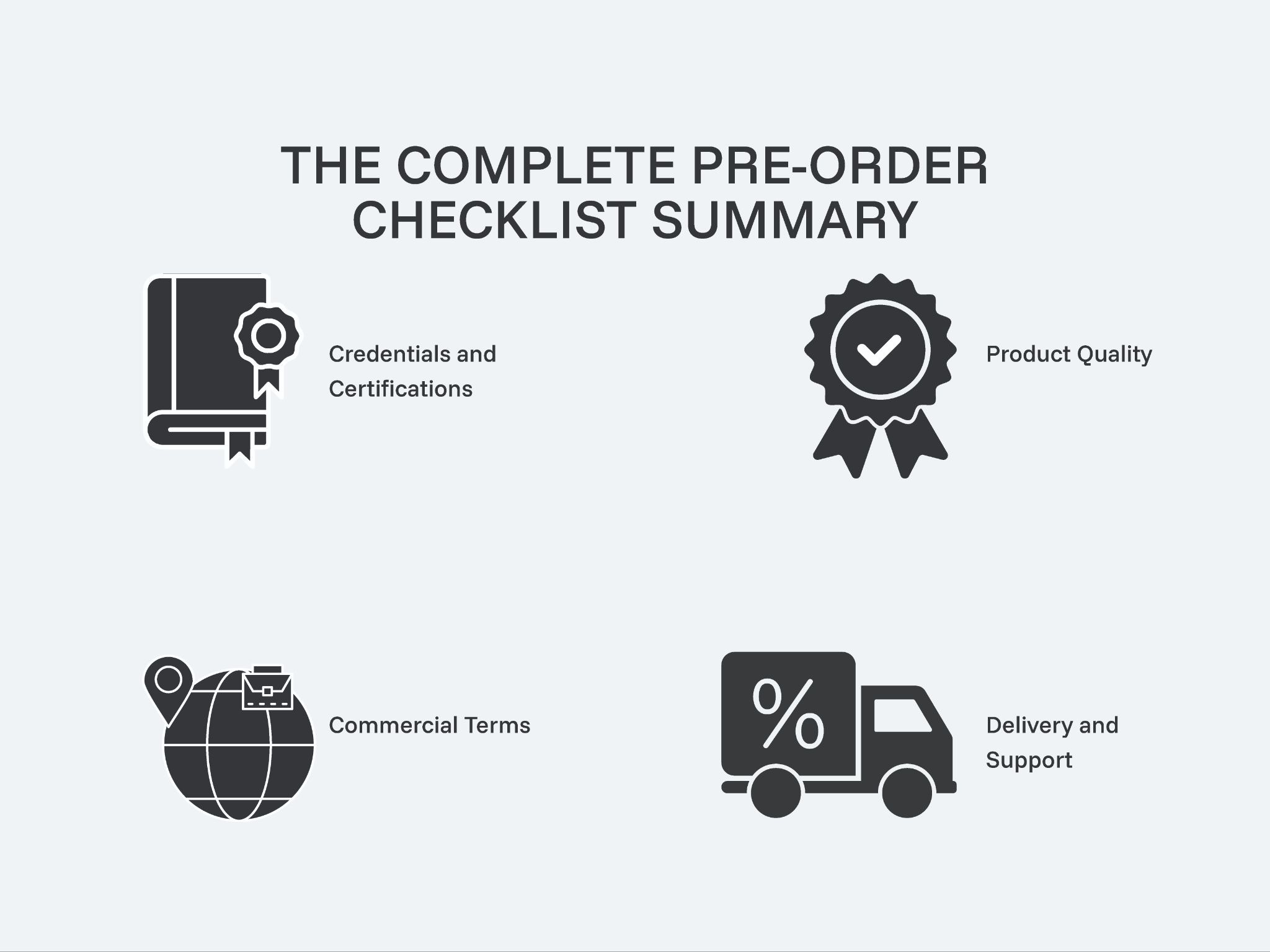
The Complete Pre-Order Checklist Summary
Credentials and Certifications
Confirm BIFMA certification with documentation. Verify ISO quality management certification. Cross-check certificate details against issuing body records. Confirm that certification covers the specific products being ordered.
Product Quality
Request a physical production sample, not a display model. Test the foam density manually. Inspect every surface finish for consistency. Test the sample for a full working day with multiple users. Verify all adjustment mechanisms against the documented specification.
Commercial Terms
Obtain a detailed written quotation with line-item cost breakdown. Confirm warranty terms in writing including all components covered and the claims process. Agree a written production and delivery schedule. Confirm damage-in-transit responsibility and replacement process.
Delivery and Support
Confirm installation is included and performed by a trained team. Verify after-sales response time commitment in writing. Confirm replacement parts availability for the full warranty period. Test the manufacturer's service responsiveness before placing the order.
How AFC Furniture Solutions Meets Every Point on This Checklist
What Makes AFC a Reliable Office Chairs Manufacturer for Large Orders?
AFC Furniture Solutions manufactures every chair in its range at its own facility in Greater Noida, with a production capacity of up to 18,000 chairs per month. This in-house manufacturing capability provides direct quality control at every stage of production, from component sourcing through final assembly and quality inspection.
The AFC Furniture Solutions seating range covers mesh chairs for open-plan corporate floors, leather chairs for executive spaces, and training chairs for flexible multi-use environments, all produced to consistent commercial specifications and available for large-scale orders with confirmed delivery schedules.
Explore the full AFC Furniture Solutions Seating range to compare ergonomic specifications, upholstery options, and configuration choices suited to large commercial procurement requirements.
What Quality Standards Back AFC Seating?
AFC Furniture Solutions holds BIFMA Level 3 certification, the highest internationally recognised standard for furniture quality, safety, and sustainability. Every chair is tested to BIFMA-compliant standards covering structural integrity, mechanism durability, and ergonomic performance across the full adjustment range.
Replacement components for all products in the AFC Furniture Solutions range are maintained in stock throughout the warranty period. After-sales support is provided through a network of experience centres across Noida, Gurugram, Mumbai, Pune, Bengaluru, Hyderabad, and Chennai.
You can also explore the AFC Furniture Solutions Mesh Chair range specifically for breathable ergonomic seating options suited to large-scale corporate floor procurement across Indian office environments.
Frequently Asked Questions
Q1. How many sample chairs should I request before placing a large order?
Request at least two to three sample units from the same production batch rather than display models. Testing multiple samples from the same batch reveals production consistency that a single sample cannot. For very large orders of two hundred or more units, requesting five to ten samples is justified.
Q2. What is the minimum warranty I should accept for a commercial chair order? Three years covering the frame, gas lift mechanism, tilt mechanism, and armrest adjustment system is the minimum reasonable expectation for commercial-grade office seating. Any warranty that excludes these components or covers them for a shorter period should be treated as a risk indicator.
Q3. How do I handle chairs that arrive damaged in a large delivery?
Confirm the damage claim process in writing before placing the order. Inspect every chair at the point of delivery and document any damage with photographs before accepting the delivery. A reputable manufacturer will have a clear process for replacing damaged units without requiring extended negotiation after the fact.
Q4. Should I visit the manufacturing facility before placing a large order?
For orders above one hundred units, a facility visit is a worthwhile investment of time. Seeing the production processes, quality control checkpoints, and component storage provides a level of confidence in the order that no documentation or showroom visit can replicate.
Q5. What is the most common quality problem in large chair orders from India?
Foam density inconsistency is the most common quality problem in bulk commercial chair orders. The foam in production units is frequently lower density than in the sample provided for evaluation. Specifying foam density in kilograms per cubic metre in the order documentation and including it in the delivery quality check is the most effective way to prevent this.
Q6. How quickly should a reliable manufacturer be able to respond to a service request?
For commercial seating under warranty, a response acknowledging the request within twenty-four hours and a technician visit within two working days is a reasonable expectation for a manufacturer with genuine local service capability. Longer response commitments indicate a service infrastructure that is not designed for commercial clients.
Final Thoughts
A large commercial chair order is a significant investment that affects the daily physical experience of everyone in your organisation for the next decade. The evaluation rigour applied before placing that order determines whether the investment delivers its full intended value or becomes a source of ongoing problems.
The steps in this checklist are not bureaucratic formalities. They are the practical actions that experienced procurement professionals use to separate reliable suppliers from unreliable ones before the order is placed rather than after the chairs arrive.
AFC Furniture Solutions has been fulfilling large commercial seating orders for Indian organisations for over 15 years, with the in-house manufacturing capability, BIFMA Level 3 certification, and pan-India service network to meet every point on this checklist.
Explore Other Popular Blogs


Let’s build together
Tell us about your project and we’ll help you plan, design, and deliver at scale.
.jpg)
.svg)