.svg)
Best Classroom Desks for Primary, Secondary & Higher Education

Discover how to choose the right classroom desks for every stage of education in India. Expert guidance on ergonomics, durability, and age-appropriate design. URL Slug: /best-classroom-desks-india
In the heart of every school, college, and coaching centre, there is one piece of furniture that quietly defines the quality of the learning experience: the classroom desk. For an Indian student, this is not simply a surface to place books on. It is a personal workspace where they spend six to eight hours every single day — often for twelve or more consecutive years of their education.
Whether you are a school principal upgrading facilities, a university trustee planning a campus fit-out, or an institutional procurement manager evaluating options, choosing the right desk for each age group is a decision with direct consequences for student health, concentration, and long-term academic outcomes.
At AFC Solutions, we have supplied educational furniture to institutions across India for over 15 years. In this guide, we share what we have learned about matching the right desk to the right stage of education.
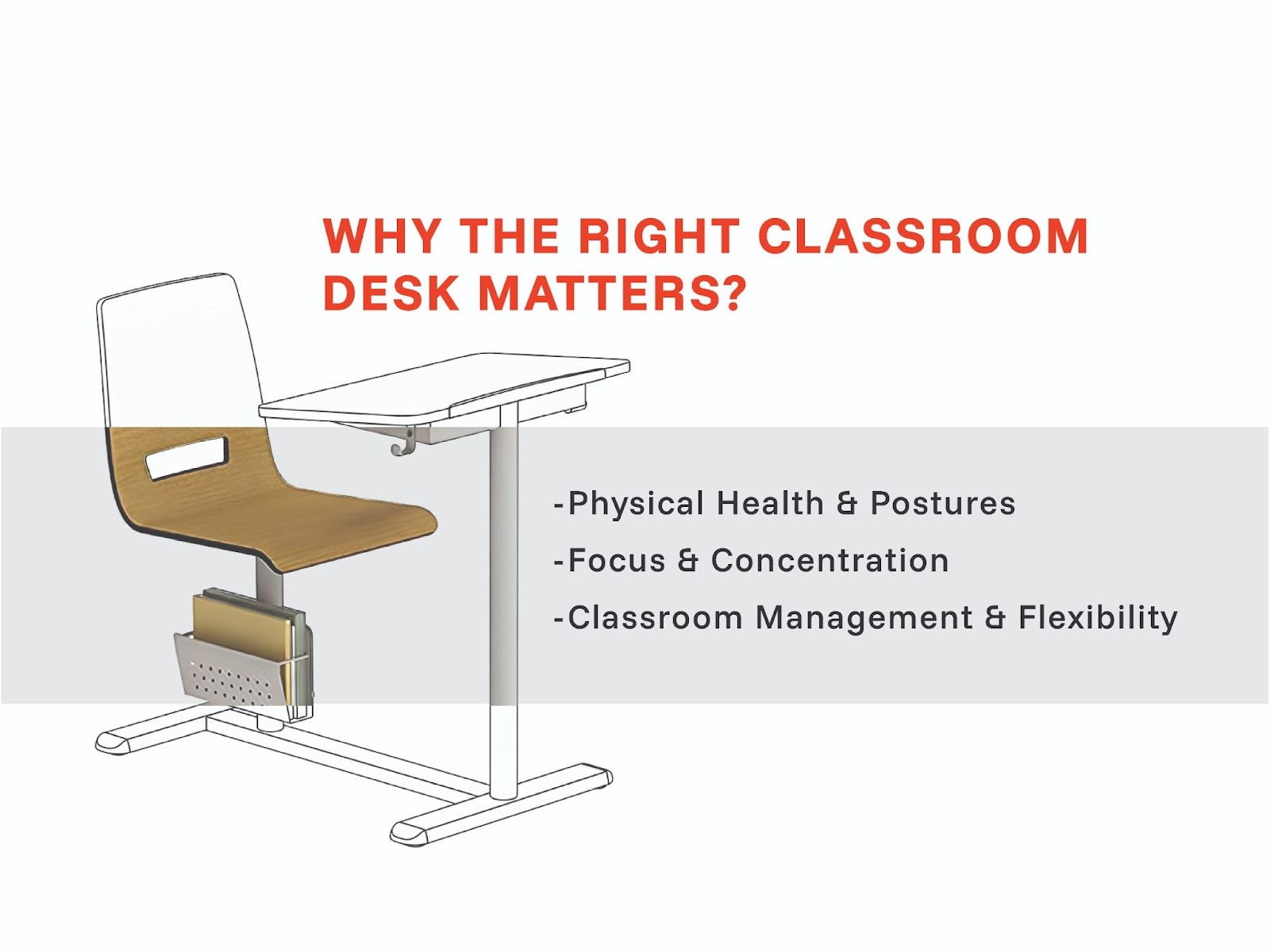
Why the Right Classroom Desk Matters
It is a reasonable question: does a desk really make that much of a difference? The short answer, based on both research and field experience, is yes — significantly.
Physical Health and Posture
Musculoskeletal problems among school-going children in India are more common than most educators realise. A significant contributing factor is furniture that does not match the physical dimensions of the student using it. A desk that is too high forces the shoulders up; one that is too low encourages chronic slouching. Over months and years, these small daily stresses accumulate into real postural and spinal issues.
An ergonomically designed classroom desk supports the natural curve of the spine, keeps the writing surface at the correct elbow height, and allows the student's feet to rest flat on the floor. These are not premium features — they are foundational requirements that every institution should insist upon.
Focus and Concentration
A wobbling desk or a chair that scrapes loudly across a tiled floor is not a minor inconvenience. It is a persistent distraction that fragments attention across an entire classroom. Stable, well-constructed school furniture removes this friction entirely, allowing both students and teachers to concentrate on what actually matters.
Classroom Management and Flexibility
The physical arrangement of desks shapes the pedagogical culture of a room. Fixed, immovable furniture locks a teacher into one format of instruction. Modular classroom desks that can be quickly rearranged — from traditional rows into collaborative clusters, discussion circles, or project stations — give educators genuine flexibility to adapt their teaching approach to the lesson at hand.
Best Classroom Desks for Primary Education (Grades 1 to 5)
Primary school children are energetic, physically small, and still developing their fine motor skills and attention spans. The furniture for primary classrooms needs to reflect all of that.
Safety above everything else. Young children move quickly and unpredictably around a classroom. Sharp metal edges or corners at head height are a genuine hazard. Look for manufacturers who provide fully rounded or "duck-nose" edge profiles on all surfaces and corners. This is a non-negotiable specification for any primary institution.
Proportional sizing. A six-year-old and a ten-year-old are very different in height and reach. Desks for primary classrooms should be available in multiple height options, or ideally be height-adjustable, to accommodate the range of physical sizes across a single classroom.
Colour and visual environment. Research in educational psychology consistently supports the positive impact of considered colour in primary learning environments. Blues, greens, and yellows are associated with calm focus and engagement. Furniture in these tones contributes to an environment that feels welcoming and stimulating rather than institutional.
Bag storage. The weight of Indian school bags is a well-documented concern among paediatric health professionals. A student desk with under-surface storage or a side hook keeps the bag off the floor and reduces the time students spend managing belongings at the start and end of each lesson.
Modularity for group work. At the primary level, a significant proportion of learning happens through collaborative play and structured group activities. Modular desks that can be pushed together to form a shared activity surface support this pedagogy naturally and without requiring additional furniture.
Best Classroom Desks for Secondary Education (Grades 6 to 12)
Secondary school marks a significant transition — in student size, in workload, and in the nature of the learning tasks being undertaken. The school desk requirements shift accordingly.
Adequate legroom. Students in the upper secondary years are often as tall as adults. A desk that does not provide sufficient clearance under the surface forces tall students into uncomfortable postures that become genuinely painful over a full school day.
Structural durability. Teenagers are harder on furniture than any other age group. Frames for secondary school desks should be constructed from powder-coated steel — resistant to rust, bending, and the general wear of heavy daily use across multiple academic years. Tabletops in high-pressure laminate over an engineered wood core offer the best combination of writing comfort, scratch resistance, and cleanability.
Adequate surface area. A secondary student routinely works with an open textbook, an exercise book, a pencil case, and — increasingly — a tablet or laptop simultaneously. The desk surface area must be large enough to accommodate this without items being stacked precariously at the edge.
Technology readiness. India's push towards smart schools means that secondary classrooms are increasingly equipped with devices. A tablet groove along the desk edge and a cable management grommet are simple additions that make a significant practical difference in these environments, keeping surfaces clear and devices accessible without trailing wires.
You can explore AFC Solutions' full Classroom furniture range for options specifically designed to meet the demands of secondary learning environments.
Best Classroom Desks for Higher Education (Colleges and Universities)
University and college environments combine the professional demands of a workplace with the academic intensity of a learning institution. The furniture needs to reflect both.
Generous surface area. College students work with large-format textbooks, laptops, printed reference materials, and personal notes simultaneously. A university desk that cannot comfortably accommodate all of this forces students into inefficient working postures and creates unnecessary frustration.
Integrated power access. A three-hour lecture on a laptop requires charging. Built-in power sockets and USB ports in lecture hall and seminar room desks are now an expectation, not a premium.
Aesthetic quality. Universities compete for students on the basis of their environment and facilities as much as on academic reputation. Contemporary classroom furniture in lighter oak or maple finishes tends to make spaces feel larger and more open than traditional dark wood, contributing meaningfully to the impression a campus makes on prospective students and their families.
Auditorium and tiered seating. For large lecture theatres, folding tablet-arm chairs that integrate a writing surface into the seat itself are the standard solution. These allow a high density of seating while still providing each student with a practical working surface for notes.
For a full overview of AFC Solutions' range across classroom, library, hostel, and auditorium settings, visit the Educational furniture category.
How to Identify Reliable Classroom Furniture Suppliers
With a large and varied market, knowing what to look for in a classroom furniture supplier is as important as knowing what to look for in the furniture itself.
Material standards. High-quality classroom desk manufacturers use CRCA (Cold Rolled Close Annealed) steel for frames. This material offers excellent strength-to-weight ratio, a smooth surface finish that accepts powder coating cleanly, and long-term resistance to the bending and deformation that cheaper mild steel is prone to in high-use environments.
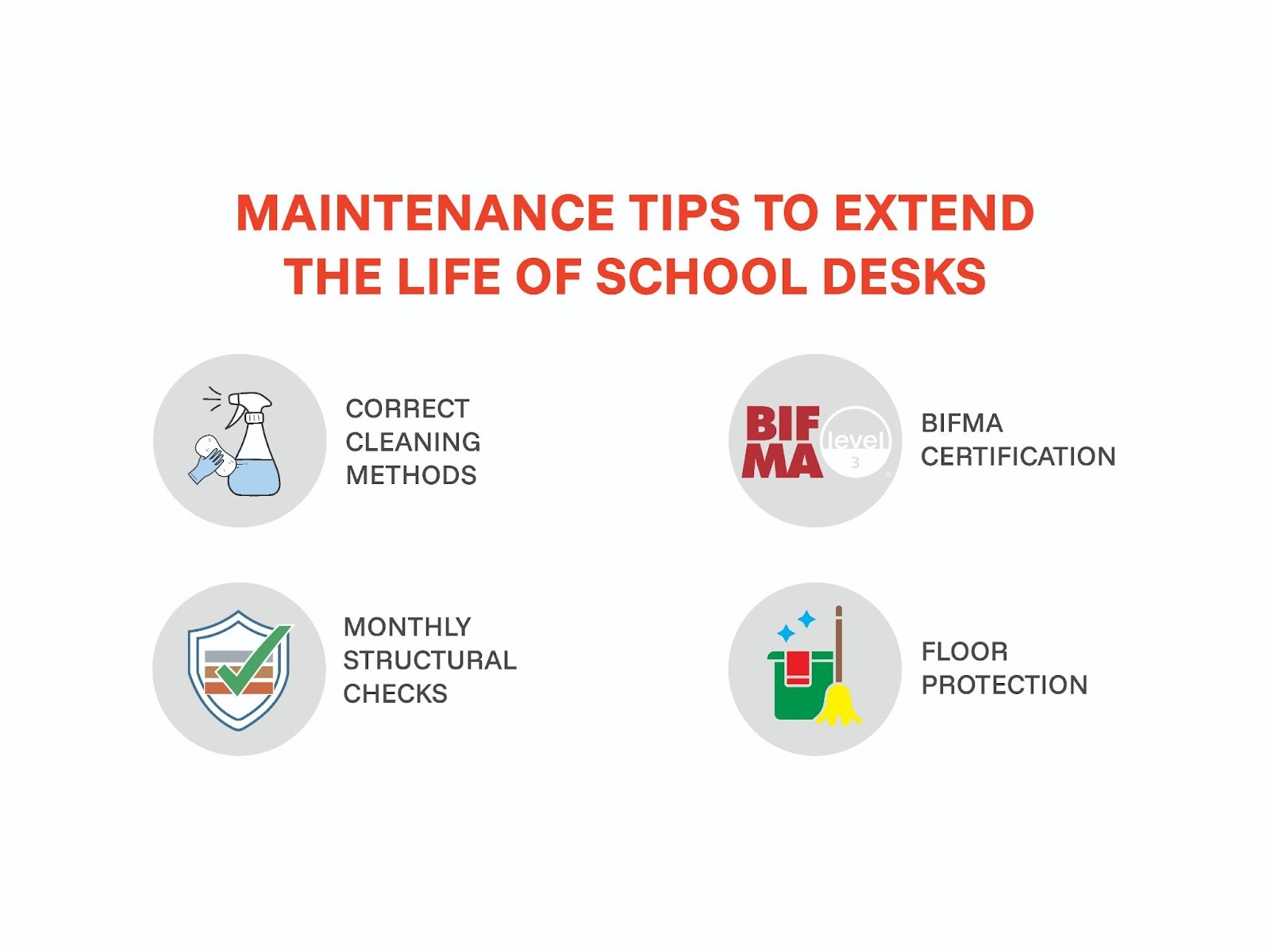
BIFMA certification. When a supplier references BIFMA compliance, it indicates their products have been independently tested against internationally recognised safety and durability standards. This is a meaningful signal of product quality, particularly for institutions making large-scale educational furniture procurement decisions.
Customisation capability. Every institution has its own identity. A school furniture supplier who can offer a range of frame colours and tabletop finishes — allowing the furniture to align with school colours, brand guidelines, or interior design choices — is a more valuable long-term partner than one offering only standard configurations.
After-sales support. For large institutional orders, the quality of installation, warranty fulfilment, and ongoing service support is as important as the product itself. Ask prospective educational furniture suppliers for references from comparable institutional clients.
Maintenance Tips to Extend the Life of School Desks
Investing in quality school furniture is only part of the equation. Consistent maintenance protects that investment and keeps the environment looking professional for years longer.
Monthly structural checks. The constant movement of desks in active classrooms gradually loosens joints and fasteners. A monthly check by maintenance staff — tightening screws and bolts across the entire classroom desk set — can double the functional lifespan of even standard commercial furniture.
Correct cleaning materials. Harsh chemical cleaners damage laminate surfaces and accelerate wear on edge banding. A damp cloth with mild soap solution is sufficient for daily cleaning. Avoid excess moisture on wooden components, as sustained dampness causes edge swelling and delamination over time.
Floor protection. Rubber or high-quality plastic caps on desk legs serve two purposes: they protect flooring from scratching, and they dramatically reduce the noise generated when students move desks during group activities. In stone-floored Indian classrooms, the acoustic difference is immediately noticeable.
Why Quality Furniture Is a Long-Term Investment
The instinct to minimise upfront expenditure on school furniture is understandable, particularly for institutions managing tight budgets. However, the economics of low-quality classroom furniture rarely work out in the institution's favour.
Well-constructed student desks from established manufacturers typically deliver ten to fifteen years of reliable service. Budget alternatives sourced from unverified suppliers often show significant structural deterioration within two years of installation — meaning the institution faces replacement costs, procurement time, and classroom disruption well before the quality option would have required any attention.
Beyond cost, there is a reputational dimension. Parents evaluating schools during admissions visits form impressions quickly, and the condition and quality of classroom furniture is one of the most visible proxies they use for assessing the overall quality of the learning environment. Broken or worn furniture does not just affect student experience — it directly affects enrolment decisions.
Frequently Asked Questions
Q1. Which tabletop material is best for classroom desks?
Pre-laminated board (PLB) or MDF with a high-pressure laminate finish is the most practical choice for Indian classrooms. It resists scratching, cleans easily, and holds up well under the daily wear of shared use across multiple student cohorts.
Q2. How much space should be maintained between rows of desks?
A minimum of two to three feet between rows allows teachers to move freely around the classroom to assist students and ensures safe, quick egress during emergency situations. For primary classrooms where children move frequently, the wider end of this range is preferable.
Q3. Are desks with attached chairs a good option for Indian schools?
Dual desks — with a fixed attached chair — work well in classrooms where consistent layout and orderly appearance are priorities. They prevent chairs from being displaced around the room and are particularly practical in primary settings. The trade-off is reduced flexibility for classroom rearrangement.
Q4. What are the advantages of height-adjustable desks for schools? Height-adjustable desks can be set to the correct ergonomic position for each individual student, regardless of their height. They also extend the usable life of the furniture as students grow, making them a cost-effective option for institutions looking to reduce replacement frequency.
Q5. Is a metal frame better than a wooden frame for school desks? The most durable and practical classroom desks combine both materials. A powder-coated steel frame provides structural strength and resistance to the stresses of daily institutional use. A laminated wooden top provides a warm, comfortable writing surface that is easy to maintain. Purely wooden desks are vulnerable to termite damage and moisture; purely metal surfaces are noisy and uncomfortable to write on.
Final Thoughts
Choosing the right classroom desk is fundamentally about understanding the student who will use it. A primary school child needs safety, colour, and the freedom to collaborate. A secondary student needs space, durability, and technology readiness. A university student needs professional quality, adequate surface area, and the infrastructure to work through long academic sessions without interruption.
In each case, the desk is not a passive object in the background. It is an active component of the learning environment — one that either supports or undermines the experience of every student who sits at it, every single day.
AFC Solutions has been helping educational institutions across India make these decisions for over 15 years, with manufacturing capacity and customisation capability to support projects of any scale.
Contact Us
📧 Email:customercare@afcindia.in
📞 Phone: +91 9999006933
🌐 Website: www.afcindia.in
Head Office: Plot No. 33, Ecotech 12, Greater Noida West, UP – 201310
Experience Centres: Noida · Gurugram · Mumbai · Bengaluru · Hyderabad· Pune
Explore Other Popular Blogs

Let’s build together
Tell us about your project and we’ll help you plan, design, and deliver at scale.
.jpg)
.svg)