.svg)
Why Mesh Chairs Are the Future of Indian Office Seating

Discover why mesh chairs are becoming the standard for Indian offices. This complete guide covers benefits, trends, buying tips, and expert guidance from AFC Furniture Solutions.
How Has Indian Office Seating Evolved Over the Last Decade?
A decade ago, the standard office chair in most Indian corporate environments was a foam-padded, fabric or leatherette-upholstered seat with basic height adjustment and a fixed backrest. It looked professional enough. It served its functional purpose for the working day. And it was selected primarily on price.
The story of Indian office seating since then is a story of rising expectations driven by longer working hours, growing health awareness, and the physical reality of sitting in warm, high-density offices for ten or more hours a day. The foam chair that was adequate for a six-hour working day in 2010 is visibly inadequate for the twelve-hour working day that is normal in Indian technology, finance, and consulting sectors today.
Mesh seating is the direct response to these changed conditions. Its rapid adoption across Indian corporate offices is not a design trend. It is a functional evolution driven by real physical requirements that the previous generation of seating was not built to meet.
What Did Most Indian Offices Use Before Mesh Chairs?
The dominant seating specification in Indian corporate offices through the 2000s and early 2010s was foam-padded chairs in fabric or leatherette upholstery. These chairs provided a professional visual appearance at low procurement cost and were adequate for the working patterns and session durations of that era.
Executive chairs in leather or leatherette occupied the senior professional layer of the market. Basic task chairs in fabric served open-plan floors. Both categories shared the same fundamental limitation: solid contact surfaces that retained heat, lost their support quality within two to three years of commercial daily use, and provided little meaningful ergonomic adjustability for individual users.
What Triggered the Shift Toward Mesh Seating in India?
Three converging forces drove the shift toward mesh seating in Indian corporate environments. The first was the dramatic extension of daily working hours across India's high-growth professional sectors. The physical demands on office seating increased significantly as the standard professional working day lengthened from six to eight hours toward ten to twelve.
The second was the entry of multinational corporations into India's major commercial centres, bringing international workspace standards that included ergonomic seating specifications as a baseline procurement requirement rather than a premium option.
The third was the growing awareness among Indian HR professionals and facilities managers that seating quality has a direct and measurable impact on employee health, attendance, and productivity. Organisations that previously selected chairs entirely on cost began to apply ergonomic criteria to their seating procurement, and mesh chairs performed better against those criteria than any alternative at comparable price points.
What Exactly Makes a Chair a Mesh Chair?
How Is the Mesh Material Made?
Mesh fabric for commercial seating is manufactured from interlocked polymer fibres woven into an open-weave structure with specific tension, elasticity, and load-bearing properties. The weave density, fibre material, and mounting tension collectively determine how the mesh performs under body weight, how long it maintains that performance, and how effectively it allows air to circulate at the contact surface.
Commercial-grade mesh specified for office seating is engineered to very different standards from decorative mesh fabrics used in other applications. It must maintain consistent tension under the sustained body weight loading of commercial daily use, resist the UV degradation that occurs in offices with natural light, and maintain its structural integrity through the repeated flexion cycles of daily professional use across seven to twelve years of service life.
How Does Mesh Work Differently from Foam and Leather?
Foam-upholstered chairs present a fixed padded surface that the user sits against. The surface is initially soft and comfortable. Over time, and with sustained daily loading, the foam compresses progressively, reducing support density and eventually creating the hard, unsupported surface that characterises older foam chairs in commercial use.
Leather and leatherette present a smooth, non-porous surface that creates a sealed interface between the body and the chair. This seal traps heat and moisture at every contact point across the sitting session, creating the progressive thermal discomfort that makes leather chairs increasingly difficult to use comfortably as the session extends in warm conditions.
Mesh presents neither of these limitations. Its open-weave structure means there is no solid contact surface to compress over time and no sealed interface to trap heat. The mesh conforms dynamically to the body's shape under load and returns to its resting position as load is removed. Air circulates freely through the structure continuously. These properties are intrinsic to the material and not subject to the degradation that affects both foam and leather under sustained commercial daily use.
Why Are Mesh Chairs Particularly Suited to Indian Office Conditions?
The Climate Factor: Heat and Humidity in Indian Workplaces
India's climate creates physical conditions for office seating that are more demanding than those in the temperate markets where many chair specifications originated. Delhi NCR experiences summer temperatures exceeding 45 degrees Celsius. Mumbai and Chennai sustain high humidity through extended periods of the year. Bengaluru and Hyderabad maintain warm year-round temperatures that make air conditioning a continuous requirement rather than a seasonal one.
Even in well air-conditioned Indian offices, the ambient temperature maintained for energy efficiency is typically 24 to 26 degrees Celsius, significantly warmer than the 18 to 21 degrees common in equivalent European and North American offices. At these temperatures, the thermal performance of the chair's contact surfaces becomes a meaningful daily comfort variable for any professional sitting for extended periods.
Mesh eliminates the heat accumulation problem at its source. The open weave allows room-temperature air to circulate through the fabric continuously, maintaining the contact surface at ambient temperature throughout the session regardless of session duration. This is a genuine physical advantage that no solid-surface upholstery alternative can replicate.
Extended Working Hours in Indian Corporate Culture
India's high-growth professional sectors have established working cultures where ten to twelve hour working days are normal rather than exceptional. Technology, financial services, consulting, legal, and media professionals across India's major commercial centres work sessions that place sustained physical demands on their seating specification far beyond the eight-hour standard that most international chair specifications are tested against.
A chair that provides adequate support for eight hours may begin to show its physical limitations beyond that threshold. Mesh maintains its support properties and breathability performance equally at hour eight as at hour one, because its function depends on structure rather than on foam density or surface material properties that change with sustained loading.
High-Density Open Plan Offices Across Indian Cities
India's commercial real estate economics have produced office floor plates with occupancy densities that are significantly higher than those of equivalent spaces in other markets. High-density open-plan floors with many people seated close together generate more ambient heat than equivalent low-density spaces, amplifying the climate challenge that individual chair breathability must address.
In a fully occupied open-plan floor in a Delhi NCR summer, the combination of solar gain, occupant body heat, and equipment heat creates an ambient temperature that tests the limits of even well-specified building air conditioning. In this environment, the breathability of every individual chair becomes a collective contributor to the thermal comfort of the entire floor.
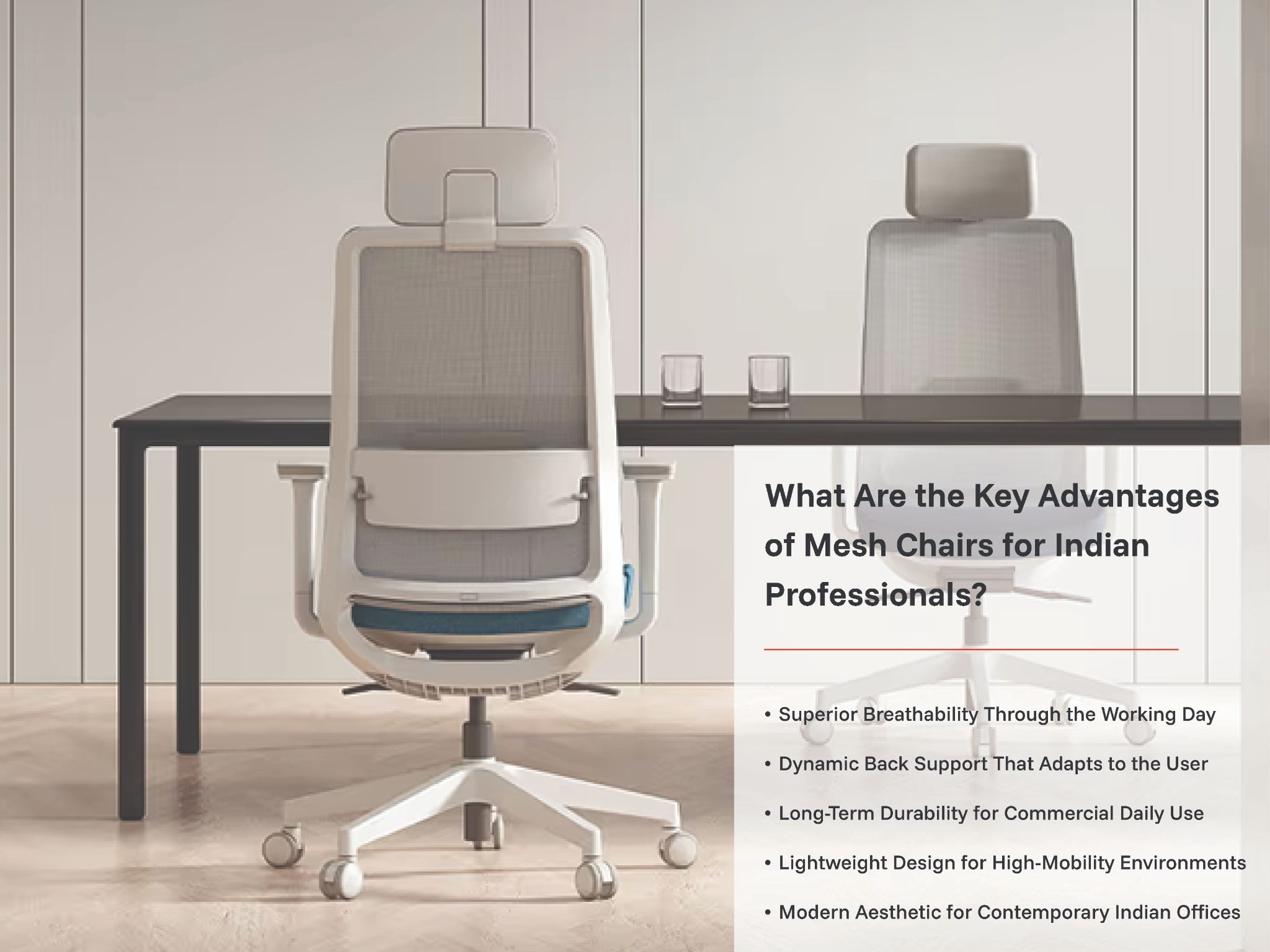
What Are the Key Advantages of Mesh Chairs for Indian Professionals?
Superior Breathability Through the Working Day
The breathability advantage of mesh over all solid-surface alternatives is not a marginal preference difference. It is a consistent, measurable physical benefit that becomes more pronounced as session duration increases and as ambient temperature rises.
At hour one of a working session, the difference between mesh and a solid-surface chair is modest. At hour four in a warm office, it is noticeable. At hour eight in an Indian summer, it is significant enough to meaningfully affect the comfort, focus, and physical fatigue of the professional sitting in the chair.
For Indian professionals working the kind of hours that characterise high-growth corporate careers, this sustained breathability advantage accumulates into a meaningful daily wellbeing difference that compounds across every working day of the professional year.
Dynamic Back Support That Adapts to the User
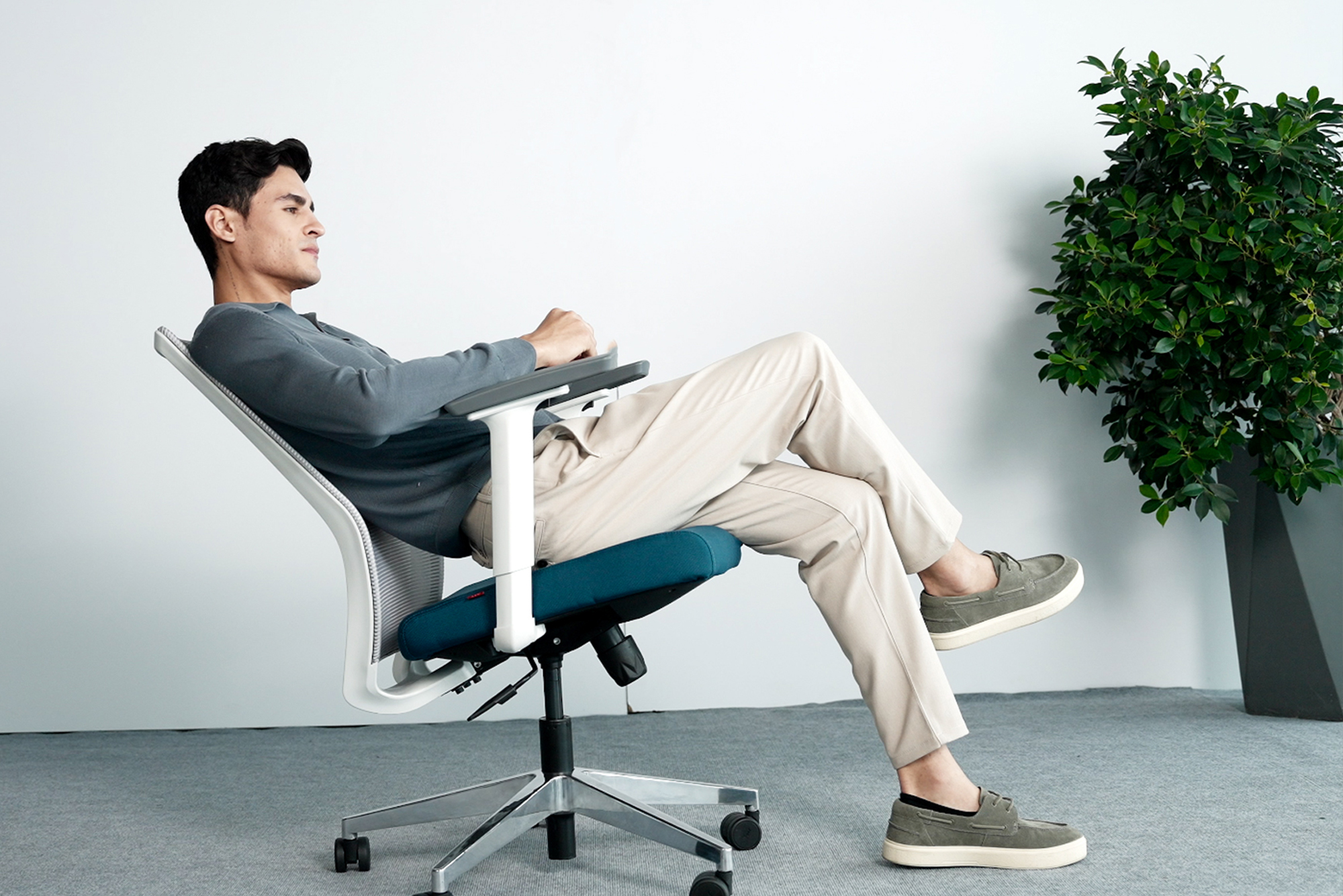
Commercial-grade mesh conforms to the shape of the user's back dynamically under load, distributing the contact pressure evenly across the full backrest surface rather than concentrating it at the specific contact points that a rigid foam back presents.
This distributed contact reduces the localised pressure points that create the specific zones of discomfort on the upper and mid back that many professionals experience with foam-back chairs across long sessions. The mesh follows the actual contours of the individual user's back rather than imposing its own fixed shape, providing a support quality that is inherently more personalised than any fixed-surface alternative.
Long-Term Durability for Commercial Daily Use
Commercial-grade mesh maintains its structural performance, tension, and breathability properties across seven to twelve years of sustained daily professional use without the progressive degradation that affects foam and leather alternatives.
Foam loses its density. Leather cracks, peels, and loses its surface integrity. Mesh, correctly specified and manufactured to commercial standards, continues to perform functionally and maintain its appearance without the scheduled replacement that degraded foam and leather require.
For organisations procuring seating at scale, the durability advantage of commercial-grade mesh over equivalent foam or leather alternatives translates into a lower total cost of ownership over any planning horizon of five or more years, even when the higher upfront cost of quality mesh is factored into the calculation.
Lightweight Design for High-Mobility Environments
The structural efficiency of mesh upholstery allows chair frames to be lighter than equivalent foam-padded alternatives without sacrificing strength or load capacity. This weight advantage matters in environments where chairs are moved frequently, stacked for storage, or rearranged for different configurations across the working day.
In training rooms, collaborative spaces, and open-plan floors where chair mobility is a regular operational requirement, a lighter chair reduces the physical effort of room reconfiguration and lowers the handling risk of damage to the chair or the floor surface during movement.
Modern Aesthetic for Contemporary Indian Offices
The visual quality of a well-specified mesh chair communicates a contemporary, considered approach to workspace design that aligns with the professional identity of modern Indian corporate environments. Technology campuses, financial services offices, and forward-thinking professional services firms across India's major commercial centres have adopted mesh seating as a visual signal of progressive, employee-focused workplace culture.
The clean, open visual structure of mesh upholstery also makes office floors feel lighter and more spacious than the solid visual mass of equivalent foam-and-fabric seating. In the high-density floor plates of Indian commercial real estate, this visual lightness is a practical aesthetic benefit alongside its physical performance advantages.
Tip: When specifying mesh chairs for a large open-plan floor, request physical tension samples of the mesh backrest material before approving the order. Run your hand firmly across the surface from the centre to the edges and assess whether the tension is consistent throughout. Quality commercial mesh maintains even resistance across the full surface. Budget mesh is tighter at the edges where it is clamped to the frame and softer in the centre where it sags under body weight. The centre of the back is precisely where lumbar support is most needed, making this the most critical quality test available before bulk specification.
How Do Mesh Chairs Support Employee Health and Productivity?
Reducing Physical Fatigue Across Long Sessions
Physical fatigue from thermal discomfort is one of the most consistent and least discussed productivity drains in Indian office environments. When the body is managing heat buildup at the chair contact surfaces, it is diverting physiological resources to thermal regulation that would otherwise be available for sustained cognitive performance.
Mesh eliminates this thermal regulation burden by preventing the heat buildup that creates it. Professionals in well-specified mesh seating consistently report lower end-of-day physical fatigue than those in foam or leather alternatives working equivalent sessions, with the difference most pronounced in the afternoon hours when the cumulative thermal load of the day is highest.
Maintaining Posture Without Conscious Effort
The dynamic conforming of quality mesh to the individual user's back profile reduces the conscious effort required to maintain correct seated posture across extended sessions. When the contact surface follows the user's natural back shape, maintaining contact with the lumbar support is easier and requires less active correction than when sitting against a fixed surface that does not match the individual's anatomy.
Better passive posture maintenance across the working day means lower sustained muscular load on the erector spinae and cervical muscles, which directly translates into less accumulated back and neck tension by end of day.
Reducing Heat-Related Discomfort That Affects Focus
Thermal discomfort is a consistent low-level cognitive distraction. Research in environmental psychology consistently demonstrates that mild thermal discomfort, the warm, slightly sticky feeling of prolonged sitting against a non-breathable surface, reduces sustained attention and increases the frequency of task-switching behaviour that reduces the quality of focused professional output.
Removing this thermal distraction through breathable seating is a genuine productivity intervention, not a comfort luxury. For Indian professionals working in conditions where the thermal comfort of their seating is frequently tested, the cognitive benefit of mesh breathability is a real contribution to the professional output quality across the full working day.
What Trends Are Driving Mesh Chair Adoption in Corporate India?
The Rise of Employee Wellness Programmes
Indian organisations across technology, financial services, consulting, and professional services sectors have made employee wellness a genuine strategic priority rather than a peripheral HR initiative. The physical workspace is increasingly understood as a direct lever of the wellness outcomes that these programmes are designed to achieve.
Seating quality is one of the most directly physical elements of the daily workspace experience. Organisations committed to employee wellness increasingly specify ergonomic mesh seating as a baseline workplace standard rather than a selective premium. The employee expectations generated by wellness-focused workplace cultures accelerate this shift.
ESG and Sustainable Procurement Priorities
According to IMARC Group, India's ergonomic chair market reached USD 374.39 million in 2025 and is projected to grow at a CAGR of 6.06%, reaching USD 635.63 million by 2034. Sustainability and employee health priorities are identified as primary growth drivers alongside hybrid work trends.
For Indian organisations with documented ESG commitments and sustainability reporting obligations, mesh seating offers procurement advantages beyond physical performance. Quality mesh chairs from certified manufacturers have lower environmental footprints than leather alternatives. They require no animal-derived materials, can be partially disassembled for component recycling, and last longer under commercial daily use, reducing the replacement frequency and associated material consumption of the seating specification.
Hybrid Working and the Home Office Boom
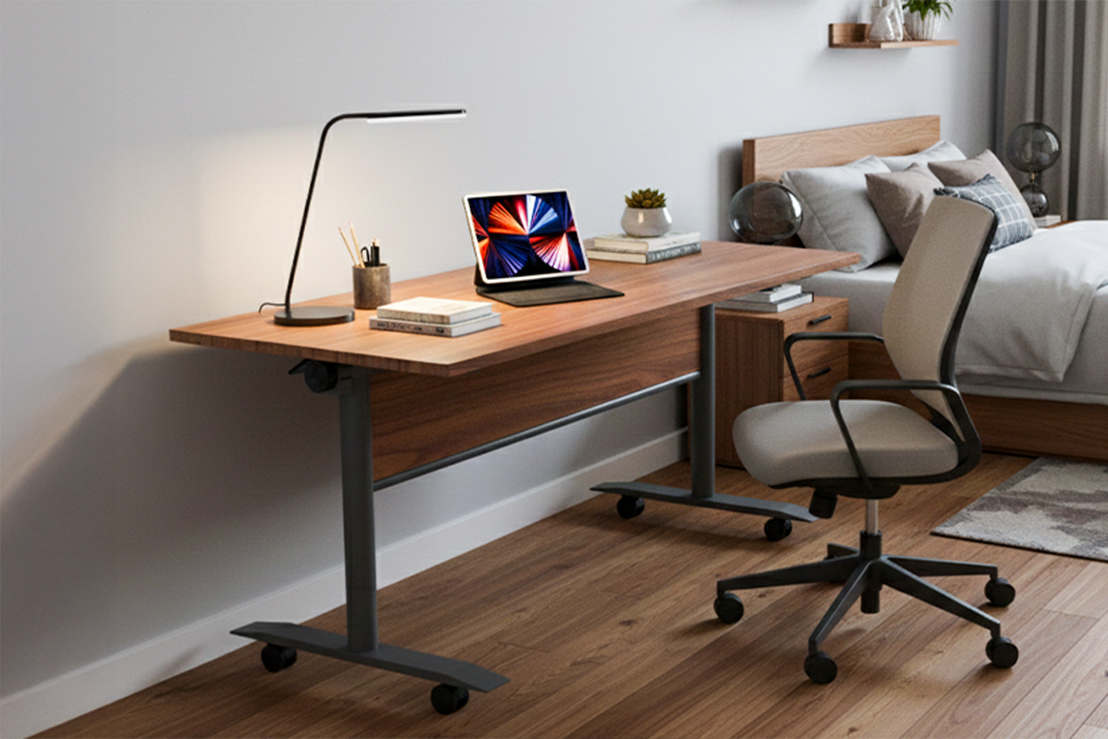
India's permanent shift to hybrid working has created a new category of mesh chair demand from professionals furnishing home offices that need to deliver the ergonomic performance of a corporate workstation environment. The combination of compact dimensions, lightweight construction, and full ergonomic adjustability makes mesh chairs particularly well suited to home office environments where space efficiency and self-assembly are practical requirements alongside physical performance.
What Should You Look for When Buying Mesh Chairs for Your Office?
Mesh Quality and Tension Rating
Always physically test the mesh tension on any chair before specifying it for a commercial order. Press firmly on the centre of the backrest and assess whether the resistance is consistent across the full surface from centre to edge.
Commercial-grade mesh maintains even tension throughout. Budget mesh that feels loose or inconsistent in the centre will provide inadequate back support precisely where lumbar support is most needed, and will sag progressively under sustained commercial daily loading.
Lumbar Support Adjustability
Mesh breathability is the most visible advantage of mesh seating but adjustable lumbar support is the most important ergonomic feature for back health and comfort across extended sessions. Verify that the lumbar support is genuinely adjustable in height and where possible in depth, not merely a fixed contour built into the backrest design.
A mesh chair without adjustable lumbar support relies entirely on mesh tension for lower back support. For sessions under three hours this may be adequate. For sessions of six or more hours daily, dedicated adjustable lumbar support is a physical health requirement.
Frame and Base Construction
The frame supporting the mesh backrest must be rigid enough to maintain consistent mesh tension under sustained body weight loading. Flex in the frame allows the mesh tension to change as body weight shifts, creating an inconsistent support quality that undermines the physical performance the mesh is designed to deliver.
A five-point nylon or polished aluminium base provides the stability footprint appropriate for commercial professional daily use. Verify that the gas lift column and castor specification match the floor surface and working pattern of the intended environment.
BIFMA Certification as Quality Proof
BIFMA certification is the most reliable independent quality indicator for commercial mesh chairs in India. It confirms that the chair has been independently tested to verified structural, ergonomic, and mesh performance standards under sustained commercial daily use conditions.
A mesh chair claiming commercial-grade performance without BIFMA certification cannot substantiate those claims with independent evidence. For any significant corporate procurement decision, BIFMA certification is the minimum quality assurance standard that responsible procurement should require.
For a direct comparison of how mesh chairs perform against foam alternatives in Indian corporate conditions, read our detailed guide on Mesh vs Foam Office Chairs: Which Is Better for Your Corporate Workplace.
Bonus Point: When organisations transition from foam or leather to mesh seating across a corporate floor, brief the team on how to correctly adjust the new chairs before installation. The most common reason mesh chair transitions underperform expectations is that professionals configure the new chairs exactly as they configured the old ones, without using the additional adjustability that the mesh specification provides. A fifteen-minute chair adjustment workshop on installation day consistently improves both adoption satisfaction and the physical benefit outcomes the specification investment is designed to deliver.
How AFC Furniture Solutions Is Leading the Mesh Chair Category in India
What Mesh Chair Options Does AFC Offer?
AFC Furniture Solutions offers the most comprehensive mesh chair range in its product portfolio, with sixteen distinct models covering every professional context from open-plan workstations and home offices to executive cabins and training rooms. Every model is manufactured at the Greater Noida facility to consistent BIFMA Level 3 certified quality standards.
The Myel is the flagship specification with full multi-point adjustability including 3D armrests, adjustable lumbar depth and height, seat depth adjustment, and weight-balance tilt mechanism. The Spino adds an adjustable headrest for full cervical coverage in extended session roles.
The Fluid and Fluid X deliver complete adjustability in configurations balancing ergonomic performance with clean contemporary aesthetics. The Sway provides a high-back profile suited to open-plan corporate floors. The Revoq and Flex offer robust commercial-grade specifications for intensive daily use environments.
The Logica, Sullion, Nuvic, and Rock provide additional high-back configurations across different working contexts and body proportions. The Breeze, X-Mesh, Orbit, and Toro complete the range with varied ergonomic configurations across different back heights, adjustment profiles, and price points suited to every corporate seating requirement from primary workstations to meeting rooms and collaborative spaces.
What Makes AFC Mesh Chairs Different?
Every AFC Furniture Solutions mesh chair is specified with commercial-grade mesh fabric tested for consistent tension across the full backrest surface under sustained daily loading. The mesh specification is verified at the Greater Noida manufacturing facility before any product leaves production.
AFC Furniture Solutions has supplied mesh seating to institutional clients including Tata Consultancy Services, Air India, Maruti Suzuki, and DXC Technology. These relationships, across India's most demanding and quality-conscious corporate environments, provide the most reliable validation of the commercial performance of AFC mesh chairs available in the Indian market.
The Greater Noida manufacturing facility operates across 150,000 square feet with a production capacity of up to 18,000 chairs per month, ensuring consistent quality and reliable supply for mesh chair orders at any scale from single units to large corporate floor installations.
Explore the full AFC Furniture Solutions Mesh Chair range to compare all sixteen models across ergonomic specifications, back heights, and adjustment profiles suited to every professional context in Indian corporate offices.
What Quality Standards Back AFC Mesh Chairs?
AFC Furniture Solutions holds BIFMA Level 3 certification, the highest internationally recognised standard for office furniture quality, sustainability, and safety. Every mesh chair in the range is independently tested to BIFMA-compliant standards covering mesh tension performance, structural integrity, mechanism durability, foam density in seat cushions, and overall ergonomic adjustability range under sustained commercial daily use.
AFC Furniture Solutions also holds ISO 9001, ISO 14001, and ISO 18001 certifications covering quality management, environmental responsibility, and occupational health and safety across the full manufacturing operation.
Frequently Asked Questions
Q1. Why are mesh chairs better than foam or leather chairs for Indian offices?
Breathability is the primary advantage in Indian conditions. Mesh maintains consistent surface temperature at the body-chair interface throughout the working session, preventing the heat buildup that makes solid-surface chairs progressively uncomfortable as sessions extend. Combined with dynamic back conforming, long-term durability without foam compression, and a contemporary aesthetic, mesh outperforms solid-surface alternatives across every dimension relevant to extended professional use in Indian corporate environments.
Q2. How long does commercial-grade mesh maintain its performance in an Indian office?
Commercial-grade mesh from a reputable BIFMA-certified manufacturer maintains its tension, breathability, and support properties across seven to twelve years of sustained daily professional use under normal commercial conditions. This is significantly longer than the three to five-year effective support life of equivalent foam-upholstered alternatives, making quality mesh a lower total cost of ownership specification over any planning horizon of five years or more.
Q3. Are mesh chairs suitable for Indian summer conditions without air conditioning?
Mesh chairs are significantly more comfortable than solid-surface alternatives in warm conditions, with or without air conditioning. The open-weave structure allows natural air circulation that foam and leather cannot match. However, for sessions of six or more hours in environments without any climate control, mesh provides comfort improvement rather than complete thermal resolution. Air circulation from fans or natural ventilation further extends the comfortable working duration in mesh seating beyond what any solid-surface chair can achieve in equivalent conditions.
Q4. What is the minimum mesh quality I should accept for a commercial office floor?
The minimum commercial specification requires consistent mesh tension across the full backrest surface that does not sag measurably under sustained body weight, a frame that maintains mesh tension without flexing under loading, and BIFMA certification from the manufacturer confirming independent quality verification. Any mesh chair that cannot meet all three criteria is not an appropriate commercial specification regardless of its price point or visual appearance.
Q5. Can executive professionals use mesh chairs or are they only for open-plan floors?
Contemporary high-back mesh chairs in premium configurations are entirely appropriate for executive cabins and senior professional environments. Many directors, founders, and senior leaders across India's leading organisations specifically choose high-back mesh for their executive cabins because the ergonomic performance advantage across a twelve-hour professional working day matters more to them than the traditional leather executive chair convention.
Q6. Does AFC Furniture Solutions supply mesh chairs across multiple cities in India?
Yes. AFC Furniture Solutions supplies mesh chairs across India through its pan-India network covering Noida, Gurugram, Mumbai, Pune, Bengaluru, Hyderabad, and Chennai. Large multi-city corporate floor specifications can be coordinated through a single account relationship with consistent product specification, delivery management, and installation across all locations.
Final Thoughts
Mesh chairs are not simply a modern aesthetic preference in Indian corporate offices. They are a functional response to the specific physical demands of Indian professional working conditions: warm ambient temperatures, extended daily working hours, high-density office environments, and growing awareness of the direct connection between physical workspace quality and employee health and performance.
The Indian ergonomic chair market's projected growth to USD 635.63 million by 2034 reflects a fundamental and permanent shift in how Indian organisations understand and invest in the daily physical environment of their people. Breathable, adjustable, durable ergonomic mesh seating is at the centre of this shift.
AFC Furniture Solutions has been designing and supplying mesh office seating for Indian professionals for over 15 years, with the most comprehensive mesh chair range in the market, BIFMA Level 3 certified manufacturing quality, and pan-India supply capability from the Greater Noida facility.
Explore Other Popular Blogs

Let’s build together
Tell us about your project and we’ll help you plan, design, and deliver at scale.
.jpg)
.svg)