.svg)
Why Investing in High-Quality Materials Saves You Money in the Long Run

Discover how investing in high-quality office furniture materials reduces replacement costs, boosts productivity, and delivers greater long-term value for your workspace
When you're furnishing an office or setting up a workspace, the temptation to cut costs with cheaper materials is very real. But here's a question worth sitting with: what does that short-term saving actually cost you over the next five, seven, or ten years?
The truth is, the furniture and materials you choose today will shape your team's productivity, comfort, and even your brand image for years to come. Choosing high-quality materials isn't about spending more — it's about spending smarter.
1. The Real Cost of Cheap: Why Low-Quality Materials Cost More Over Time
Most of us have heard the phrase "buy cheap, buy twice." In the context of office furniture and workspace design, this couldn't be more accurate.
When a chair buckles after 18 months, when a workstation surface warps from humidity, or when a storage cabinet hinge snaps under regular use — the cost isn't just the repair or the replacement. It's the disruption, the downtime, and the impact on team morale.
What Actually Happens When Quality Is Compromised?
- Furniture needs early replacement, often before a single depreciation cycle is complete
- Maintenance and repair costs accumulate quietly in the background
- Worn-out or uncomfortable furniture affects posture, focus, and overall employee satisfaction
- Cheaply made pieces are often made from materials that off-gas harmful VOCs, affecting indoor air quality
- Visual wear and tear sends an unintended message to clients and visitors
The financial math is simple: a workstation that costs 40% more upfront but lasts three times as long is, by any calculation, a better investment. Add in reduced maintenance, fewer replacements, and a healthier workforce — and the value gap widens even further.
2. What Makes a Material 'High-Quality'?
The word "quality" can feel vague without context. When it comes to office furniture and workplace environments, there are specific, measurable markers that separate genuinely high-quality materials from the rest.
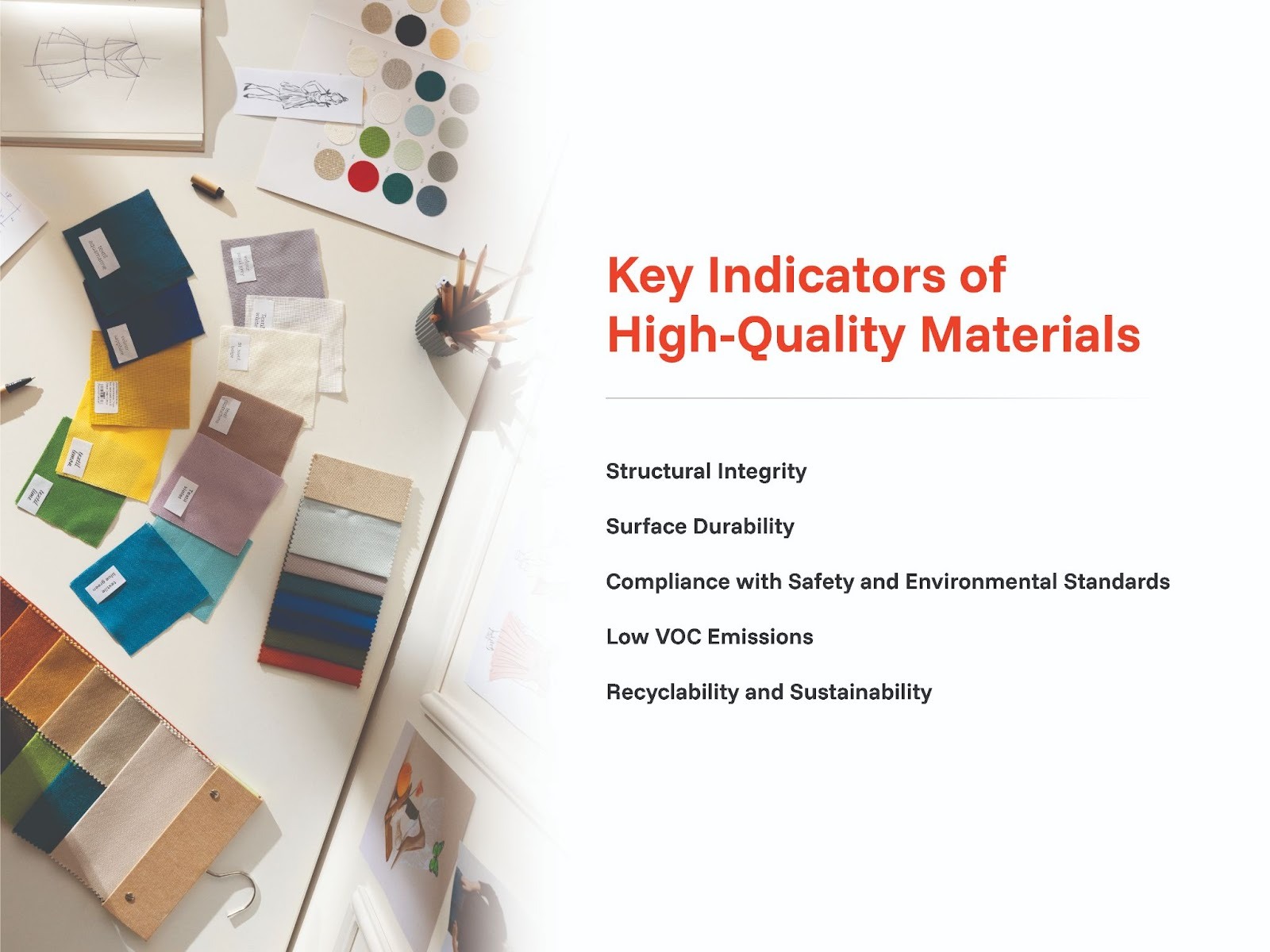
Key Indicators of High-Quality Materials
a) Structural Integrity
Whether it's a steel frame, a wood panel, or a laminate surface — structural integrity means the material can withstand the physical demands of daily use without deforming, cracking, or losing its load-bearing capacity.
b) Surface Durability
Finishes — whether powder-coated metal, high-pressure laminate, or fabric upholstery — should resist scratches, stains, and fading. A quality finish isn't just cosmetic; it's a protective layer that extends the life of the underlying material.
c) Compliance with Safety and Environmental Standards
Look for materials that meet recognized certifications such as BIFMA, GREENGUARD, LEED, or Indoor Air Advantage. These certifications confirm that materials have been tested for safety, emissions, and performance.
d) Low VOC Emissions
High-quality materials should contribute to healthy indoor air. Materials made with low-emission adhesives, waterborne paints, and non-toxic finishes are a strong sign of quality.
e) Recyclability and Sustainability
Durable doesn't have to mean wasteful. The best materials today are designed with end-of-life in mind — they can be recycled, repurposed, or responsibly disposed of without significant environmental impact.
3. Durability and Longevity: The Foundation of Long-Term Savings
When we talk about durable office furniture and materials, we're really talking about their ability to perform consistently over years of real-world use — under varying loads, changing temperatures, and daily human interaction.
How Durability Translates to Cost Savings
Think of it this way: a set of workstations built from high-density particleboard with reinforced edging and a quality laminate surface might cost more on day one. But over a 10-year lifecycle, you're likely to see:
- Zero or minimal structural replacements
- Consistent performance in terms of surface usability
- Lower cleaning and maintenance time
- Retained aesthetic appeal, reducing the need for refurbishment
Contrast this with cheaper alternatives, which may begin showing visible wear within two to three years — leading to premature refits that throw off capital budgets and disrupt operations.
The Role of Testing in Ensuring Durability
Reputable manufacturers don't just claim durability — they test for it. BIFMA-compliant testing subjects seating, workstations, and storage to rigorous simulations of real-world stress, load, and movement. Materials that pass these tests are far more likely to hold up in demanding environments.
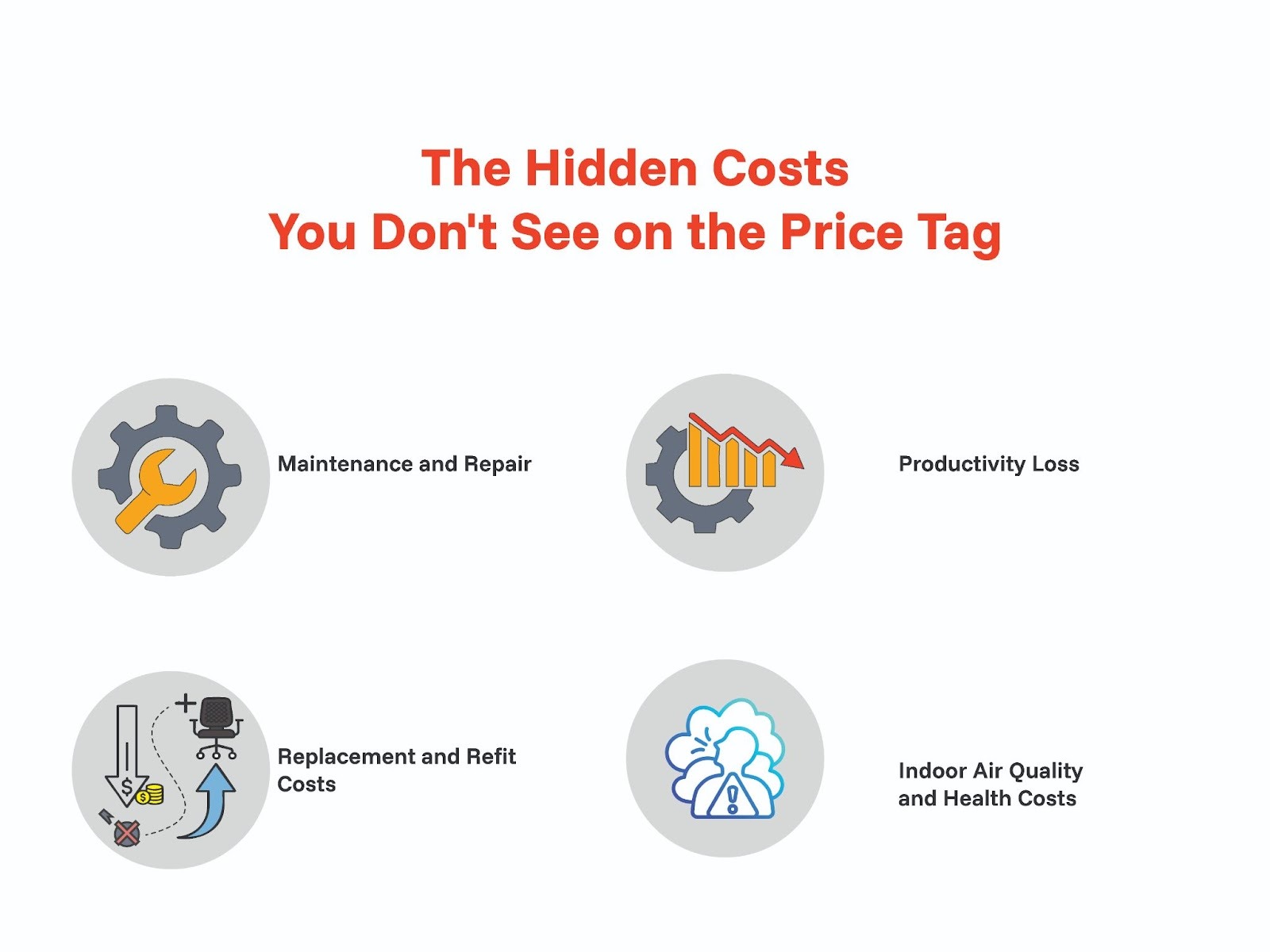
4. The Hidden Costs You Don't See on the Price Tag
The purchase price of furniture is just one part of the total cost of ownership. When evaluating workspace investment decisions, these are the costs that often go unaccounted for — until it's too late.
a) Replacement and Refit Costs
Low-quality materials often require earlier replacement cycles. A full office refit — even on a modest scale — involves vendor coordination, installation downtime, disposal of old furniture, and disruption to your teams. These costs, when summed up, routinely exceed the initial savings many times over.
b) Productivity Loss
Uncomfortable, poorly designed, or structurally compromised furniture doesn't just look bad — it affects how people feel and work. Employees dealing with inadequate seating or unstable workstations tend to experience more physical discomfort, distractions, and fatigue. The cost of reduced productivity is real, even if it's invisible in your accounts.
c) Maintenance and Repair
Repairs to low-quality furniture are rarely a one-time fix. Hinges, surface peeling, wobbly legs, broken castors — small failures cascade quickly and keep recurring. In contrast, quality materials with manufacturer warranties significantly reduce maintenance overhead.
d) Indoor Air Quality and Health Costs
Some lower-cost materials are manufactured with adhesives, paints, or resins that release volatile organic compounds (VOCs) into the air. Over time, poor air quality in a workspace can contribute to headaches, respiratory issues, and reduced cognitive performance — all of which translate into absenteeism and healthcare costs.
5. Sustainability and High-Quality Materials: Two Sides of the Same Coin
One of the most important shifts happening in workspace design today is the recognition that sustainability and quality are not separate objectives — they reinforce each other.
Materials that are built to last are, by definition, more sustainable. They don't need to be replaced as frequently, which means less waste, fewer resources consumed, and a lower environmental footprint over time.
What Sustainable Material Choices Look Like in Practice
- Responsibly sourced wood panels and engineered wood with low-emission binders
- Metal components that are powder-coated with environmentally safer finishes
- Upholstery and fabrics with recycled content or recyclable composition
- Products designed for disassembly — making end-of-life recycling more efficient
When a product has a higher percentage of recyclable content and is designed for responsible disposal, it not only reduces landfill burden — it also supports your organisation's ESG commitments and reporting goals.
For organisations pursuing LEED, WELL, or IGBC certifications, the materials you choose are directly tied to your certification outcomes. Selecting verified, low-emission, sustainably sourced furniture contributes measurable points to your building's environmental rating.
6. Ergonomics, Wellness, and Productivity: The Human ROI
There's a compelling human dimension to material quality that often gets overlooked in purely financial discussions.
High-quality materials don't just last longer — they support better-designed products. And better-designed products enable ergonomic functionality that directly impacts human health and output.
The Connection Between Material Quality and Ergonomic Performance
Seating
A chair built with quality foam, breathable mesh, and a robust structural frame can maintain its ergonomic properties through years of daily use. A cheap alternative may lose its lumbar support after months, leaving users hunched forward and experiencing spinal discomfort.
Workstations
A workstation surface with proper material integrity remains stable under load, enabling consistent posture and focused work. Warped or unstable surfaces introduce micro-adjustments and physical compensation that add cumulative strain.
Storage
Well-built office storage solutions ensure that drawers open smoothly, locks function reliably, and items are easy to access — all small but significant contributors to daily workflow efficiency.
When your workspace is built on quality materials, your team spends less time managing discomfort and more time contributing to what matters. That's a return on investment that doesn't show up in a depreciation schedule, but it's very real.
7. What to Look for When Evaluating Material Quality in Office Furniture
Whether you're outfitting a new office or refreshing an existing space, here's a practical checklist to assess whether the materials being offered genuinely represent quality — and value.
Quality Evaluation Checklist
1. Ask About Certifications
- Does the product carry BIFMA or GREENGUARD certification?
- Is the manufacturer IGBC or LEED-aligned?
- Are VOC emission standards documented?
2. Inspect the Core Materials
- What grade of particleboard, plywood, or MDF is used?
- Are metal frames using structural grade steel?
- Is the surface laminate high-pressure or low-pressure?
3. Evaluate the Finish Quality
- Is the powder coating consistent and uniform?
- Does the edging prevent moisture ingress?
- Is fabric upholstery rated for commercial-grade use?
4. Review Warranty Terms
- What does the warranty cover and for how long?
- Is the manufacturer's testing process documented?
- Are spare parts available if components need replacement?
5. Consider Sustainability Credentials
- What percentage of the product is recyclable?
- Does the manufacturer offer an end-of-life take-back or recycling programme?
8. Real-World Perspective: How AFC Solutions Approaches Material Quality
At AFC Solutions, material quality isn't a marketing statement — it's engineered into every product through deliberate design, rigorous testing, and responsible sourcing.
Manufacturing Standards
AFC Solutions operates state-of-the-art manufacturing facilities where raw materials — from wood panels and metal frames to upholstery and surface finishes — undergo extensive in-house testing before being incorporated into any product. This includes BIFMA-compliant ergonomic and durability testing, environmental compliance checks, and quality audits at every stage of production.
Material Efficiency and Recyclability
AFC Solutions has achieved 86% material efficiency at its manufacturing plant — meaning the vast majority of raw materials actually end up in finished products rather than waste. Additionally, products are designed to be up to 66% recyclable, supporting a genuine circular economy approach.
Sustainability Certifications
Products from AFC Solutions carry recognised certifications including IGBC Gold, Indoor Air Advantage, BIFMA, and GREENGUARD — independent verification that the materials used meet stringent standards for safety, performance, and environmental responsibility.
Warranty and After-Sales Support
AFC Solutions backs its products with warranties of up to 10 years, reflecting confidence in the materials and workmanship that go into every piece.
To understand how AFC Solutions integrates sustainable material choices across its entire product lifecycle, explore the
AFC Solutions Sustainability Approach — a detailed look at the certifications, material standards, and environmental commitments that guide every product decision.
For readers who want to go deeper into the specific materials used in modern office furniture — from solid wood and engineered panels to metal and fabric — this resource offers a practical overview:
Different Types of Furniture Materials and Their Durability — a guide to understanding how material choices affect performance and longevity.
9. Frequently Asked Questions (FAQs)
Q1: Is high-quality office furniture always more expensive upfront?
Not necessarily. While premium materials often carry a higher initial price, the gap is smaller than many assume — and when you factor in longevity, reduced maintenance, and avoided replacement costs, the total cost of ownership is typically lower than budget alternatives.
Q2: How do I verify whether a furniture manufacturer uses quality materials?
Ask for third-party certifications such as BIFMA, GREENGUARD, or IGBC. Request information about the grade of materials used (e.g., particleboard density, laminate pressure rating) and review their warranty terms — a long warranty is usually a manufacturer's confidence in their own materials.
Q3: Does sustainable furniture mean sacrificing durability?
Quite the opposite. The most durable materials tend to be the most sustainable, because they last longer and require less frequent replacement. Look for products made with low-emission materials, recycled content, and designs that support end-of-life recyclability.
Q4: How long should quality office furniture typically last?
Quality office furniture — when properly maintained — should last anywhere from 10 to 20 years, depending on usage intensity. Seating with commercial-grade foam and mechanisms, workstations with quality laminate surfaces, and storage built with reinforced joinery all tend to perform well across long timelines.
Q5: What role do VOC emissions play in material quality?
VOCs (volatile organic compounds) are gases released by certain materials, adhesives, and finishes. High-quality materials use formulations that minimise VOC emissions, contributing to better indoor air quality and a healthier environment for building occupants.
10. Final Thoughts
The question was never really whether quality materials cost more. The real question is: how much does choosing the wrong materials actually cost you — in replacements, in maintenance, in productivity, and in the wellbeing of the people who use these spaces every day?
When you step back and look at the full picture — lifecycle costs, sustainability impact, ergonomic benefits, and brand perception — the case for investing in high-quality materials becomes not just sensible, but financially compelling.
The best workspace decisions are made when short-term budget pressures are balanced with long-term thinking. And in the world of office furniture and workspace design, long-term thinking almost always points in the same direction: choose quality, and the savings follow.
AFC Solutions builds workspaces that are designed to last — combining quality materials, sustainable practices, and ergonomic intelligence to create environments where people and businesses thrive.
About AFC Solutions
AFC Solutions is one of India's leading manufacturers of modular office furniture, delivering workstations, seating, storage, and lab furniture solutions built to international quality standards. With a commitment to sustainability, ergonomic design, and material excellence, AFC Solutions partners with organisations across sectors to create workspaces that perform today — and endure tomorrow.
Contact Us
📧 Email:customercare@afcindia.in
📞 Phone: +91 9999006933
🌐 Website: www.afcindia.in
Head Office: Plot No. 33, Ecotech 12, Greater Noida West, UP – 201310
Experience Centres: Noida · Gurugram · Mumbai · Bengaluru · Hyderabad· Pune
Explore Other Popular Blogs


Let’s build together
Tell us about your project and we’ll help you plan, design, and deliver at scale.
.jpg)
.svg)