.svg)
What Is a Compactor Storage System and Does Your Office Need One?

Discover what a compactor storage system is, how it works, and whether your office needs one. Expert guidance on space saving, organisation, and quality from AFC Furniture Solutions.
What Is a Compactor Storage System?
Every growing organisation eventually faces the same problem. The volume of physical documents, files, and materials that needs to be stored keeps increasing while the office floor space available to store it does not.
Standard fixed shelving addresses this problem by adding more shelving units, which requires more floor area, which reduces the usable working space on the floor. This approach works up to a point, and then it stops working entirely.
A compactor storage system solves this problem differently. Rather than requiring more floor area for more storage, it allows significantly more storage volume to be housed within the same floor area by eliminating the fixed aisles between shelving rows that conventional shelving systems require.
How Does a Compactor Storage System Work?
A compactor storage system consists of multiple shelving units mounted on wheeled carriages that run along fixed floor tracks. The units can be pushed together to close the gaps between them, and pulled apart to create a single access aisle wherever it is needed at any point in the storage run.
At any given time, only one access aisle exists within the system. Every other unit is closed against its neighbour. When a different section of the storage run needs to be accessed, the units are rolled to create the aisle at the new position.
This mechanism allows the system to store the same volume of material as a conventional fixed shelving layout that would require two to three times the floor area, because the floor space that fixed shelving permanently dedicates to access aisles between every row is recovered and used for additional storage capacity.
What Are the Different Types of Compactor Storage Systems?
Manual compactor systems are operated by turning a handle mechanism that rolls the shelving unit along the floor tracks. They require no electrical connection and have minimal maintenance requirements. They are the most widely used specification in Indian offices due to their reliability and straightforward operation.
Mechanical or electrically assisted compactor systems use a motor to move the shelving units, operated by a button or keypad. They suit very heavy loads or very large storage runs where the physical effort of manually rolling fully loaded units would be impractical.
Anti-tipping compactor systems include safety mechanisms that prevent a shelving unit from being opened while an adjacent unit is already open, eliminating the risk of a unit tipping or falling if the system is operated incorrectly. This safety feature is non-negotiable for any compactor storage system used in an occupied office environment.
How Is a Compactor Storage System Different from Regular Shelving?
Space Efficiency Comparison
Standard fixed shelving requires a dedicated access aisle of approximately 700mm to 900mm between every pair of shelving rows. In a typical office storage room with four rows of fixed shelving, three permanent aisles consume approximately 40 to 50 percent of the total floor area without providing any storage capacity.
A compactor system serving the same storage volume requires only one access aisle at any time. The floor area previously consumed by the two permanent intermediate aisles becomes additional storage capacity. In practical terms, a compactor system can store the same volume of material as conventional shelving in approximately 50 to 60 percent of the floor area.
According to the National Institute of Standards and Technology (NIST), high-density mobile storage systems can increase storage capacity per square metre by up to 100% compared to conventional fixed shelving in equivalent floor areas.
Accessibility and Organisation
A common misconception about compactor storage is that retrieving items takes significantly longer than with fixed open shelving. In practice, opening a single aisle in a compactor system takes ten to fifteen seconds with a manual handle operation, which is negligible compared to the time spent locating and retrieving a specific item in a well-organised system.
The physical compactness of the closed system also encourages more disciplined organisation because items cannot be placed randomly across open aisles the way they sometimes can in a conventional fixed shelving environment.
Cost and Long-Term Value
The upfront cost of a compactor storage system is higher than an equivalent volume of conventional fixed shelving. The relevant financial comparison is not upfront cost per shelf but the cost per cubic metre of usable storage delivered per square metre of floor area consumed.
When measured against the rental or opportunity cost of the additional floor area that conventional shelving would require, a compactor system almost always delivers lower total cost of ownership over any planning horizon of five years or more in Indian commercial real estate markets.
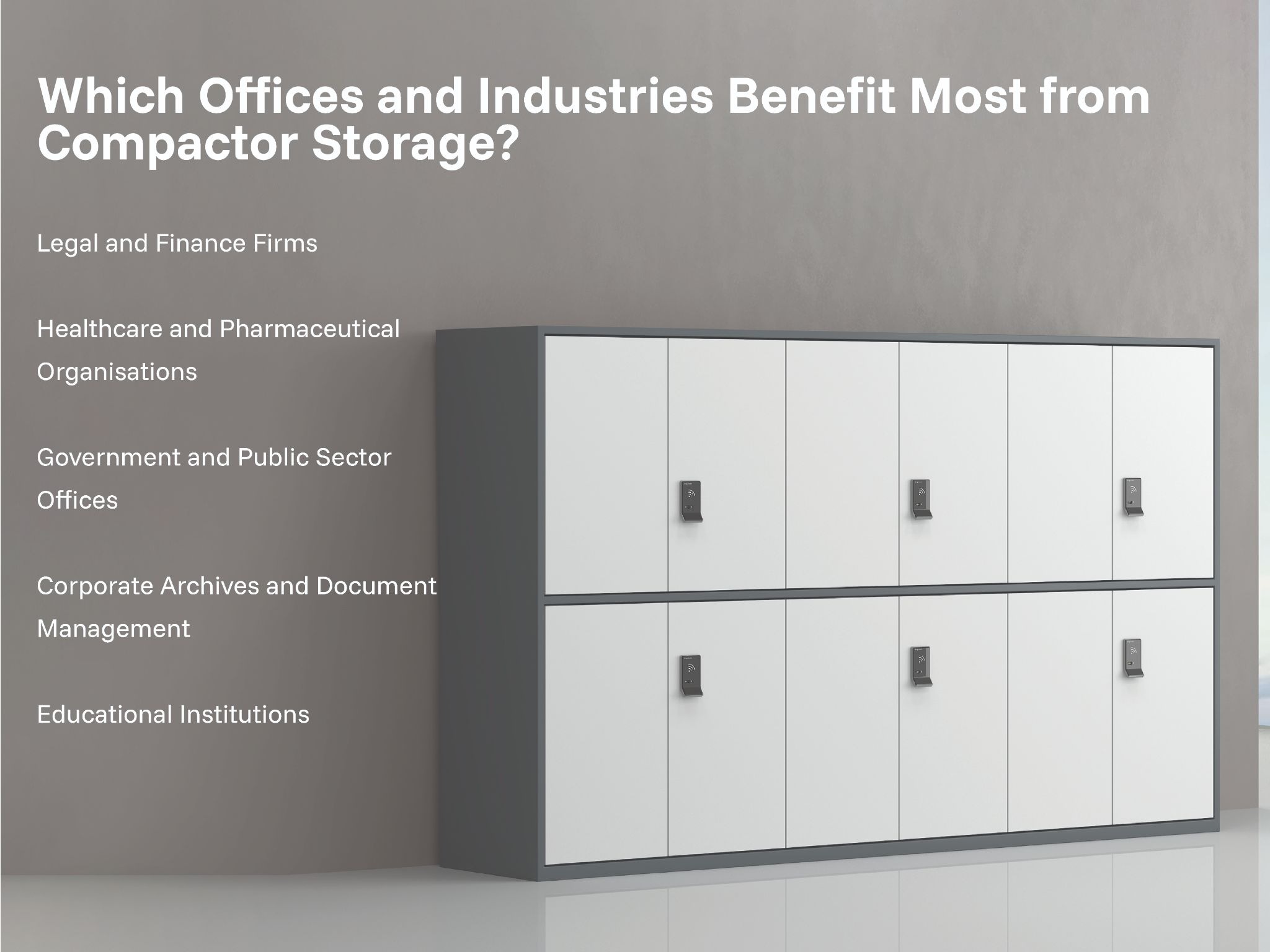
Which Offices and Industries Benefit Most from Compactor Storage?
Legal and Finance Firms
Legal practices and financial services organisations maintain large volumes of physical documents that must be retained for regulatory compliance periods of seven to twelve years or longer in many cases. The document volume grows every year and the regulatory obligation to retain it does not diminish.
A compactor storage system allows these organisations to manage expanding physical document obligations within fixed office space without either compromising the working environment or committing to expensive off-site document storage.
Healthcare and Pharmaceutical Organisations
Patient records, clinical trial documentation, regulatory submissions, and pharmaceutical batch records all represent high-volume physical document holdings that healthcare and pharmaceutical organisations are required to maintain for defined retention periods.
The sensitivity of this material additionally requires secure, controlled access that mobile compactor storage with lockable units provides more effectively than open fixed shelving in a shared storage area.
Government and Public Sector Offices
Government offices at every level maintain substantial physical record holdings that are subject to retention requirements significantly longer than those of most private sector organisations. Many of these records cannot be digitised due to legal or evidentiary requirements.
Mobile compactor storage allows government offices to manage growing record volumes within existing building footprints without the construction costs associated with expanding storage areas.
Corporate Archives and Document Management
Large corporate organisations maintain HR records, contracts, financial documentation, board minutes, and operational records that require physical retention for compliance and evidentiary purposes.
A well-specified compactor system in a dedicated archive room allows these organisations to manage their physical document obligations efficiently without consuming productive floor space on the main working floors.
Educational Institutions
Universities and colleges maintain student records, examination papers, research materials, and administrative documentation that accumulates continuously across each academic year and must be retained for defined periods.
Library reference collections that cannot be digitised also benefit significantly from compactor storage, which can effectively double the physical collection housed within an existing library floor area.
Tip: Before specifying a compactor storage system for your office, conduct a physical audit of the documents and materials you currently hold. Classify them into active records accessed regularly, semi-active records accessed occasionally, and inactive records retained for compliance but rarely accessed. This classification determines the most efficient compactor configuration for your specific access frequency pattern and prevents overspecification or underspecification of the system.
What Are the Key Benefits of a Compactor Storage System?
Significant Floor Space Savings
The floor space savings delivered by a compactor system represent genuine operational value in any Indian commercial office environment where rental costs per square metre are a significant operational expense.
Recovering 40 to 50 percent of a storage room's floor area from unnecessary fixed aisles either allows the same room to hold significantly more storage volume or allows a smaller room to be allocated to storage, freeing productive floor area for working use.
In high-cost commercial real estate markets such as Mumbai, Delhi NCR, Bengaluru, and Hyderabad, the annual rental value of the floor area recovered by switching from conventional to compactor storage frequently exceeds the total cost of the compactor system within two to three years.
Better Document Security and Access Control
Compactor systems with lockable units provide physical access control to the entire storage run. When the system is closed, every shelf and every document within it is physically secured behind the closed face of the adjacent unit.
This level of physical security is not achievable with conventional open shelving and is particularly important for document categories including personnel records, financial data, legal files, and any other material subject to data protection or confidentiality obligations.
Improved Organisation and Retrieval Speed
The structured physical format of a compactor system encourages systematic filing practices because the closed system makes random placement of items impractical. Documents are filed to their designated location or they cannot be retrieved efficiently.
This structural discipline typically improves retrieval speed for organised document holdings compared to conventional open shelving where informal placement habits gradually undermine the filing system over time.
Long-Term Durability for Heavy Loads
Commercial compactor shelving is designed and tested for heavy sustained loads including bound volumes, lever arch files, and box files that individually weigh two to four kilograms and accumulate to very substantial total loads across a fully populated run.
The floor track system distributes this load across the building floor structure in a controlled way. The shelving frame materials and shelf load ratings must be specified specifically for the density of the material being stored to ensure the system performs safely and reliably across its service life.
What Should You Check Before Buying a Compactor Storage System?
Load Capacity and Shelf Specifications
Every shelf in a compactor system has a specified safe working load that must be matched to the actual weight of the items being stored. Legal files, medical records, and bound journals are among the heaviest categories of stored material and require shelf specifications significantly higher than general office paper filing.
Ask the supplier to specify the shelf load rating in kilograms per shelf and per unit, not just a general statement about heavy-duty capability. Verify that this rating covers the maximum realistic load for your specific document and material types.
Manual vs Mechanical Operation
For most Indian office compactor applications, a manual handle-operated system is the most practical and reliable specification. Manual systems require no electrical connection, have minimal maintenance requirements, and are not affected by power outages or electrical faults.
Electrically operated systems are justified for very large storage runs where the total loaded weight of each unit exceeds the practical limit of comfortable manual operation, or where accessibility requirements make motorised operation necessary for specific users.
Floor Load and Installation Requirements
A fully loaded compactor storage system places significantly higher concentrated loads on the building floor than conventional shelving. Before any compactor installation, the structural engineer responsible for the building must confirm that the floor slab can support the concentrated load at the proposed installation location.
This structural verification is non-negotiable. A compactor system installed without floor load confirmation on an inadequate slab is a genuine structural safety risk that no procurement saving justifies accepting.
Safety Features
Every compactor system specified for an occupied office must include anti-tip safety mechanisms that prevent a unit from being moved while an adjacent unit is already open. The risk of a fully loaded shelving unit tipping in an occupied area is a serious safety concern that basic systems without this feature do not adequately address.
Access control locks, end-of-run stops that prevent units from running off the tracks, and clearly marked safe operating instructions should all be confirmed as standard inclusions before any purchase order is placed.
Bonus Point: When planning a compactor storage installation, always include a 10 to 15 percent capacity buffer in the total storage volume specification. A system that is fully populated at installation provides no room for the document growth that will occur across the first twelve to eighteen months of operation. Building in expansion capacity from the outset eliminates the disruption of needing to extend or reconfigure the system within the first year.
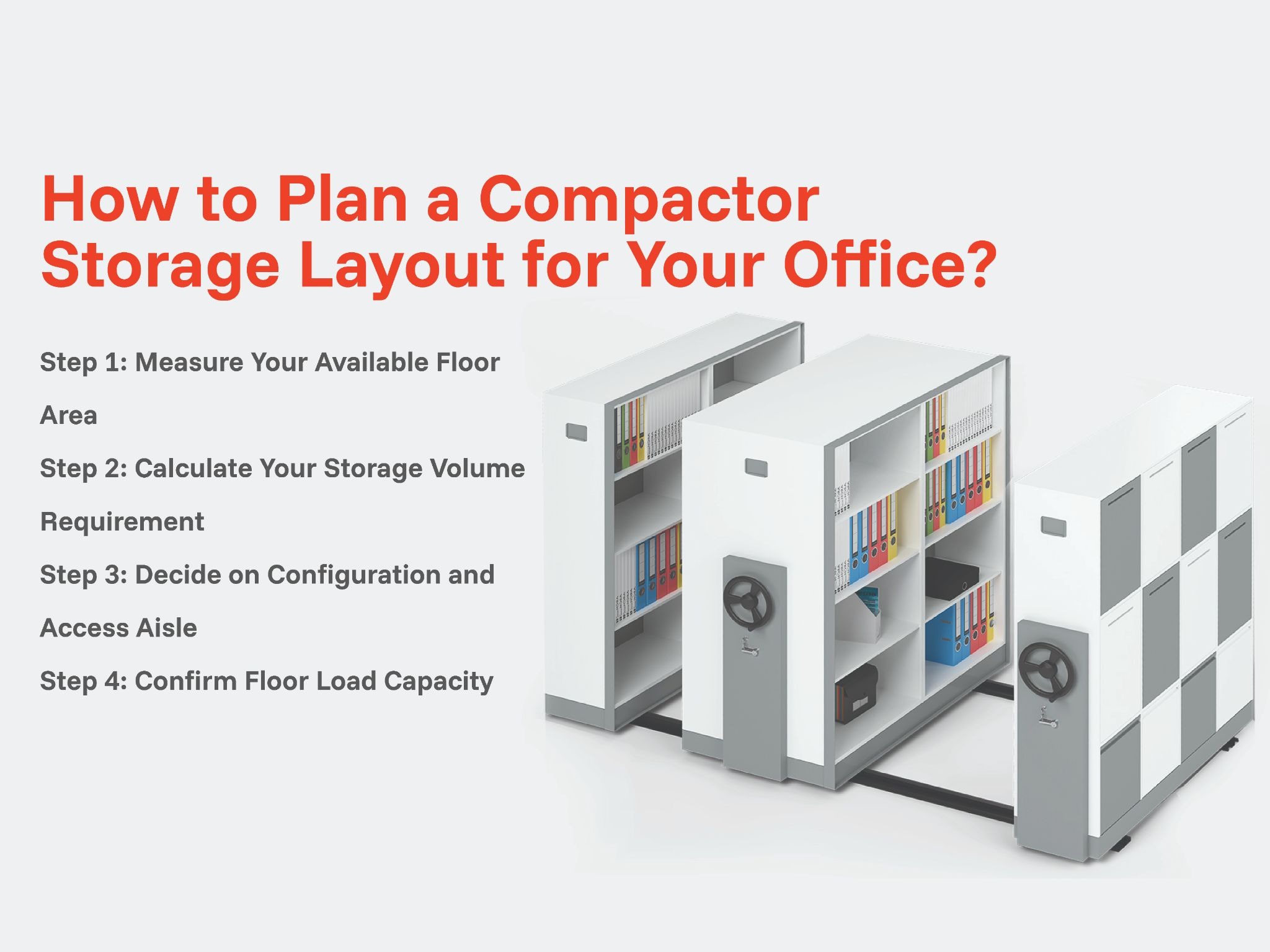
How to Plan a Compactor Storage Layout for Your Office?
Step 1: Measure Your Available Floor Area
Measure the storage room or area precisely, noting the positions of all doors, windows, columns, electrical fixtures, and air conditioning units. These elements all affect the viable placement and configuration of the compactor system.
Confirm the clear floor-to-ceiling height. The shelving unit height must allow safe manual operation of the top shelf without requiring a ladder in a space where the compactor aisles are being opened and closed dynamically.
Step 2: Calculate Your Storage Volume Requirement
Count the total number of lever arch files, box files, bound volumes, or other items currently requiring storage and those anticipated over the next three to five years. Convert this into a total linear metre figure of shelf space required.
Add the 10 to 15 percent capacity buffer discussed earlier before finalising the total storage volume specification. This buffer is the most practical single step available to prevent the system from being inadequate within its first year of operation.
Step 3: Decide on Configuration and Access Aisle
Determine how many units the run will contain and where the access aisle will typically be positioned. For storage areas where specific sections are accessed significantly more frequently than others, position the most frequently accessed section nearest the standard aisle opening position to minimise the rolling operation required for routine access.
Confirm whether a single access aisle moving across the full run is adequate for your access frequency or whether the access patterns justify a configuration with a permanently open end aisle in addition to the mobile internal aisle.
Step 4: Confirm Floor Load Capacity
Engage a structural engineer to assess the floor slab capacity at the proposed installation location before finalising the system specification. Provide the engineer with the total loaded weight per unit and the track spacing to allow accurate point load calculations.
If the floor slab is inadequate for the full planned system, the engineer can identify a reduced configuration that the floor can safely support, allowing the installation to proceed within safe structural limits.
How AFC Furniture Solutions Designs Compactor Storage for Indian Offices?
What Does AFC Offer in Compactor Storage?
AFC Furniture Solutions offers the Compactor from its dedicated Compactor Storage range, designed specifically for the document volume, climate conditions, and commercial use intensity of Indian office environments.
The AFC Compactor is built on a robust powder-coated steel frame with a manual roller track system engineered for smooth, quiet operation under fully loaded commercial daily use conditions. Anti-tip safety mechanisms and lockable unit options provide the physical security and operational safety required in occupied professional environments.
The system is available in configurations suited to different room dimensions, storage volume requirements, and shelf load specifications. AFC Furniture Solutions workspace consultants provide scaled layout plans showing the proposed configuration within the actual room dimensions before any order is finalised.
AFC Furniture Solutions operates a 150,000 square foot manufacturing facility in Greater Noida with production capacity verified under ISO 9001 quality management certification, ensuring consistent manufacturing quality across every unit in a compactor system order.
Explore the full AFC Furniture Solutions Storage range to compare compactor, metal, prelam, and locker storage options suited to different office storage requirements.
What Quality Standards Back AFC Storage Products?
AFC Furniture Solutions holds BIFMA Level 3 certification, the highest internationally recognised standard for office furniture quality, sustainability, and safety. Every storage product in the range is manufactured at the Greater Noida facility and tested to commercial-grade standards appropriate for sustained institutional daily use.
AFC Furniture Solutions also holds ISO 9001, ISO 14001, and ISO 18001 certifications covering quality management, environmental responsibility, and occupational health and safety standards across the full manufacturing operation.
You can also explore the AFC Furniture Solutions Compactor Storage range specifically for mobile compactor storage configurations suited to Indian corporate, institutional, and government office environments.
Frequently Asked Questions
Q1. What is the main advantage of a compactor storage system over regular shelving?
The primary advantage is space efficiency. A compactor system eliminates the permanent fixed aisles that conventional shelving requires between every row, recovering 40 to 50 percent of the floor area for additional storage capacity. This allows the same storage volume to be housed in approximately half the floor area, or significantly more storage volume in the same floor area.
Q2. How much floor space can a compactor storage system save?
According to the National Institute of Standards and Technology, high-density mobile storage systems can increase storage capacity per square metre by up to 100% compared to conventional fixed shelving. In practical Indian office terms, this typically means a compactor system can store the same document volume as conventional shelving in 50 to 60 percent of the floor area.
Q3. Is a compactor storage system suitable for a small office?
Yes, provided the storage room floor can support the concentrated load of a fully loaded system. Compactor systems are available in compact configurations suitable for small storage rooms of fifteen square metres or more. The space saving benefit is proportionally as valuable in a small room as in a large one.
Q4. What is the difference between a manual and electrical compactor system?
A manual compactor system uses a handle mechanism to roll the shelving units along floor tracks. An electrical system uses a motor operated by a button or keypad. For most Indian office applications, a manual system is the more practical and reliable choice due to its independence from electrical supply and its minimal maintenance requirements.
Q5. Does a compactor storage system require special floor preparation?
The floor tracks require a level, structurally adequate floor surface. The building floor slab must be assessed by a structural engineer to confirm it can support the concentrated load of a fully populated system before installation. If the floor is uneven, a levelling screed may be required before tracks are laid.
Q6. Can AFC Furniture Solutions install a compactor system across multiple office locations?
Yes. AFC Furniture Solutions serves organisations across India through its pan-India network covering Noida, Gurugram, Mumbai, Pune, Bengaluru, Hyderabad, and Chennai. Multi-location compactor installations can be coordinated through a single account relationship with consistent product specification and installation management across all sites.
Final Thoughts
A compactor storage system is not a premium addition for organisations with exceptional storage requirements. It is a practical, cost-effective solution for any Indian office that is managing growing physical document volumes within fixed floor space constraints.
The combination of significant space savings, improved document security, better organisation, and long-term durability makes it one of the highest-return storage investments available for document-intensive organisations across every sector of Indian commercial life.
AFC Furniture Solutions has been designing and supplying commercial storage solutions for Indian organisations for over 15 years, with a complete range from compactor systems to metal storage, prelam storage, and lockers, all manufactured to BIFMA Level 3 and ISO certified quality standards.
Explore Other Popular Blogs




Let’s build together
Tell us about your project and we’ll help you plan, design, and deliver at scale.
.jpg)
.svg)