.svg)
How to Choose the Right Executive Chair for Long Working Hours
Choosing an executive chair for long working hours? This complete guide covers key features, materials, setup tips, and expert recommendations from AFC Furniture Solutions.
Why Do Senior Professionals Need a Different Chair?
Senior leaders, directors, founders, and senior managers in Indian corporate offices work some of the longest daily hours of any professional category. A long working day is routine rather than exceptional for many people in these roles.
Yet the chair beneath them is frequently chosen for the impression it makes rather than the physical support it delivers. The visual authority of an executive chair matters in a professional context. But visual authority without genuine ergonomic performance means the chair is failing the person sitting in it for the majority of every working day.
The right executive chair delivers both. It communicates professional presence and seniority while actively protecting the spine, maintaining circulation, and removing the accumulated physical distractions that reduce afternoon quality and decision-making sharpness.
How Are Executive Working Patterns Different from Open Plan Roles?
An open plan professional typically alternates between focused screen work, team interactions, and movement across the floor throughout the day. Their seated time is interrupted by physical variation.
A senior professional in an executive cabin spends significantly more time in sustained one-to-one or one-to-many conversations, video calls, document review sessions, and focused decision-making work. These activities are less physically varied. The same chair, in the same cabin, for significantly more continuous hours.
The physical demands on the chair are therefore more sustained and the consequences of inadequate support are more pronounced. An executive working twelve-hour days in a poorly specified chair is accumulating physical strain at a faster rate than most people who share that chair's cost category.
What Does a Long Working Day in an Executive Role Actually Demand?
According to OSHA's computer workstation guidelines, a well-designed chair provides necessary support to the back, legs, buttocks, and arms while reducing exposure to awkward postures, contact stress, and forceful exertions. Poor back support and inappropriate postures resulting from inadequate backrest size, material, or positioning lead directly to back pain and fatigue.
For a senior professional, these guidelines define the minimum standard for a chair supporting their working day. The chair must maintain correct spinal alignment across extended seated sessions, support the varied postural demands of video calls, document review, and visitor meetings, and maintain its performance hour after hour without the physical deterioration that cheaper chairs show by mid-afternoon.
What Is an Executive Chair and How Is It Different from a Task Chair?
What Makes a Chair an Executive Chair?
An executive chair is a high-back seating solution designed to combine ergonomic support with the visual authority appropriate to a senior professional environment. The defining physical characteristics are a taller backrest that supports the full length of the spine including the upper back and neck, premium upholstery in leather or leatherette, and a design aesthetic that communicates professional seniority rather than functional minimalism.
Beyond aesthetics, a genuine executive chair for professional daily use must also deliver full ergonomic adjustability. A chair that looks executive but cannot be correctly configured for the individual user's body dimensions is not a professional chair regardless of its visual quality or its price.
Executive Chair vs Ergonomic Task Chair: Key Differences
An ergonomic task chair prioritises maximum adjustability, breathable materials, and functional performance across a wide range of users and working activities. It is designed for open-plan floors and roles involving intensive sustained screen work.
An executive chair combines these ergonomic requirements with the visual authority, premium materials, and aesthetic quality suited to a senior professional environment. The backrest is typically taller, the padding more substantial, and the finish more formal.
For most executive roles, the correct specification is an executive chair that also delivers full ergonomic adjustability rather than a purely decorative executive chair that sacrifices support for appearance. The two requirements are not mutually exclusive in a well-specified product.
What Features Must an Executive Chair Have for Long Working Hours?
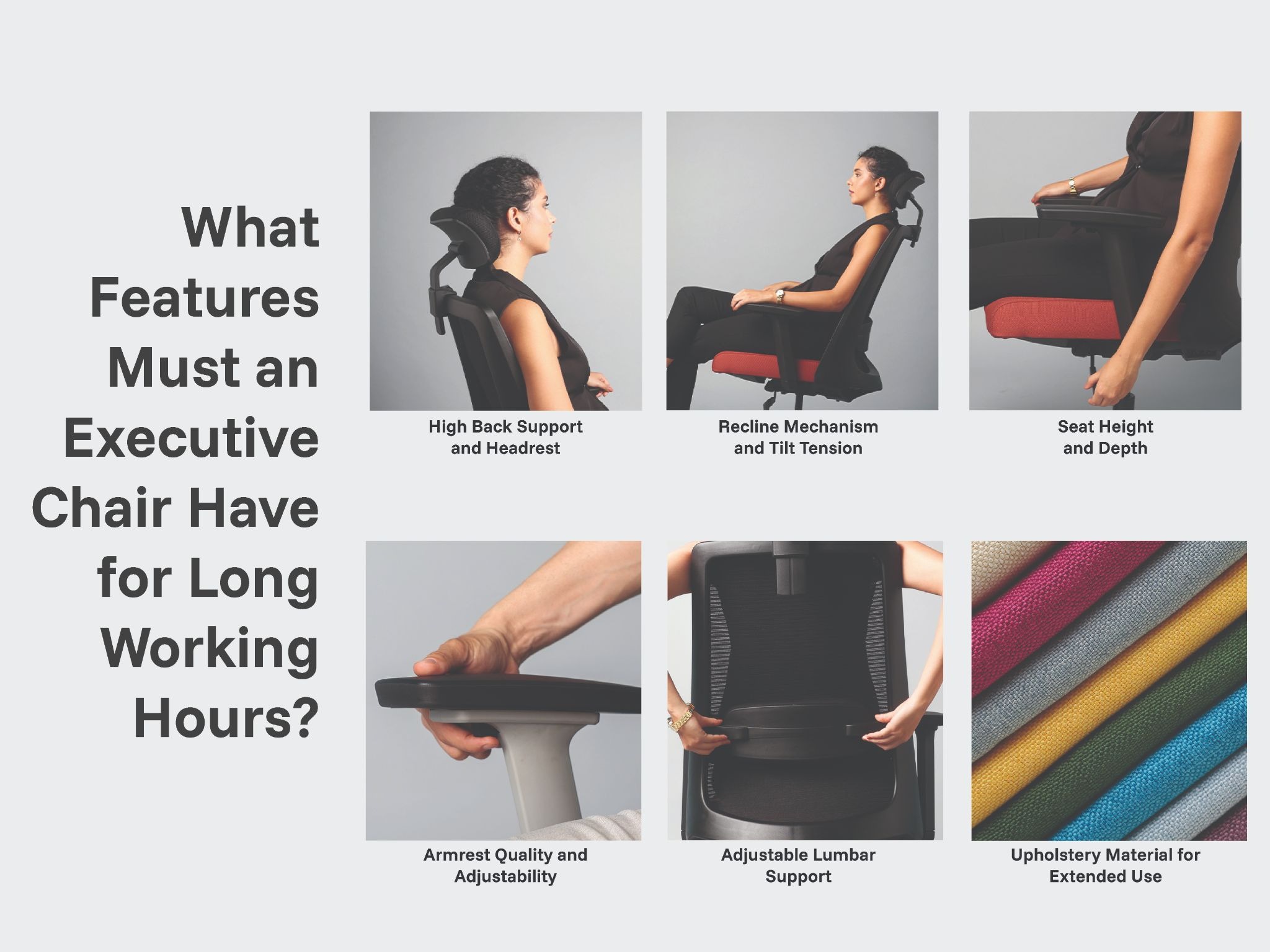
High Back Support and Headrest
A high backrest extending to support the full length of the thoracic spine and the cervical region is the single most important structural feature of an executive chair intended for extended daily professional use.
The neck and upper back support provided by a high backrest significantly reduces the sustained muscular load required to maintain correct head position across long video calls, reading sessions, and focused work periods. Without this support, the neck muscles work continuously against the weight of the head, creating the progressive tension that causes the headaches and cervical stiffness common among senior professionals working long days.
An adjustable headrest that can be positioned at the precise height of the cervical spine for each individual user provides the highest level of upper body support available in executive seating.
Adjustable Lumbar Support
Adjustable lumbar support is not optional in any chair used for long daily professional hours. The lower back must be actively supported to maintain its natural inward curve under the sustained compressive load of extended sitting.
Height adjustment allows the lumbar support to be aligned precisely with each user's specific lumbar anatomy. Depth adjustment allows the firmness of contact to be personalised. Both dimensions of adjustment matter, because a lumbar support that is positioned incorrectly for a specific user provides no benefit and may actively create discomfort by pushing the spine into an unnatural position.
Seat Height and Depth
The correct seat height places both feet completely flat on the floor with the knees at approximately 90 degrees and the thighs roughly horizontal. This alignment maintains circulation in the thighs and keeps the pelvis in the neutral position that allows the lumbar support to function correctly.
Seat depth must leave a two to three finger gap between the front seat edge and the back of the knees. An excessively deep seat compresses the popliteal artery, restricting blood flow and creating the leg heaviness that senior professionals often experience during long afternoon sessions.
Armrest Quality and Adjustability
For a senior professional, armrest quality is a meaningful daily comfort factor. Armrests that position the forearms at keyboard height with the shoulders completely relaxed and dropped eliminate the sustained upper trapezius tension that is among the most common sources of the neck and shoulder stiffness executive professionals experience after long working days.
Height adjustable armrests are the minimum specification. For professionals who spend significant daily time on calls or reading documents where arm positioning varies from the keyboard position, 3D adjustable armrests that also move in forward and backward position and lateral angle provide a meaningfully more comfortable sustained experience.
Recline Mechanism and Tilt Tension
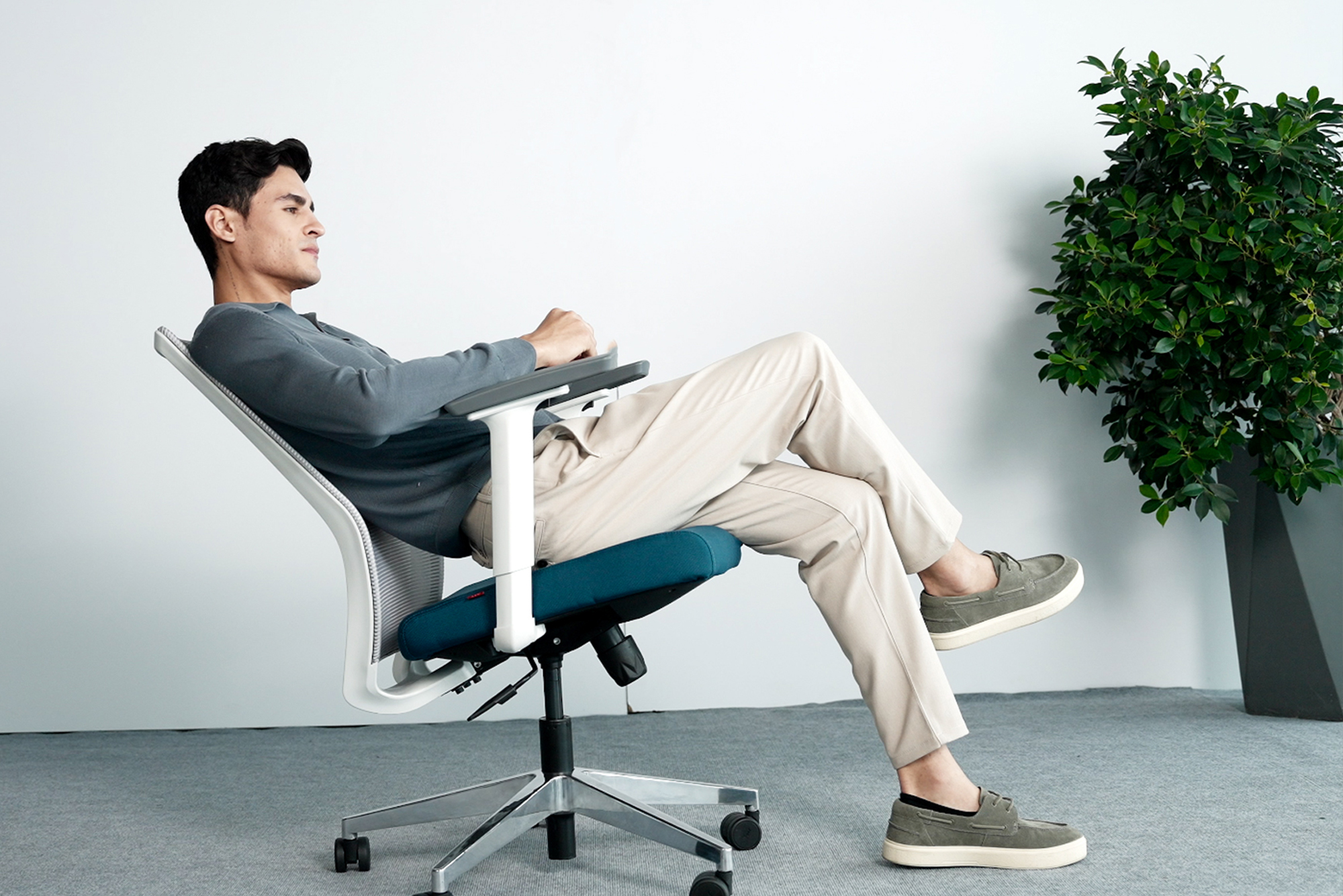
A quality recline mechanism with adjustable tension control is particularly valuable in an executive chair because the working day of a senior professional includes varied activities demanding different postural positions.
Reading a lengthy document benefits from a slight recline of 100 to 110 degrees that reduces disc pressure. Active keyboard work is better served by a more upright position. A tilt mechanism with a smooth tension control and a reliable tilt lock allows the chair to serve each activity optimally without jarring transitions.
The quality of this mechanism distinguishes professional executive seating from furniture that merely looks the part. A recline mechanism that moves roughly, loses its tension setting, or produces noise under use signals a manufacturing quality that will become a daily irritation under sustained commercial professional use.
Upholstery Material for Extended Use
The upholstery choice in an executive chair affects both physical comfort across long sessions and the visual quality that the chair communicates to everyone who enters the cabin.
Genuine leather and high-grade leatherette provide the visual authority appropriate to a senior professional environment. They clean easily, wear with distinction, and communicate professional seriousness in client and visitor meetings. Their limitation in Indian conditions is heat retention in warm environments, which makes reliable climate control in the cabin a genuine prerequisite for comfortable extended use.
High-back mesh executive chairs provide the breathability advantage that makes them more comfortable in warm conditions while maintaining a clean, contemporary professional aesthetic suited to modern executive environments.
Base Stability and Castor Quality
A five-point chrome or polished aluminium base is the appropriate specification for an executive chair. It provides the most stable footprint under the lateral loads created when reaching across the desk or rotating to face a visitor, and communicates the quality level consistent with the broader executive chair specification.
Castor type must match the floor surface in the cabin. For the polished stone, tiled, or hardwood floors common in executive spaces across Indian corporate offices, soft-wheel hard-floor castors roll smoothly without marking or scratching the surface.
Tip: When evaluating any executive chair for professional daily use, sit in it for a minimum of thirty minutes with all adjustments correctly configured for your body before forming any opinion about its suitability. The physical support quality of any chair only reveals itself after the initial impression of softness and premium material quality settles. A chair that feels excellent for five minutes in a showroom but creates discomfort after thirty minutes of sustained use is not suitable for a twelve-hour working day regardless of its visual quality or price.
Leather vs Mesh Executive Chairs: Which Works Better for Long Hours?
When Leather Is the Right Choice
Leather is the appropriate specification when the executive cabin has reliable air conditioning that maintains a consistently comfortable ambient temperature throughout the working day, and when the visual authority and professional impression the chair communicates to visitors is a genuine daily business consideration.
A quality leather executive chair also ages with distinction. Genuine leather develops a patina over years of professional use that adds rather than subtracts from the visual quality of the cabin. For senior professionals who remain in the same role for many years, a well-maintained leather chair is an investment that matures.
When Mesh Is the Better Option
Mesh is the better specification when the climate control in the executive space is variable or unreliable, when the professional works through the warmer periods of the Indian year without consistent air conditioning, or when the professional prioritises physical comfort across a twelve-hour day above the traditional leather executive aesthetic.
Contemporary high-back mesh executive chairs in premium configurations are entirely appropriate for senior professional environments. The perception that executive spaces require leather is a convention, not a functional requirement. Many of India's leading technology executives, founders, and senior directors specifically choose high-back mesh for their executive cabin because the ergonomic performance advantage across a long working day matters more to them than the traditional leather signal.
What Indian Office Conditions Demand
India's climate makes the upholstery decision significantly more consequential than it would be in a cooler temperate market. Delhi NCR summer temperatures, the humidity of monsoon season, and the variable air conditioning quality across Indian commercial real estate all make the breathability of the seating surface a meaningful daily comfort factor.
For executive cabins with consistently reliable air conditioning, leather remains a strong and appropriate specification. For spaces where the temperature varies, or where the professional works in different locations across the day, a premium mesh specification delivers better sustained comfort across the full range of Indian working conditions.
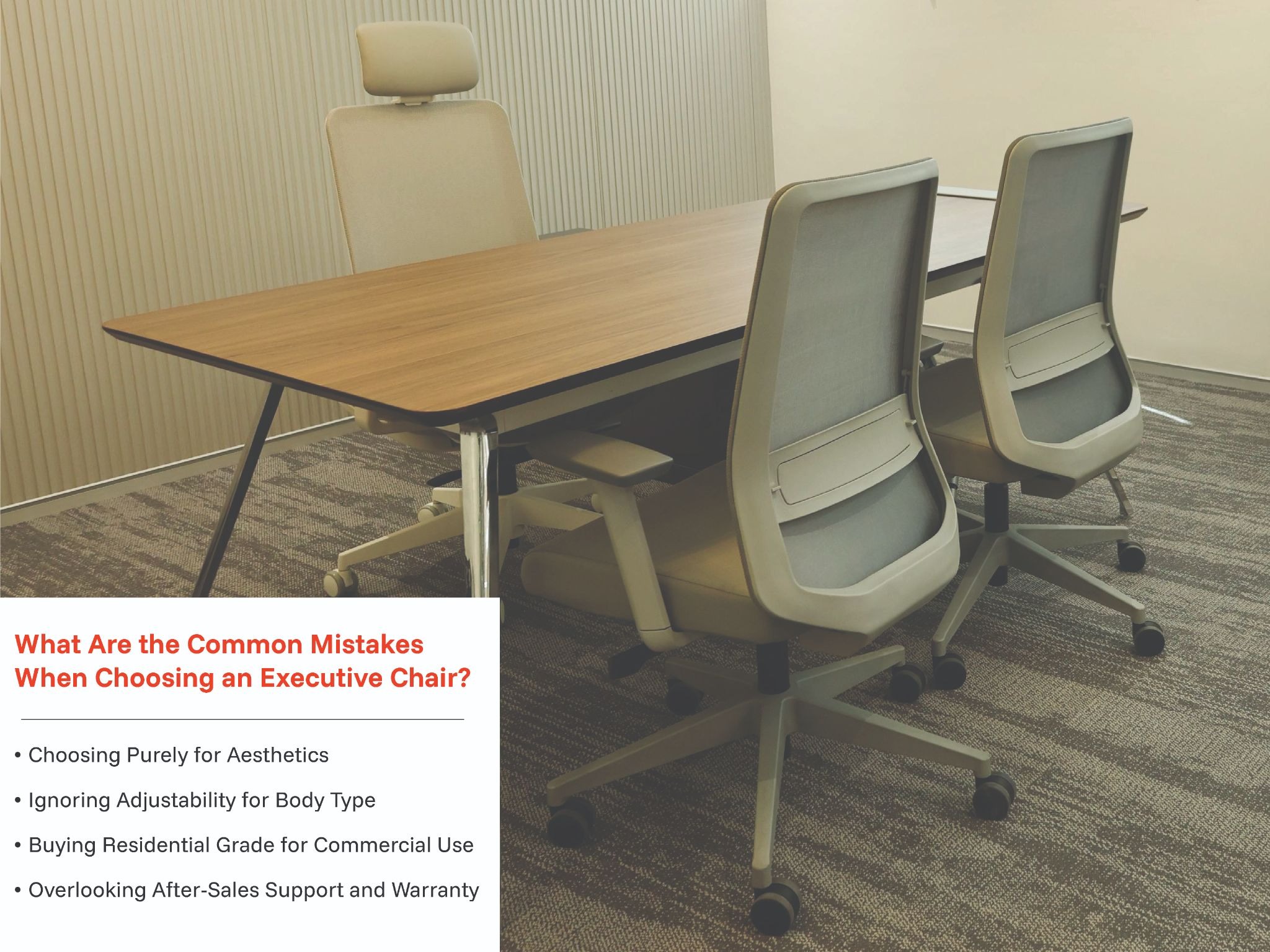
What Are the Common Mistakes When Choosing an Executive Chair?
Choosing Purely for Aesthetics
The most common and most consequential mistake in executive chair selection is choosing on visual impression alone. A chair that looks impressive in a catalogue or showroom but lacks adjustable lumbar support, adequate seat depth, and a quality recline mechanism will fail the physical demands of a long working day within weeks of daily use.
The features that determine genuine suitability for long-hour professional use are invisible in photographs. They require physical evaluation with correct adjustment and an honest assessment of support quality after sustained use.
Ignoring Adjustability for Body Type
Every chair has a specific seat height range, seat depth dimension, armrest adjustment range, and lumbar support position range. All of these must accommodate the actual body dimensions of the specific person who will sit in the chair for most of their working day.
A chair whose seat height range cannot place the user's elbows at keyboard height with their feet flat on the floor will not provide ergonomic benefit regardless of any other quality it may have. Always verify adjustment specifications against actual body measurements before committing.
Buying Residential Grade for Commercial Use
Residential executive chairs are designed for occasional home use at a fraction of the intensity of commercial professional daily use. The foam density, recline mechanism quality, frame gauge, and castor durability are all specified to fundamentally different standards.
A residential chair placed in a professional cabin where someone sits for ten or more hours daily deteriorates visibly within months and creates safety and comfort risks well before the end of its designed residential service life.
Overlooking After-Sales Support and Warranty
A meaningful warranty for a professional executive chair should cover the frame, recline mechanism, and gas lift for a minimum of three years. After-sales service capability matters equally. A supplier who cannot respond to a mechanism failure in an executive cabin within two working days is not providing the service quality that professional environments require.
Bonus Point: For organisations furnishing multiple executive cabins, specify all chairs from the same manufacturer in the same finish family. Visual consistency across executive spaces communicates organisational coherence and quality. Mismatched chairs across a leadership floor, even individually good ones, create a disorganised impression that undermines the professional environment the furnishing investment is intended to create.
How to Set Up an Executive Chair Correctly for Long Hours
Step 1: Set the Correct Seat Height
Adjust the gas lift until both feet rest completely flat on the floor with the knees at approximately 90 degrees and the thighs roughly horizontal. If the desk height makes this impossible without raising the seat too high for the desk, a footrest solves the problem without forcing a compromise in either direction.
Verify the alignment specifically at the desk where the chair will be used daily. The correct seat height at a standard desk may not be correct at a cabin table of different height, and the difference of even 30mm in seat height materially affects the postural quality and physical comfort of a long working session.
Step 2: Adjust Lumbar Support
Move the lumbar support up or down until it makes firm, consistent, comfortable contact with the inward curve of the lower back in the natural seated posture. The support should feel like a continuous, quiet presence rather than a point of pressure.
Recheck the position after fifteen minutes of sitting. The body settles into position as the session continues and the optimal lumbar support height frequently shifts slightly from the initial setting. Spending two minutes on this adjustment at the start of the working day is one of the most effective daily investments in long-session comfort available.
Step 3: Configure Headrest Position
Adjust the headrest height until it supports the back of the head in a neutral position with the gaze directed naturally toward the monitor without any upward or downward tilt of the neck.
The headrest should make light, supportive contact rather than pushing the head forward. If the headrest pushes the head forward from its natural neutral position, it is set too high or the depth is too prominent and needs adjustment.
Step 4: Set Recline Tension
Set the tilt tension so the chair reclines smoothly against a resistance that requires deliberate gentle pressure from the back rather than either reclining freely under body weight or requiring significant muscular effort to move.
A correctly set tension feels balanced and controlled. It allows a natural lean-back during calls or reading and returns upright easily for active keyboard work without jarring transitions.
How AFC Furniture Solutions Designs Executive Chairs for Indian Professionals
What Executive Chair Options Does AFC Offer?
AFC Furniture Solutions offers a complete Leather Chair range designed specifically for senior professional environments in Indian corporate offices, manufactured at the Greater Noida facility to consistent commercial quality standards.
The Grace provides a high-back leather executive chair specification suited to directors and senior management roles, combining full recline functionality with adjustable lumbar support and premium leatherette upholstery appropriate for client-facing cabin environments.
The Pinnacle delivers a premium high-back executive specification with an adjustable headrest, making it particularly suited to professionals working ten or more hours daily who require the additional cervical support that a headrest provides across extended continuous sessions.
The Moonlight provides an executive specification in a contemporary aesthetic suited to modern professional environments where the traditional heavy executive chair look is not the preferred visual. The Rider rounds out the range with a robust executive specification designed for intensive daily professional use across the full range of Indian working conditions.
All models are available in leatherette upholstery specified for Indian conditions, with commercial-grade foam cushioning that maintains its support density under sustained daily professional use without the progressive compression that lower-density alternatives show within months of commercial use.
You can explore the ergonomic and physical differences between a standard chair and a genuine ergonomic specification in our guide on Ergonomic Chair vs Normal Chair to understand the full value of correct seating specification for long working hours.
AFC Furniture Solutions operates a 150,000 square foot manufacturing facility in Greater Noida with a production capacity of 18,000 chairs per month, ensuring consistent quality and reliable supply across executive chair orders of any scale.
Explore the full AFC Furniture Solutions Seating range to compare leather executive chair options, high-back mesh alternatives, and the full range of professional seating specifications suited to every zone of the modern Indian corporate office.
What Quality Standards Back AFC Executive Chairs?
AFC Furniture Solutions holds BIFMA Level 3 certification, the highest internationally recognised standard for office furniture quality, sustainability, and safety. Every chair in the Leather Chair range is manufactured at the Greater Noida facility and tested to BIFMA-compliant structural, mechanism, and durability standards appropriate for sustained commercial professional daily use.
AFC Furniture Solutions also holds ISO 9001, ISO 14001, and ISO 18001 certifications covering quality management, environmental responsibility, and occupational health and safety standards across the full manufacturing operation.
These combined certifications provide procurement managers, HR teams, and facilities professionals with the most comprehensive independent quality assurance available for executive seating in the Indian market.
Frequently Asked Questions
Q1. What is the most important feature in an executive chair for long working hours?
Adjustable lumbar support combined with a high backrest and headrest are the most critical features for long professional daily use. The lumbar support protects the lower spine across extended sitting. The high backrest and headrest eliminate the sustained neck and upper back muscular load that creates the cervical stiffness and headaches common among senior professionals working long hours.
Q2. Is leather or mesh better for an executive chair in an Indian office?
For cabins with consistently reliable air conditioning, leather remains a strong and appropriate specification that communicates professional authority. For spaces with variable temperature control or for professionals who prioritise physical comfort above traditional executive aesthetics, a premium high-back mesh executive chair delivers better sustained comfort across the full range of Indian working conditions.
Q3. How long should a quality executive chair last in professional daily use?
A commercial-grade executive chair from a reputable manufacturer should deliver ten to fifteen years of reliable daily professional use under normal conditions. Genuine leather upholstery and quality foam cushioning are the components that most benefit from ongoing care to achieve this service life. A manufacturer warranty of at least three years covering the frame, mechanism, and gas lift is the minimum quality indicator for any serious professional executive chair purchase.
Q4. Can an executive chair also serve as the chair for a meeting table in the same cabin?
Yes, provided the seat height is compatible with the meeting table height and the chair's dimensions allow comfortable seating for visitors of varied proportions. In most cabin layouts, the executive chair behind the main desk and a different specification of meeting chair at the cabin table serves both functions more effectively than a single chair type for both positions.
Q5. How do I know if my executive chair needs to be replaced?
The most reliable indicators are foam cushioning that has compressed to the point where the seat feels hard rather than supportive, a recline mechanism that no longer holds its tension setting reliably, and lumbar support that has lost its adjustment capability. If the chair is causing discomfort that was not present in the first year of use, the physical specification has likely deteriorated beyond the point of effective rehabilitation.
Q6. Does AFC Furniture Solutions supply executive chairs for multi-city corporate fit-outs?
Yes. AFC Furniture Solutions serves organisations across India through its pan-India network covering Noida, Gurugram, Mumbai, Pune, Bengaluru, Hyderabad, and Chennai. Multi-city executive cabin fit-outs can be coordinated through a single account relationship with consistent product specification, delivery management, and after-sales support across all locations.
Final Thoughts
The right executive chair is not simply a status symbol for the corner office. It is a daily physical tool that either protects the health and sustains the performance of the senior professional using it, or quietly undermines both across the accumulated hours of every working day.
For professionals working ten or more hours daily in demanding leadership roles, the chair specification deserves the same careful, evidence-based decision-making applied to any other significant professional tool. Getting it right means ending long working days with physical capacity and mental clarity rather than accumulated discomfort.
AFC Furniture Solutions has been designing and supplying executive seating for Indian professionals for over 15 years, with a complete leather chair range tested and certified to BIFMA Level 3 standards, manufactured at the Greater Noida facility, and available through experience centres across India.
Explore Other Popular Blogs

Let’s build together
Tell us about your project and we’ll help you plan, design, and deliver at scale.
.jpg)
.svg)