.svg)
Ergonomic Chair vs Normal Chair: Which One Is Worth the Investment?

Wondering whether an ergonomic chair is worth the investment over a normal chair? This practical guide compares both on comfort, health impact, and long-term value.
Why Does Your Office Chair Choice Matter More Than You Think?
How Much Time Do You Actually Spend in Your Office Chair?
Most Indian desk professionals spend between six and nine hours seated every working day. Over a full year, that adds up to well over 1,500 hours spent in the same chair.
No other piece of equipment in your office is in contact with your body for that long. Not your laptop, not your phone, not your headset.
The chair you choose is not a passive piece of furniture. It actively shapes your posture, your physical health, and your ability to concentrate every single working hour.
What Are the Real Costs of Sitting in the Wrong Chair?
A chair that does not support the body correctly does not just cause discomfort. It causes chronic lower back pain, neck stiffness, poor circulation, and the kind of persistent physical fatigue that slowly reduces daily output.
These effects do not appear overnight. They accumulate quietly over months and years until they become difficult to reverse without medical intervention.
The financial cost of poor office seating and ergonomics includes sick leave, reduced productivity, and the eventual replacement cost of furniture that fails prematurely.
What Is a Normal Office Chair?
A normal office chair is a basic desk chair designed for general use. It typically offers a fixed or minimally adjustable seat, a single backrest position, and no dedicated lumbar support.
It is built primarily for affordability and appearance rather than sustained health support. For short periods of use, it performs adequately. For a full professional working day, it consistently falls short.
Normal chairs are widely sold across India because they appear functional in a showroom context. The limitations only become apparent after several hours of continuous daily use.
What Are the Key Features of a Normal Chair?
A typical normal office chair offers basic seat height adjustment via a gas lift, a padded seat and backrest, and fixed or non-adjustable armrests.
The backrest is usually flat or very slightly curved, offering minimal support for the lumbar spine. There is no mechanism for personalising the fit to the individual user's body proportions.
The foam density in budget normal chairs is usually insufficient for sustained commercial use, compressing within months and leaving the user effectively sitting on a hard surface with thin padding.
Where Does a Normal Chair Fall Short?
The most significant failing of a normal office chair is the absence of adjustable lumbar support. Without it, the lower back gradually rounds outward during extended sitting, placing progressive stress on the intervertebral discs.
Fixed armrests at the wrong height force the shoulders into a raised or dropped position, creating sustained tension in the upper trapezius that accumulates into neck and shoulder pain by end of day.
For anyone sitting more than four hours daily, a normal chair is not simply inadequate. It is actively contributing to physical problems that compound over time.
What Is an Ergonomic Office Chair?
An ergonomic office chair is a professionally engineered seating solution designed to support the human body's natural posture and movement during extended periods of desk work.
The word ergonomics comes from the Greek words for work and natural laws. Applied to office seating, it means the chair fits the person rather than the person adapting to the chair.
The defining characteristic of an ergonomic chair is its multi-point adjustability, which allows it to be configured for each individual user's body proportions and working posture.
What Makes a Chair Truly Ergonomic?
A chair can only genuinely claim to be ergonomic if it allows independent adjustment of at minimum three key dimensions: seat height, lumbar support, and backrest recline.
Without all three, the chair cannot be correctly configured for the full range of users who might sit in it. A chair that adjusts only in height provides no more ergonomic benefit than a basic normal chair for a user of non-standard proportions.
Truly ergonomic seating also uses materials that support the body without creating pressure points, maintain their structural properties under sustained commercial use, and allow appropriate air circulation across long working sessions.
How Is an Ergonomic Chair Designed Differently?
Every dimension of an ergonomic office chair is determined by biomechanical research rather than aesthetic preference. The seat depth is calculated to prevent pressure on the back of the knees. The backrest curve follows the natural S-shape of the spine.
The lumbar zone is positioned to support the inward curve of the lower back specifically, rather than providing a flat surface that the back must adapt to.
Armrest geometry is designed to support the forearms at a height that allows the shoulders to remain completely relaxed, eliminating the sustained muscular tension that is a primary cause of upper body pain in desk workers.
Ergonomic Chair vs Normal Chair: Direct Comparison
Posture and Spinal Support
A normal office chair provides a flat or minimally curved backrest with no dedicated lumbar support. The lower back loses its natural inward curve within minutes of sustained sitting, leading to progressive spinal strain.
An ergonomic chair maintains the spine's natural S-curve through properly positioned lumbar support and a backrest contoured to follow the thoracic spine. This reduces the muscular effort required to maintain correct posture throughout the day.
Over months and years of daily use, this difference in spinal support is the primary determinant of whether an employee develops chronic postural problems or remains physically healthy in their role.
Comfort Over Long Hours
A normal chair feels acceptable for the first thirty to sixty minutes. After that, the foam compression, inadequate support, and fixed positioning create increasing discomfort that compounds across the working day.
An ergonomic chair is specifically designed for sustained commercial use. High-density foam maintains its support properties across years of daily use. The mesh backrest or contoured cushioning distributes pressure evenly rather than concentrating it at specific contact points.
The practical result is that employees in ergonomic seating consistently report significantly lower physical discomfort levels at the end of a working day compared to those using standard chairs.
Adjustability and Personalisation
A normal chair typically offers only basic seat height adjustment. Every other dimension is fixed, which means it correctly fits only a narrow range of body types by accident rather than design.
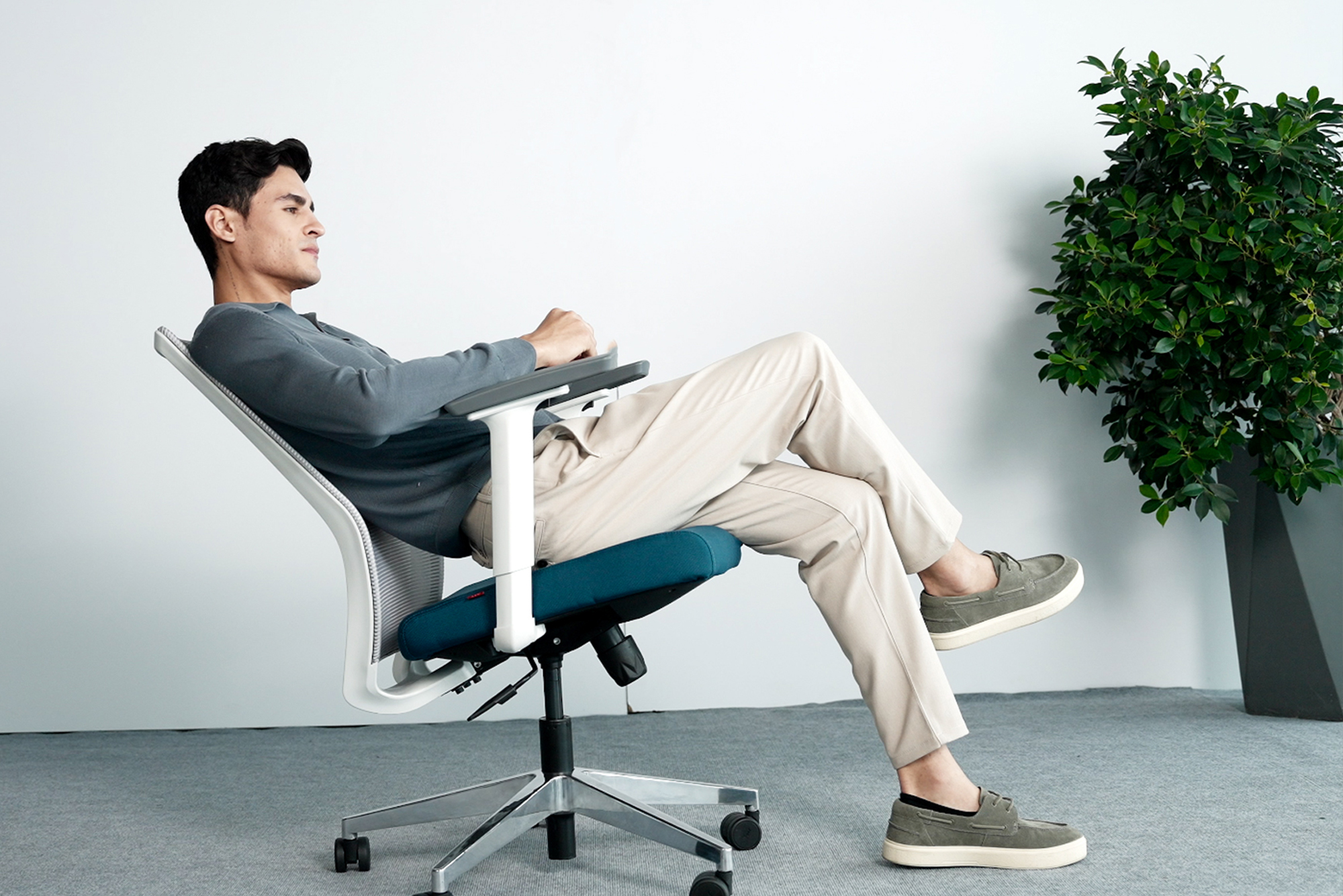
An ergonomic chair provides independent adjustment of seat height, seat depth, lumbar support height and depth, armrest height and angle, and recline tension. This allows the chair to be precisely configured for each individual user.
In a shared office where multiple people of different heights and body types use the same chair, this adjustability is not a luxury. It is the only way the chair can actually support everyone who sits in it.
Health and Wellbeing Impact
Research referenced by the National Institutes of Health found that employees using ergonomic seating reported up to 17.7% higher productivity and 24% less job-related stress compared to those using standard chairs.
Poor office seating and ergonomics is one of the most consistent contributors to occupational musculoskeletal disorders in Indian corporate environments. The effects are largely preventable with the right chair specification.
Better blood circulation, reduced spinal disc pressure, and lower muscular fatigue are the three most direct health benefits of switching from a normal chair to a well-specified ergonomic chair.
Cost and Long-Term Value
A normal chair carries a lower upfront cost but typically requires replacement within twelve to eighteen months of commercial daily use. Over five years, the total replacement and procurement cost almost always exceeds the price of a quality ergonomic chair purchased once.

Beyond direct cost, the indirect cost of poor office seating and ergonomics includes sick leave, reduced afternoon productivity, and the long-term health costs that accumulate from years of inadequate support.
A quality ergonomic office chair from a reputable manufacturer delivers seven to ten years of reliable daily performance. The per-day cost over that service life is consistently lower than any budget alternative replaced multiple times across the same period.
Tip: When evaluating the cost of an ergonomic chair, calculate the daily cost over its expected service life rather than comparing the upfront price to a budget alternative. A chair costing three times more but lasting five times longer is significantly more economical, and that calculation does not yet include the health and productivity benefits.
Who Needs an Ergonomic Chair the Most?
Professionals Who Sit 6 or More Hours a Day
Software developers, analysts, writers, finance professionals, and administrative staff are the clearest beneficiaries of proper ergonomic seating. For these roles, the chair is the single most consequential equipment decision in the workspace.
The cumulative physical load of sustained daily sitting in an unsupportive chair is what drives the chronic conditions that affect long-term working capacity and career sustainability for desk-based professionals.
People with Existing Back or Neck Conditions
For anyone already managing lower back pain, cervical discomfort, or sciatic issues, the right ergonomic chair combined with correct setup can meaningfully reduce symptom severity during the working day.
The chair does not replace professional medical care but it removes the daily aggravation of inappropriate seating that makes existing conditions significantly worse.
Always consult a physiotherapist or occupational health specialist for personalised guidance alongside any furniture change for an individual with a pre-existing condition.
Remote and Home Office Workers
Home office setups frequently involve dining chairs, folding chairs, or basic task chairs that were never designed for sustained professional use. These are among the most common sources of occupational back pain in India today.
An ergonomic chair is consistently the single highest-impact upgrade available to a home-based worker. The daily improvement in comfort and focus is immediate and sustained for years.
For organisations supporting hybrid or remote teams, providing guidance on ergonomic seating for home offices is one of the most practical wellbeing investments available.
Corporate Teams and Shared Workspaces
In hot-desking and shared office environments, chairs are used by multiple people of different heights and body proportions throughout the day. Fixed chairs that fit only one body type correctly serve most of their users poorly.
Ergonomic chairs with wide adjustment ranges serve every user who sits in them rather than fitting some well and others poorly. In high-occupancy environments, this inclusive adjustability directly protects the health of the entire team.
What Are the Key Features to Look for in an Ergonomic Chair?
Lumbar Support
Adjustable lumbar support is the single most important feature in any chair designed for extended daily use. It should be adjustable in both height and depth so it aligns with each individual user's specific lower back anatomy.
A fixed lumbar insert that cannot be repositioned will not align correctly with most users and provides far less benefit than its presence on the specification sheet suggests.
Seat Height and Depth
The correct seat height allows both feet to rest flat on the floor with the knees at approximately a 90-degree angle. A chair that cannot be adjusted to achieve this forces compensatory postures throughout the day.
Seat depth should be adjustable to leave two to three finger-widths of clearance between the front seat edge and the back of the knees. This prevents the seat edge from restricting circulation in the thighs.
Adjustable Armrests
Armrests set at the wrong height cause more problems than they solve. Too high and the shoulders are forced upward; too low and the user leans sideways, disrupting the entire upper body alignment.
Look for 3D adjustable armrests that move in height, forward and backward position, and lateral angle. This level of adjustability allows the forearms to rest naturally at keyboard height with the shoulders completely relaxed.
Backrest Recline and Tilt
Sitting rigidly upright at 90 degrees for hours is harder on the spinal discs than a slight backward recline of 100 to 110 degrees. A tilt tension control that matches the recline resistance to the user's body weight makes this natural variation effortless.
A recline lock that holds the preferred angle for different task types rounds out the recline specification for a chair intended for varied professional daily use.
Breathable Material
Mesh upholstery is the most practical choice for most Indian office environments. Its open-weave structure allows continuous air circulation, preventing the heat buildup that makes solid-back chairs uncomfortable across long working sessions.
For executive settings where a premium aesthetic is important, leather or leatherette upholstery paired with a cushioned mesh seat provides both the professional appearance and the comfort needed for extended use.
Bonus Point: When testing any ergonomic chair in a showroom, spend at least fifteen minutes sitting in it before forming any opinion. Most design problems with chairs only become apparent after the initial comfort impression fades and the sustained support quality becomes the determining factor. A chair that feels good for two minutes but uncomfortable after ten is not an ergonomic chair regardless of what the label says.

Common Myths About Ergonomic Chairs Debunked
Myth 1: Ergonomic Chairs Are Only for People with Back Problems
This is the most damaging misconception in office seating and ergonomics. The majority of chronic back pain from poor seating develops in people who had no pre-existing condition before they started sitting in unsupportive chairs.
An ergonomic chair is most valuable as a preventative measure. Waiting for pain to develop before addressing the seating is a significantly more expensive and personally costly approach in every dimension.
Myth 2: All Chairs Labelled Ergonomic Are the Same
The word ergonomic has no regulated definition in most markets. It can legally appear on any chair regardless of its actual design quality or tested performance.
The only reliable way to evaluate an ergonomic chair is to assess its specific features: adjustable lumbar support, seat depth, armrest range, and build quality. The label tells you nothing on its own.
Myth 3: Ergonomic Chairs Are Too Expensive for Small Businesses
Well-designed ergonomic chairs are available across a wide range of price points in India. The comparison that matters is not upfront cost against a budget chair but total cost of ownership over five years including replacement cycles.
For small businesses where every team member's daily output matters, the productivity and health benefits of proper office seating and ergonomics deliver a return on investment that justifies the specification at virtually any scale of organisation.
How AFC Furniture Solutions Approaches Office Seating and Ergonomics?
What Ergonomic Chair Options Does AFC Offer?
AFC Furniture Solutions offers a comprehensive office seating range covering every professional context across the modern Indian workplace.
The Mesh Chair range is designed for open-plan floors and roles involving extended daily sitting, featuring adjustable lumbar support, 3D adjustable armrests, breathable mesh backrests, and a weight-balance tilt mechanism for natural postural variation. The AFC Myel chair within this range is specifically recommended for eight-hour working sessions.
The Leather Chair range is designed for executive cabins and senior professional spaces, combining a premium aesthetic with reclining functionality and cushioned comfort suited to long meeting and decision-making sessions.
Explore the full AFC Furniture Solutions Seating range covering mesh, leather, training, and cafe chair options suited to every zone of the modern corporate office.
What Certifications Back AFC Seating Quality?
AFC Furniture Solutions holds BIFMA Level 3 certification, the highest internationally recognised standard for office furniture quality, safety, and sustainability performance.
Every chair in the range undergoes BIFMA-compliant structural and ergonomic testing across its full adjustment range. This independent certification provides procurement managers and HR teams with verified assurance that the products meet consistent international quality benchmarks.
You can also explore the AFC Furniture Solutions Mesh Chair range specifically for ergonomic mesh seating options designed for Indian working conditions and extended daily professional use.
Tip: Before placing a bulk seating order for your office, request sample units of two or three shortlisted chairs and have a cross-section of your team, including different heights and body types, use each chair for a full working day. The feedback from real daily use in your specific environment is far more reliable than any showroom test or specification comparison.
Frequently Asked Questions
Q1. Is an ergonomic chair really worth the extra cost over a normal chair?
For anyone sitting more than four hours a day, yes without question. The health protection, sustained comfort, and productivity benefits compound daily across years of use. The total cost of ownership of a quality ergonomic chair is consistently lower than repeated replacement of budget alternatives over the same period.
Q2. How do I know if my current chair is causing my back pain?
If back pain is most pronounced during or after extended sitting and eases with movement or lying down, the chair is very likely a contributing factor. Switching to a correctly configured ergonomic chair will usually clarify this within the first few days of use.
Q3. What is the most important feature to look for in an ergonomic chair?
Adjustable lumbar support is the single most important feature. Without it, the lower back gradually flattens under sustained sitting and the resulting chronic lower back pain becomes one of the most common and debilitating occupational health problems for desk workers.
Q4. Can students benefit from ergonomic chairs during study sessions?
Yes. The postural demands of sustained study are effectively identical to those of desk-based professional work. The key consideration is ensuring the seat height can be set low enough for the student's feet to rest flat on the floor.
Q5. What is the difference between a mesh ergonomic chair and a leather ergonomic chair?
A mesh ergonomic chair offers superior breathability, which is particularly important in India's warm climate and for users who find heat buildup uncomfortable during long sessions. A leather ergonomic chair offers a premium executive aesthetic and easier surface cleaning, making it more appropriate for client-facing and senior professional spaces.
Q6. How long should a quality ergonomic chair last?
A commercial-grade ergonomic chair from a reputable manufacturer should deliver seven to twelve years of reliable daily use under normal professional conditions. A warranty of at least three to five years is a minimum quality indicator worth insisting on before any purchase.
Final Thoughts
The choice between an ergonomic chair and a normal chair is ultimately a choice between investing in your team's health and daily performance or accepting the hidden costs of inadequate office seating and ergonomics across years of daily use.
The normal chair is not simply a more economical version of the same thing. It is a different product that serves a different purpose, and for anyone sitting six or more hours daily, it is not fit for that purpose.
AFC Furniture Solutions has been designing and supplying ergonomic office seating for Indian professionals and organisations for over 15 years. Our team is available to help you identify the right seating specification for your working environment, team size, and budget.
Explore Other Popular Blogs

Let’s build together
Tell us about your project and we’ll help you plan, design, and deliver at scale.
.jpg)
.svg)