.svg)
How Fast-Growing Industries Are Investing in Better Office Chairs for Their Teams

Discover how fast-growing industries across India are investing in better office chairs to improve employee wellbeing, productivity, and retention. Expert guidance from AFC Furniture Solutions.
Why Is Office Seating Becoming a Strategic Business Investment?
For most of the last century, the chair was the last thing a business thought about when setting up an office. It was functional, it was cheap, and it was replaced only when it visibly broke.
That approach is changing rapidly across India's fastest-growing industries. Progressive organisations are recognising that the chair is the piece of equipment their employees interact with more than any other, for longer than any other, and with more direct consequences for their health and daily output.
What was once a procurement afterthought is now a strategic decision that reflects how an organisation views its people and how seriously it takes the conditions in which they do their best work.
What Has Changed in How Indian Companies Think About Seating?
Three converging trends have shifted how Indian businesses approach workplace seating solutions. The first is increased employee awareness of occupational health and a growing willingness to factor the quality of the physical working environment into career decisions.
The second is the rise of data on productivity and well-being that makes it possible to quantify the cost of poor seating in terms that finance and operations teams can act on. The third is intensifying competition for skilled talent in high-growth industries where the quality of the workplace is a visible differentiator.
Together, these trends have elevated the office chair from a commodity procurement decision to an investment in organisational performance.
How Does Seating Quality Directly Affect Business Performance?
The connection between physical comfort and cognitive performance is well established. When an employee is managing back pain, neck tension, or leg discomfort, a portion of their mental bandwidth is continuously consumed by that physical experience rather than by the work in front of them.
Research referenced by the National Institutes of Health found that employees using ergonomic seating reported up to 17.7% higher productivity compared to those using standard chairs. Across a team of fifty people, this difference represents a substantial annual productivity gain that no single software tool or process improvement can easily replicate.
The quality of ergonomic seating for corporate teams is not a soft benefit. It is a measurable contributor to the business outcomes that fast-growing organisations are competing to achieve.
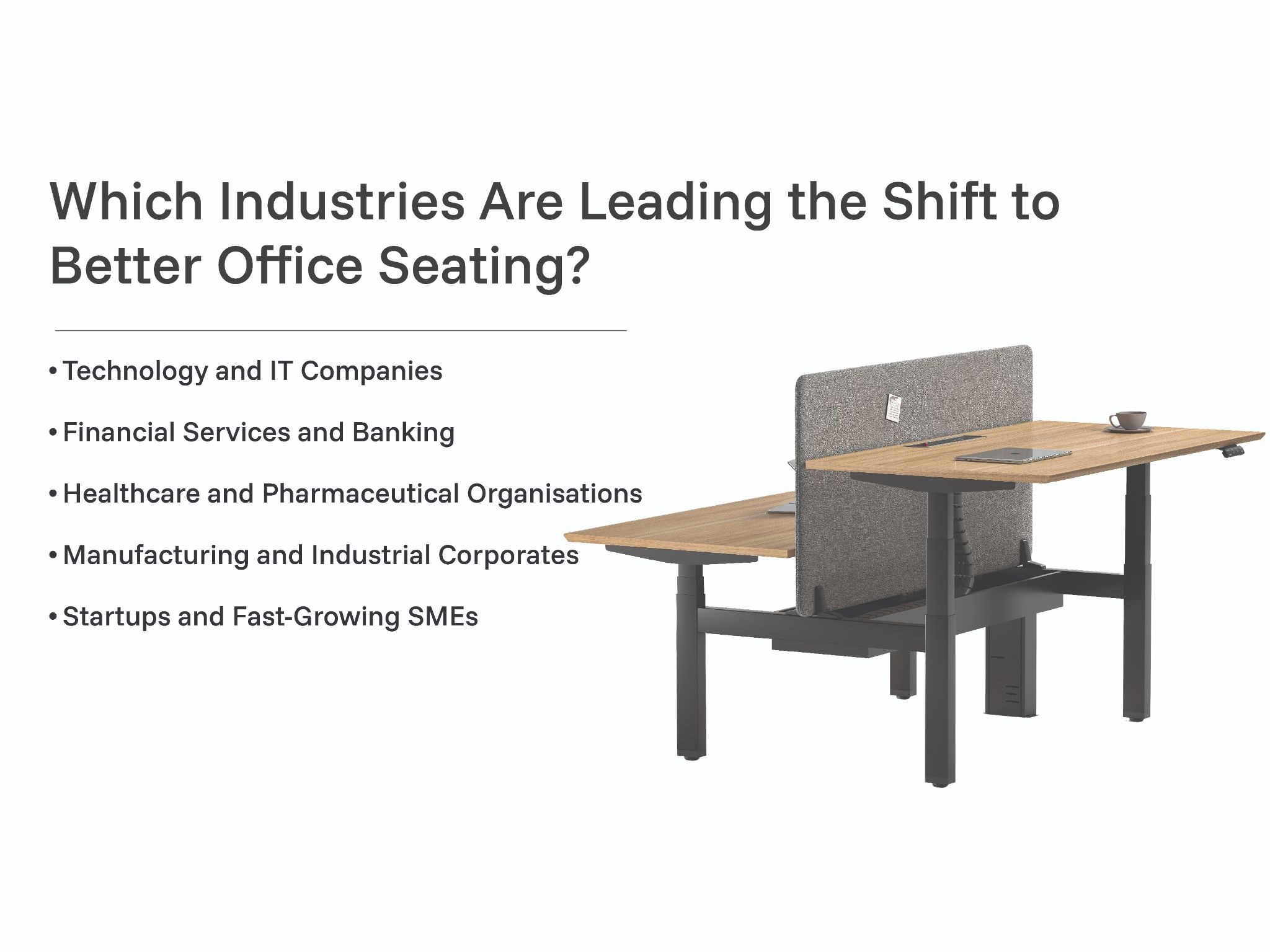
Which Industries Are Leading the Shift to Better Office Seating?
Technology and IT Companies
India's technology sector has been at the forefront of workplace seating investment for longer than most other industries. Technology professionals typically spend eight to twelve hours daily at a desk, and in a sector where the entire value of the business depends on the cognitive output of its people, the investment case for quality commercial office chairs India is straightforward.
Leading IT organisations have moved beyond basic ergonomic chairs to height-adjustable workstations paired with multi-point adjustable seating, creating environments where physical comfort is actively engineered into the working day rather than left to chance.
The talent competition in this sector also plays a role. Technology professionals evaluate the physical quality of a workplace before accepting a role and during their tenure. A floor of high-quality ergonomic seating communicates the organisation's values more immediately than any employer brand campaign.
Financial Services and Banking
Financial services professionals work in high-pressure, long-hour environments where sustained focus is the core professional requirement. A trading desk or an investment banking floor demands that every person on it maintains peak cognitive performance across an extended working day.
These organisations have invested heavily in employee wellness seating because the cost of mental fatigue in their environment, measured in errors, missed opportunities, and judgment failures, is directly quantifiable in financial terms.
The aesthetic standard of seating also matters in financial services because client-facing spaces must communicate the institutional quality and stability that clients expect from organisations managing their assets.
Healthcare and Pharmaceutical Organisations
Healthcare administrators, pharmaceutical researchers, and medical back-office professionals represent a large and growing segment of India's office-based workforce. Their working environments combine the long hours of a demanding industry with the physical sedentary nature of desk-based professional work.
Healthcare organisations have a natural and well-established institutional awareness of the connection between physical conditions and health outcomes. This awareness extends to their own workplace decisions, making them early adopters of ergonomic seating standards that many other industries are only now beginning to apply.
Manufacturing and Industrial Corporates
India's manufacturing sector has significant corporate administration workforces whose office environment has historically received less investment than the production floor it supports. This is changing as manufacturing organisations invest in the quality of their corporate functions to attract and retain the management talent they need to compete globally.
The shift is particularly visible in the head offices and regional offices of large manufacturing groups, where the working environment is being upgraded to match the international standards of the organisations they partner with and supply to.
Startups and Fast-Growing SMEs
Startups and growing SMEs are making the seating investment decision earlier in their lifecycle than previous generations of Indian businesses. Founders who have experienced high-quality working environments in larger organisations understand the productivity and culture benefits directly and build them into their own offices from an early stage.
For startups competing for talent with larger, better-resourced organisations, a visibly well-specified working environment is one of the most accessible differentiators available without requiring the budget of an established corporate.
What Are These Industries Looking for in Office Seating?
Ergonomic Support for Long Working Hours
Every industry represented in the shift toward better seating shares one common requirement: seating that genuinely supports the body across a full professional working day without creating the physical discomfort that reduces output and increases health costs.
Adjustable lumbar support, seat height and depth configurability, and three-dimensional armrest adjustment are the minimum ergonomic specifications that procurement managers in progressive Indian organisations now treat as non-negotiable rather than premium additions.
Durability for High-Occupancy Environments
Fast-growing organisations operate in high-density, high-intensity environments where chairs are used continuously by the same person for long hours or by multiple people in shift arrangements. Commercial-grade construction that maintains its performance across years of intensive daily use is the durability standard these organisations require.
Budget seating that performs adequately in light-use contexts fails visibly and mechanically in high-occupancy environments within months. The replacement cycle cost and operational disruption this creates consistently exceeds the upfront cost difference of specifying correctly from the beginning.
Scalability for Growing Teams
A fast-growing organisation cannot afford to rethink its seating strategy every time it adds twenty employees. The seating specification must accommodate growth through incremental addition of matching products rather than periodic complete replacement.
This requirement pushes organisations toward manufacturers with established product ranges, confirmed ongoing availability, and the production capacity to fulfil extension orders at any point in the organisation's growth journey.
Aesthetic Quality for Client-Facing Spaces
Industries that regularly host clients, investors, or institutional partners in their offices understand that the quality of the physical environment is an active part of the relationship they are building. Seating that looks worn, mismatched, or budget in a client-facing space undermines the institutional impression these meetings are intended to create.
Tip: When planning a seating specification for a fast-growing organisation, apply a tiered quality approach. Specify your highest quality seating in client-facing reception areas and meeting rooms where the aesthetic impression matters most. Apply commercial-grade ergonomic seating throughout the working floor where health and productivity benefits are the priority.
How Does Better Office Seating Impact Employee Wellbeing?
How Does It Reduce Physical Discomfort and Sick Leave?
Musculoskeletal disorders, particularly lower back pain and neck strain, are among the most common causes of sick leave in Indian desk-based workforces. The majority of these conditions are either caused or significantly worsened by inadequate workplace seating.
Commercial ergonomic seating reduces the daily physical load on the spine, improves seated circulation, and eliminates the compensatory postures that are the primary mechanism through which poor seating creates chronic physical problems.
Organisations that have systematically upgraded their seating specification consistently report reductions in musculoskeletal-related sick leave within twelve months of the transition.
How Does It Improve Focus and Daily Productivity?
Physical discomfort is a continuous cognitive distraction. Every employee managing pain or discomfort in their chair is directing mental bandwidth to that experience rather than to their work.
Quality ergonomic seating for corporate teams removes this distraction entirely. When the body is well supported, the mind operates without the background noise of physical discomfort, which allows sustained focus that delivers measurable productivity gains across the working day.
The afternoon hours are where this benefit is most clearly visible. Employees in well-specified ergonomic seating maintain their concentration and output into the late afternoon far more consistently than those using inadequate seating.
How Does It Contribute to Employee Retention?
In competitive talent markets, the physical quality of the working environment is one of the factors employees consciously and unconsciously weigh when deciding whether to stay with or leave an organisation.
Providing quality seating communicates a specific message: that the organisation sees its people as worth investing in beyond their salary and role. This perception of being valued is one of the most consistent predictors of employee loyalty in research on retention factors across Indian industries.
The cost of replacing a skilled employee who leaves because of a poor working environment consistently exceeds the cost of the seating investment that would have improved that environment.
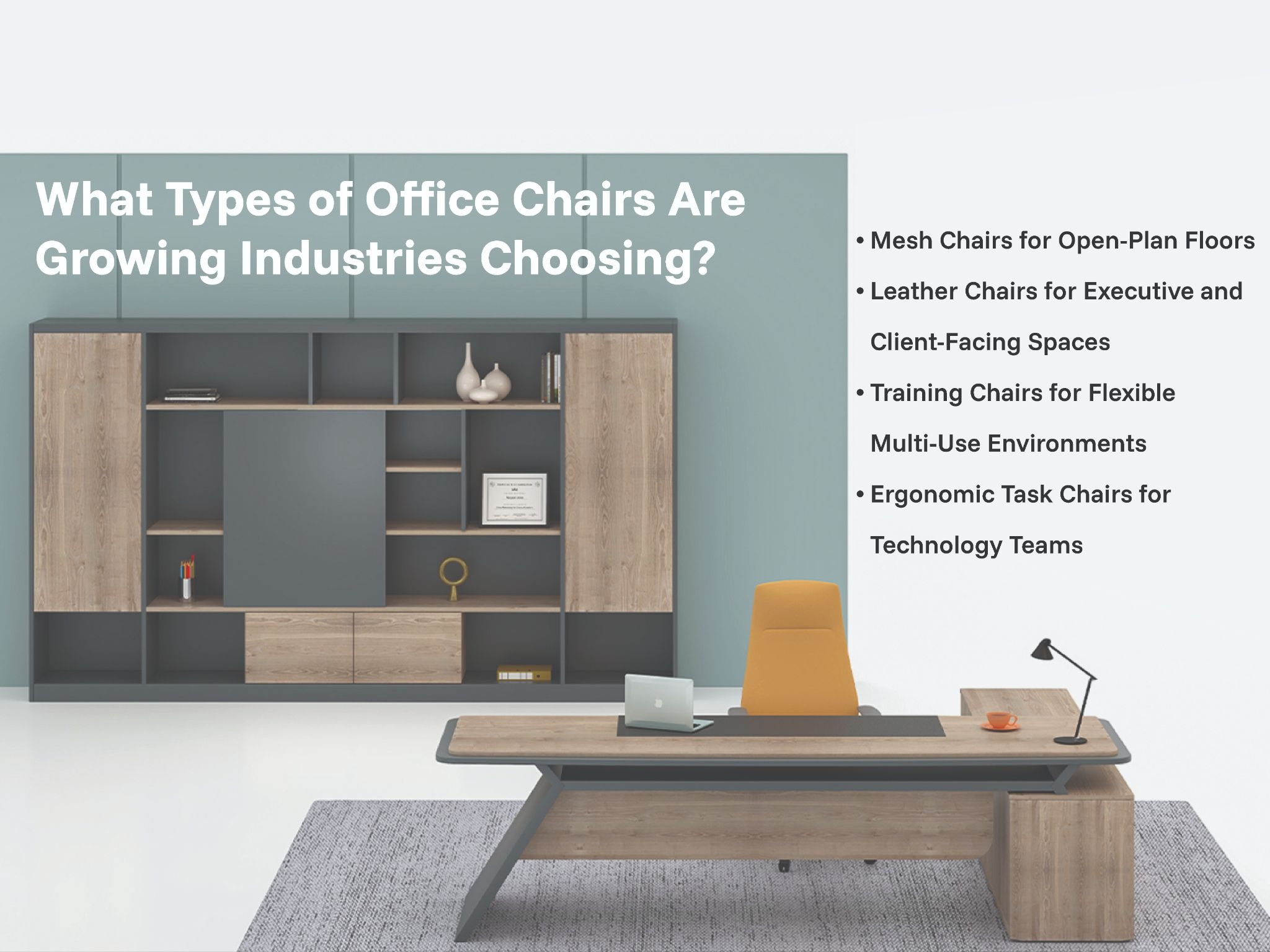
What Types of Office Chairs Are Growing Industries Choosing?
Mesh Chairs for Open-Plan Floors
Breathable mesh seating has become the dominant specification for open-plan corporate floors across India's fast-growing industries. The breathability advantage of mesh upholstery is particularly relevant in India's climate, maintaining comfort across long working sessions in ways that solid-back alternatives cannot.
Modern commercial mesh chairs provide full ergonomic adjustability including adjustable lumbar support, seat height and depth, and three-dimensional armrests, making them fully capable of serving the health requirements of professionals who sit for extended periods.
Leather Chairs for Executive and Client-Facing Spaces
Premium leather seating remains the preferred specification for executive cabins, boardrooms, and client reception areas across India's financial, professional services, and manufacturing sectors.
The aesthetic authority of leather seating in these environments communicates institutional quality in a way that is immediately understood by clients and visitors. Quality commercial leather chairs also provide the full ergonomic capability required for senior professionals who work long hours at their desks.
Training Chairs for Flexible Multi-Use Environments
Training chairs that stack and fold cleanly are essential for organisations operating multi-use spaces including training rooms, conference rooms, and event spaces. Fast-growing organisations that regularly reconfigure spaces for different purposes need seating that provides adequate comfort for sessions of one to three hours while being practical to store and redeploy.
The specification for training chairs should include adequate seat cushioning for multi-hour sessions, a stable base that remains safe under the dynamic loading of active training environments, and a stacking or folding mechanism that operates reliably without noise.
Ergonomic Task Chairs for Technology Teams
Technology teams working on extended development, analysis, or creative projects need the highest level of adjustability in their seating to support the concentrated, sustained working postures that their roles demand.
Full multi-point adjustability, including seat depth adjustment and tilt tension control in addition to the standard lumbar and armrest adjustments, is the appropriate specification for roles where sustained deep-focus work is the primary daily activity.
How to Build a Seating Strategy for a Fast-Growing Team?
Step 1: Audit Your Current Seating Quality
Before specifying new seating, understand exactly what you currently have and what the problems are. Survey employees specifically about physical discomfort related to seating. Note the age and specification of existing chairs and identify which are failing mechanically or ergonomically.
This audit provides the evidence base for the investment case and ensures the new specification addresses the actual problems rather than assumed ones.
Step 2: Match Seating Specification to Role and Duration
Not every employee in your organisation has the same seating requirement. A software developer sitting for ten hours needs a different specification than a sales professional who spends much of the day in meetings.
Map the seating requirement to the working pattern of each role group and specify accordingly. This targeted approach delivers better outcomes for every employee than a uniform specification applied across the entire organisation regardless of individual working patterns.
Step 3: Plan for Scale from the Start
Confirm that the specific seating products you are choosing will remain available for extension orders as your team grows. Ask the manufacturer explicitly about product range continuity and get the commitment in writing.
A seating specification that cannot be extended with matching products forces a complete replacement every time a growth milestone requires additional chairs. This avoidable cost should be eliminated at the specification stage rather than discovered during the next hiring phase.
Step 4: Choose a Manufacturer With Proven Large-Order Capability
The quality of the manufacturer matters as much as the quality of the product for fast-growing organisations that need consistent supply across rapid headcount growth. An in-house manufacturing capability, verified certification, and a demonstrated track record with large institutional orders are the minimum criteria.
Bonus Point: When building a seating strategy for a fast-growing team, include a review trigger in your planning calendar for every fifty-person headcount milestone. At each trigger, assess whether the seating specification still matches the organisation's working patterns, space configuration, and health priorities. This structured review prevents the gradual accumulation of seating that no longer serves the team it was originally specified for.
What Does the Investment in Better Seating Actually Cost vs Return?
What Is the True Cost of Poor Office Seating?
The upfront cost of budget seating is visible and easily quantifiable. The true cost of poor office seating is distributed across multiple business dimensions and is rarely calculated in full.
Physical discomfort reduces daily output by a measurable percentage across every employee affected. Sick leave attributable to musculoskeletal conditions directly removes productive capacity from the organisation. Recruitment and onboarding costs for employees who leave partly because of a poor physical working environment are substantial.
Replacement costs for budget seating that fails within eighteen months of purchase, combined with the operational disruption of managing that replacement, add further to the total. When all of these costs are aggregated, poor seating is almost always more expensive than quality seating across a five-year horizon.
How Do You Calculate the Return on a Seating Investment?
The most direct return on ergonomic seating investment is in productivity. A 17.7% productivity gain, referenced in NIH workplace research on ergonomic environments, applied across a team of fifty employees each working a full year, represents a significant annual output increase that justifies virtually any reasonable seating investment.
Reduced sick leave attributable to improved physical conditions provides an additional measurable return. Lower employee turnover driven by better working conditions adds a third return dimension through reduced recruitment and onboarding costs.
The calculation does not need to be precise to be compelling. Even a conservative estimate of the productivity, health, and retention returns from quality seating consistently produces a positive return on investment that justifies the specification upgrade for any organisation taking the analysis seriously.
How AFC Furniture Solutions Supports Fast-Growing Industries Across India?
What Seating Solutions Does AFC Offer for Growing Teams?
AFC Furniture Solutions offers a comprehensive range of commercial seating covering every professional context across India's fast-growing industries. The Mesh Chair range provides breathable ergonomic seating for open-plan corporate floors, with models including the Myel chair specifically recommended for eight-hour working sessions.
The Leather Chair range covers executive and client-facing environments with premium seating that combines the aesthetic authority of leather with full ergonomic adjustability. The Training Chair range provides comfortable, practical seating for flexible multi-use environments across training, conference, and event spaces.
Explore the full AFC Furniture Solutions Seating range to compare mesh, leather, and training chair options suited to different team environments and working contexts across India's growing industries.
What Quality Standards Back AFC Office Chairs?
AFC Furniture Solutions holds BIFMA Level 3 certification, the highest internationally recognised standard for office furniture quality, safety, and sustainability. Every chair is manufactured at the Greater Noida facility with a production capacity of up to 18,000 chairs per month, ensuring consistent quality and reliable supply for large-scale and rapidly scaling orders.
The commercial-grade specifications used across the AFC Furniture Solutions range are designed to serve the intensity of daily use in fast-growing organisations and to maintain their performance quality across the seven to twelve years of service life that commercial seating should deliver.
You can also explore the AFC Furniture Solutions Mesh Chair range specifically for breathable ergonomic seating designed for the long working hours and warm conditions of Indian corporate environments.
Frequently Asked Questions
Q1. Which industry in India is investing most heavily in office seating quality right now?
The technology and IT sector has been the most consistent and substantial investor in ergonomic workplace seating solutions over the past five years. Financial services, particularly investment banking and asset management firms, have also made significant seating investments driven by the productivity and client impression requirements of their environments.
Q2. How does mesh seating compare to leather for long working hours in Indian offices?
For extended working sessions in Indian office conditions, mesh seating provides better sustained comfort because its breathable structure prevents the heat buildup that makes leather upholstery increasingly uncomfortable after several hours. Leather is more appropriate for senior professional spaces with reliable climate control where the aesthetic impression is a priority alongside comfort.
Q3. What is the minimum ergonomic specification a fast-growing company should insist on?
Adjustable lumbar support, seat height adjustment covering the full adult height range, and height-adjustable armrests are the three non-negotiable ergonomic features for commercial seating intended for daily professional use. Without these three adjustments, the chair cannot be correctly configured for the range of individuals using it.
Q4. How should a startup think about seating investment when capital is constrained? Prioritise chair quality above almost every other furniture category. A team of ten people spending eight hours daily in poor seating loses more productivity value per day than the cost difference between budget and commercial-grade chairs. Chairs are the highest-return furniture investment available to a capital-conscious startup.
Q5. Can AFC Furniture Solutions supply seating for a rapidly growing team across multiple cities?
Yes. AFC Furniture Solutions serves organisations across India through its pan-India distribution and experience centre network covering Noida, Gurugram, Mumbai, Pune, Bengaluru, Hyderabad, and Chennai. Large multi-city orders can be coordinated through a single account relationship with consistent product specification across all locations.
Q6. How long does it take for employees to notice the benefit of switching to better seating?
Most employees notice an improvement in afternoon energy levels and a reduction in back and neck discomfort within the first one to two weeks of using correctly specified and configured ergonomic seating. The longer-term health benefits accumulate over months and years, but the immediate comfort improvement is typically apparent within days.
Final Thoughts
The fastest-growing industries in India are not investing in better seating because it is a fashionable workplace trend. They are investing because the evidence connecting seating quality to employee health, daily productivity, and organisational performance is clear, consistent, and practically actionable.
The organisations that make this investment early in their growth journey create working environments that attract better people, retain them longer, and extract more value from their daily presence than organisations that treat seating as a commodity procurement decision.
AFC Furniture Solutions has been supporting India's fastest-growing organisations with commercial seating solutions for over 15 years, with the manufacturing scale, certification credentials, and product range to serve teams at any stage of their growth journey.
Explore Other Popular Blogs

Let’s build together
Tell us about your project and we’ll help you plan, design, and deliver at scale.
.jpg)
.svg)