.svg)
Health Benefits of Standing Desks: What Science Really Says

Discover the science-backed health benefits of standing desks from reducing back pain to improving blood sugar, energy, and long-term wellbeing in Indian workplaces.
Most of us are aware that we sit too much. We sit during the commute, we sit through the working day, and we sit again in the evening. What fewer people appreciate is just how significant the cumulative health consequences of this pattern are and how much of a difference a relatively simple change to the workspace setup can make.
Standing desks, and more specifically height-adjustable desks that allow users to move fluidly between sitting and standing throughout the day, have moved from a niche workplace trend to a mainstream consideration in progressive Indian offices. The question worth asking is not whether they look modern; it is whether the science actually supports them.
At AFC, we've been supplying ergonomic workspace furniture to Indian organisations for over 15 years. This guide examines what research genuinely shows about the health benefits of standing desks and offers practical guidance on using them effectively.
What Is a Standing Desk, and Why Is It Gaining Ground?
A standing desk is a work surface designed to be used at a height that allows the user to stand comfortably while working. The most versatile and most health-beneficial versions are height-adjustable desks, also called sit-stand desks, which allow the work surface to be raised or lowered electronically or manually. This means users are not committed to standing all day but can alternate between sitting and standing as their work and energy levels dictate.
This flexibility is the key to the concept. The goal of a height-adjustable desk is not to replace sitting with standing; it is to introduce movement and postural variation into a working day that would otherwise be characterised by prolonged static posture. That distinction matters because the research that supports standing desks is specifically about movement and variation, not about standing as a fixed posture.
The Problem with Prolonged Sitting
To understand why height-adjustable desks are beneficial, it helps to understand what sustained sitting actually does to the body. When you sit for extended periods, large muscle groups particularly the glutes and hamstrings become inactive. Metabolic rate drops. Blood circulation slows. The body's ability to process glucose after meals is reduced. And the lumbar spine, which has a natural inward curve, is placed under continuous compressive load that gradually causes the discs between the vertebrae to compress and the surrounding musculature to fatigue.
Health researchers have described the aggregate of these effects as "sitting disease" , a term that has gained traction precisely because the evidence for the harm of sedentary behaviour has become difficult to ignore. Studies have consistently found associations between high daily sitting time and elevated risk of type 2 diabetes, cardiovascular disease, obesity, and all-cause mortality independently of whether a person exercises regularly outside of work hours.
For Indian office employees many of whom spend ten or more hours a day seated, eat a diet high in carbohydrates, and have a documented genetic predisposition to metabolic conditions this evidence is particularly relevant.
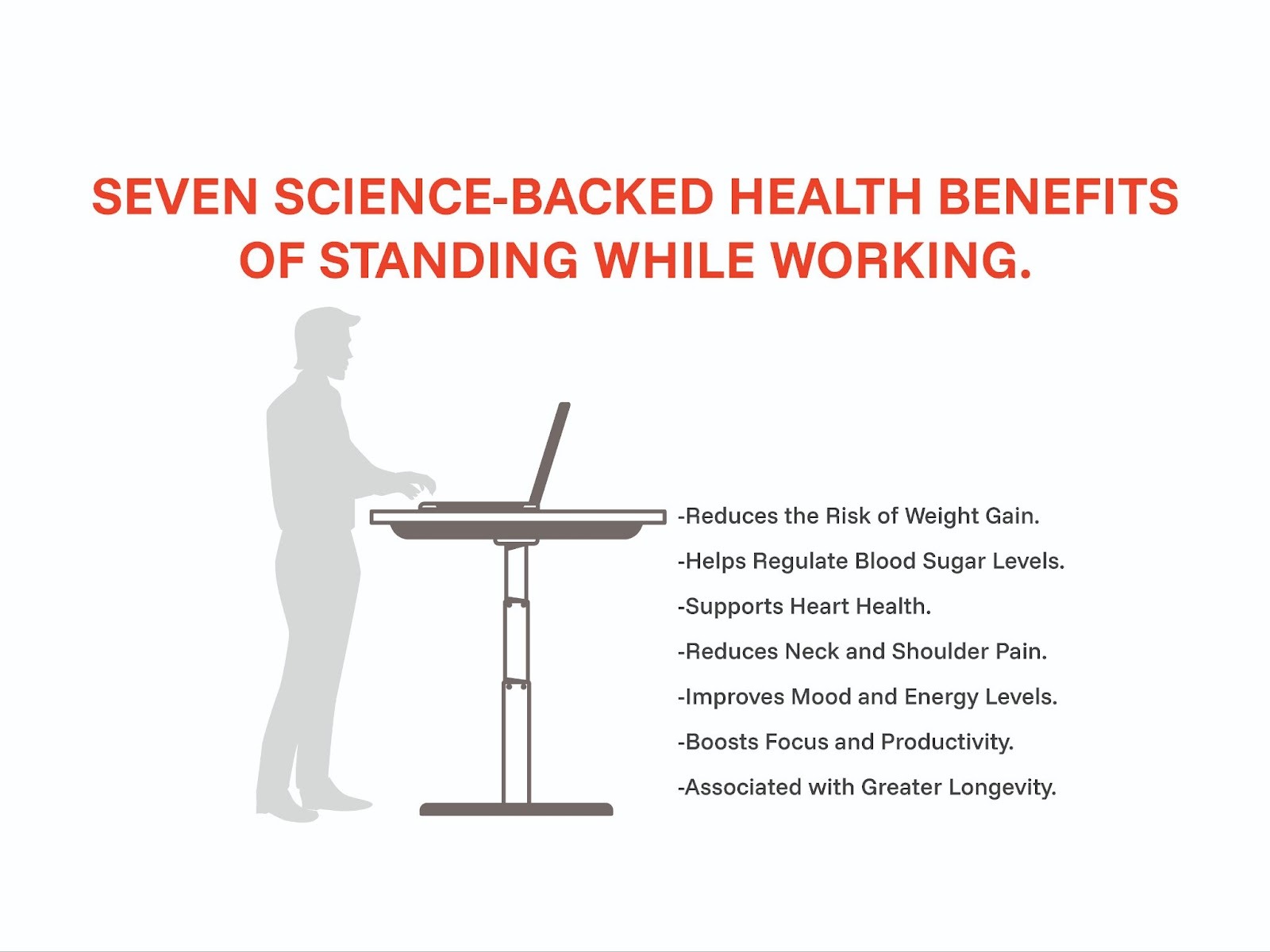
Seven Science-Backed Health Benefits of Standing While Working
1. Reduces the Risk of Weight Gain
Standing burns more calories than sitting not dramatically more per minute, but meaningfully more when the difference is accumulated across a full working day. Research indicates that standing for an afternoon burns approximately 170 additional calories compared to sitting for the same period. Extended over weeks and months, this contributes to weight management in a way that requires no additional time commitment outside of work.
The mechanism is straightforward: standing engages the leg muscles and core continuously at a low level, maintaining a baseline of muscular activity that sitting eliminates entirely. While this is not a substitute for structured exercise, it is a meaningful complement to it particularly for individuals whose working schedules make regular activity difficult.
2. Helps Regulate Blood Sugar Levels
Post-meal blood sugar spikes are a significant health concern, particularly for the Indian population where type 2 diabetes prevalence is among the highest in the world. Research has found that standing for approximately three hours after lunch reduces blood sugar elevation by over 40% compared to sitting for the same period.
The practical implication is straightforward: using a height-adjustable desk to stand during the early afternoon, the period when post-meal glucose processing is most active may be one of the most effective passive interventions available to desk workers concerned about metabolic health.
3. Supports Heart Health
The association between sedentary behaviour and cardiovascular disease is one of the most robustly established in occupational health research. A landmark 1953 study found that London bus conductors who stood throughout their working day had half the heart disease mortality of bus drivers, who sat continuously. Decades of subsequent research has confirmed and extended this finding.
Standing keeps the cardiovascular system more actively engaged: blood circulation is maintained at a higher level, the heart works slightly harder, and the muscles of the legs assist venous return, reducing the pooling of blood in the lower limbs that prolonged sitting encourages.
4. Reduces Neck and Shoulder Pain
Chronic neck and shoulder pain is among the most common health complaints of desk-based employees in India, and poor seated posture is a primary contributing factor. When a work surface is at the wrong height or when a monitor is positioned too low, workers instinctively lean forward, a position commonly described as a "tech neck," placing enormous sustained stress on the cervical spine and upper trapezius muscles.
A sit-to-stand desk allows the work surface and monitor to be positioned correctly for standing use, typically with the monitor at eye level and the keyboard at elbow height, which naturally corrects the forward head posture that causes this pain. Many users report a reduction in upper body discomfort within the first week of regular use.
5. Improves Mood and Energy Levels
The well-documented afternoon energy slump experienced by many desk workers is partly physiological, a natural circadian dip, but it is significantly amplified by prolonged static sitting, which reduces cerebral blood flow and contributes to a sense of lethargy that standing can meaningfully counteract.
Studies that followed people who used standing desks for a few weeks found that their self-reported energy levels, mood, and engagement at work all improved consistently. When the desks were subsequently removed and participants returned to conventional seated setups, the improvements reversed providing strong evidence that the effect was attributable to the change in working posture rather than placebo.
6. Boosts Focus and Productivity
A concern often raised about standing desks is whether standing interferes with concentration. Research does not support this concern. Studies measuring typing speed, accuracy, and task completion rates have found no meaningful difference between sitting and standing, and the improvements in energy and mood associated with sit-stand working are associated with higher self-reported productivity and reduced mid-afternoon attentional drift.
Standing is particularly effective for tasks that benefit from active engagement, such as phone calls, emails, and collaborative discussions, while sitting may remain preferable for extended deep-focus work such as writing or analysis. The ability to switch between postures as the work demands is precisely what makes a height-adjustable desk more valuable than either a fixed standing or fixed sitting setup.
7. Associated with Greater Longevity
The cumulative evidence linking sedentary behaviour and premature mortality is substantial. Prolonged sitting is independently associated with an elevated risk of the chronic conditions cardiovascular disease, type 2 diabetes, and certain cancers that are among the leading causes of preventable death globally.
By reducing the duration of static sitting throughout the working day and maintaining a higher baseline of physical activity, consistent use of a standing desk contributes to the body of evidence suggesting that active working practices are associated with better long-term health outcomes.
How to Use a Standing Desk Correctly
The health benefits of a height-adjustable desk can only be realised when it is set up and used correctly. Poor setup, particularly incorrect desk or monitor height, can create new problems while failing to resolve the ones it is intended to address.
Desk height for standing. The work surface should be set so that the elbows form approximately a 90-degree angle when the hands are resting on the keyboard. This keeps the wrists level and the shoulders relaxed. For most Indian adults, this corresponds to a desk height in the range of 100 to 115 centimetres from the floor.
Monitor position. The top of the screen should be at approximately eye level, with the monitor an arm's length away. If the monitor is significantly lower, the head tilts forward and downward, reintroducing the cervical strain the desk is intended to prevent.
The 20-8-2 guideline. A widely cited framework for sit-stand working recommends that for every 30 minutes of work, approximately 20 minutes be spent sitting, 8 minutes standing, and 2 minutes in active movement (walking, stretching, or changing position). This ratio can be adjusted based on individual comfort and the nature of the work, but the principle of frequent, small transitions rather than prolonged periods in either posture is well supported.
Footwear and anti-fatigue matting. Standing on hard flooring in unsupportive footwear for extended periods creates discomfort in the feet, knees, and lower back. An anti-fatigue mat is a cushioned rubber or foam mat beneath the standing position significantly reduces this discomfort and extends the duration for which standing is comfortable.
AFC's Height Adjustable Series — including the Adaptable, which features an integrated controller with memory presets, anti-collision safety, and smooth dual-motor adjustment — is designed to make the transition between sitting and standing effortless enough that users actually do it consistently, rather than defaulting to a fixed posture.
Common Myths About Standing Desks — Addressed
Myth: You should stand all day. This is not supported by research and is actively counterproductive. Prolonged standing creates its own set of problems: varicose veins, foot and knee discomfort, and lower back fatigue. The evidence supports postural variation, frequent transitions between sitting and standing, and not standing as a replacement for sitting.
Myth: Standing desks are only for executives or premium offices. The market for height-adjustable desks in India has expanded significantly, with a wide range of specifications and price points now available. The health investment is relevant at every level of the organization, not just senior roles.
Myth: It is difficult to concentrate while standing. Research consistently shows no meaningful impact on cognitive task performance between sitting and standing positions. Most users adapt within one to two weeks, after which standing feels natural for most types of work.
The Different Types of Height-Adjustable Desks
Understanding the available options helps in selecting the right product for a specific environment and budget.
Electric height-adjustable desks use a motorised mechanism, single or dual motor, to raise and lower the work surface at the touch of a button. Many models include memory preset controllers that store preferred heights for sitting and standing, eliminating the need to manually readjust each time. These are the most convenient and therefore the most consistently used options, which is the most important factor in realising the health benefits.
Manual crank desks use a mechanical handle to adjust height. They are more economical but require significantly more physical effort per adjustment, which research suggests leads to fewer transitions in practice, diminishing the health benefit over time.
Desk converters sit on top of an existing fixed desk and raise the monitor and keyboard to standing height. They are a lower-cost entry point but offer less flexibility in terms of worksurface area and height range than a purpose-built adjustable desk.
For organisations looking to pair their standing desk investment with appropriate ergonomic seating, AFC's Seating range including mesh chairs designed for breathability and lumbar support, provides the complementary seating foundation that makes a complete ergonomic workspace function properly.
Why Indian Offices Need to Take This Seriously
India faces a convergence of risk factors that makes sedentary working culture a particularly pressing concern. The Indian population has a documented genetic predisposition to insulin Resistance and cardiovascular disease occur at lower body weight thresholds than in populations where much of the foundational research was conducted. Long work hours are culturally normalised. And diets high in refined carbohydrates compound the metabolic effects of prolonged sitting.
Against this backdrop, the introduction of height-adjustable desks into Indian workplaces is not simply a wellness amenity; it is a meaningful preventive health measure with direct implications for employee productivity, sick leave rates, and long-term workforce health.
Organisations that have implemented sit-stand working practices consistently report that employees appreciate the investment, that the furniture becomes a visible signal of genuine care for employee wellbeing, and that productivity and morale benefits justify the cost within the first year.
How to Transition Gradually A Week-by-Week Plan
The body adapts to new demands progressively. Attempting to stand for four or five hours on the first day with a new standing desk is likely to produce sore feet and lower back fatigue which creates a negative association with the product and undermines consistent use.
Week one: Stand for fifteen minutes in the morning and fifteen minutes in the afternoon. Use the time for email, phone calls, or other lower-concentration tasks.
Week two: Increase to thirty minutes of standing twice daily. Begin using the standing position for more varied tasks as comfort allows.
Week three: Aim for ten minutes of standing in each working hour. Experiment with which tasks feel most natural in each posture.
Week four onwards: Establish a personal rhythm based on your work pattern, energy levels, and the nature of your daily tasks. Most regular users settle into a pattern of standing for one to two hours across the working day — far below what feels demanding, but sufficient to deliver the health benefits the research supports.
The Mental Health Dimension
The conversation about standing desks typically focuses on physical health, but the mental health implications are equally real. Physical discomfort chronic back pain, tension headaches, leg heaviness is a persistent cognitive distraction. Removing that discomfort allows the mind to operate without the background noise of physical complaints.
Beyond pain reduction, the act of standing is associated with a heightened sense of physical agency a feeling of being active and in control rather than passive and confined. Research has found associations between standing desk use and reduced self-reported stress and anxiety, and between physical movement during the working day and improved mood stability.
The release of endorphins the body's natural mood-regulating chemicals is stimulated by physical activity. Even the low-level muscular engagement of standing contributes to this effect over the course of a full working day.
Frequently Asked Questions
Q1. Is it better to sit or stand at work?
Neither exclusively the evidence consistently supports postural variation as the healthiest approach. A height-adjustable desk that makes frequent transitions easy is the most effective tool for achieving this in a working environment. The goal is to avoid prolonged static posture in either position.
Q2. Does using a standing desk help with back pain?
Yes, this is true for most users and for most types of back pain associated with poor seated posture. Standing allows the lumbar spine to maintain its natural inward curve, reducing the compressive load on the intervertebral discs that prolonged slouched sitting generates. Most users notice a reduction in lower back discomfort within the first two weeks of regular use.
Q3. Can a standing desk contribute to weight management?
Standing burns meaningfully more calories than sitting across a full working day studies suggest approximately 170 additional calories per afternoon session. This is a supplementary contribution to weight management rather than a primary one, but it is a genuine and consistent effect that accumulates significantly over weeks and months.
Q4. What is the correct height for a standing desk?
The desk should be set so that the elbows form a 90-degree angle when the hands are resting on the keyboard and the monitor top is at eye level. For most Indian adults of average height, this value corresponds to a surface height in the range of 100 to 115 centimetres from the floor.
Q5. Are standing desks suitable for children and students?
Yes. Several schools have introduced height-adjustable desks as part of broader active learning initiatives, finding that students who can alternate between sitting and standing maintain attention more consistently than those in fixed seated arrangements. The key consideration is ensuring the desk's height range accommodates the student's physical dimensions.
Q6. How stable are electric height-adjustable desks at full height?
A well-engineered electric standing desk with a quality dual-motor system and a heavy-gauge steel frame is stable at all height settings. The AFC's adaptable desk, for example, is tested to BIFMA Level 3 standards—the highest tier of international furniture safety and durability certification—ensuring structural integrity throughout its full height range.
Q7. How quickly will I notice the benefits?
Most users notice improvements in energy levels and a reduction in upper body discomfort within the first one to two weeks of consistent use. Metabolic benefits including improved blood sugar regulation and cardiovascular health markers are associated with sustained use over months, consistent with the broader evidence base on the effects of reduced sedentary behaviour.
Final Thoughts
The science supporting height-adjustable desks is not a trend it is a growing and increasingly robust body of evidence that prolonged static sitting is genuinely harmful, and that postural variation throughout the working day meaningfully reduces that harm. For Indian office workers who face a specific convergence of long working hours, dietary patterns, and genetic predispositions that compound the metabolic risks of sedentary behaviour the case for introducing sit-stand working practices is particularly strong.
A height-adjustable desk is not a standalone solution to workplace health. It works best as part of a complete ergonomic workspace that includes appropriate seating, accurate monitor positioning, and a working culture that normalises regular movement. But as a single investment in employee health and wellbeing, it delivers measurable, science-supported benefits that few other workspace interventions can match.
For over 15 years, AFC has been helping Indian organisations design and furnish ergonomic workspaces. Our team is available to advise on height-adjustable desk specifications, seating recommendations, and complete workspace configurations suited to your environment and team size.
Contact Us
📧 Email: customercare@afcindia.in
📞 Phone: +91 9999006933
🌐 Website: www.afcindia.in
Head Office: Plot No. 33, Ecotech 12, Greater Noida West, UP – 201310
Experience Centres: Noida · Gurugram · Mumbai · Bengaluru · Hyderabad· Pune
Explore Other Popular Blogs


Let’s build together
Tell us about your project and we’ll help you plan, design, and deliver at scale.
.jpg)
.svg)