.svg)
Metal Storage Cabinets for Offices: Types, Uses, and Buying Tips

Choosing metal storage cabinets for your office? This guide covers types, features, and buying tips for corporate procurement. By AFC Furniture Solutions.
Choosing the right metal storage cabinets for office use is one of the most practical procurement decisions a corporate facilities team makes. The right storage system keeps the workspace organised, protects documents and equipment, and contributes to a professional office environment. This guide by AFC Furniture Solutions covers every type of Metal Storage available for corporate offices, along with the key features and buying decisions that matter most.
What Are Metal Storage Cabinets?
Metal storage cabinets are office storage units manufactured from cold-rolled steel or powder-coated mild steel. They are designed for commercial use and are specified for their durability, security, and long service life compared to wood or laminate alternatives.
In corporate office environments, metal storage cabinets are used across a wide range of applications, including document filing, personal locker storage, equipment housing, and general office organisation. Their robustness makes them the standard specification for high-use commercial environments across India.
AFC Furniture Solutions manufactures metal storage cabinets at its Greater Noida facility, with all products tested to BIFMA-compliant standards and backed by a warranty of up to 10 years on structural components.
Why Metal Is the Right Choice for Office Storage
Metal outperforms wood and laminate in commercial storage applications across several key dimensions that matter specifically in a high-use office environment.
Durability is the primary advantage. A well-manufactured steel cabinet will not warp, swell, or degrade under the humidity and temperature variations common in Indian office buildings. Wood and pre-laminated alternatives are susceptible to moisture damage, particularly in ground-floor offices or buildings without consistent climate control.
Security is the second key advantage. Metal cabinets accept standard locking mechanisms reliably and resist forced entry significantly better than wood-based alternatives. For offices storing sensitive documents, financial records, or valuable equipment, metal is the only appropriate specification.
Maintenance is minimal. Steel surfaces can be wiped clean with standard cleaning products without risk of surface damage. There are no upholstery panels or laminate edges that can peel or crack over time.
Types of Metal Storage Cabinets for Offices
Corporate offices require different types of metal storage for different purposes. Understanding which type suits each application prevents over-specification in some areas and under-specification in others.
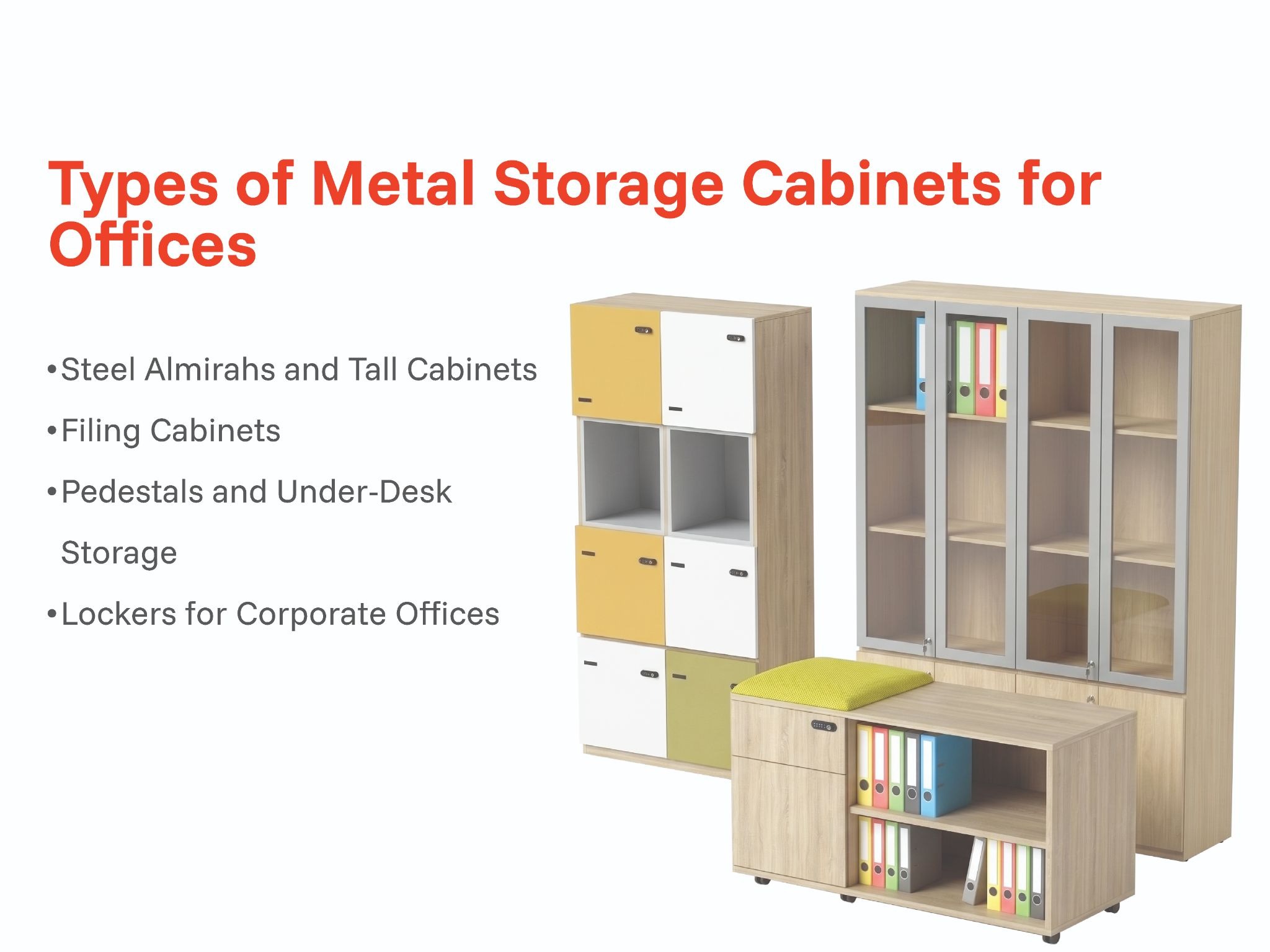
Steel Almirahs and Tall Cabinets
A steel almirah or tall storage cabinet is a full-height unit typically ranging from 1800mm to 1950mm in height. It provides the largest storage volume of any individual cabinet and is used for general document storage, stationery, equipment, and archival files.
Tall cabinets are available in swing-door configurations with internal shelving, and in tambour or roll-up door configurations where space in front of the cabinet is limited. Swing-door cabinets are more common in general office areas. Tambour door cabinets are specified where the open door would obstruct a walkway or adjacent workstation.
For corporate offices, tall steel almirahs are typically specified in groups of two or three to create a storage wall along one face of the office, freeing up the main floor area for workstations and circulation.
Filing Cabinets
Filing cabinets are purpose-built for storing hanging files and physical documents in a format that allows quick retrieval. They are available in two-drawer, three-drawer, and four-drawer configurations, with four-drawer vertical filing cabinets being the standard specification for offices with significant document storage requirements.
Lateral filing cabinets are wider than vertical cabinets and store files side-on rather than front-to-back. They provide faster access to files and are better suited to offices where multiple people need to retrieve documents from the same cabinet frequently.
When specifying filing cabinets for a corporate fit-out, check the drawer extension length. Full-extension drawers allow complete access to the rear of the drawer without needing to reach into the cabinet, which is a meaningful practical advantage in daily use.
Pedestals and Under-Desk Storage
Metal pedestals are compact storage units that sit beneath or beside a workstation desk. They typically include one or two box drawers for stationery and personal items, a filing drawer for A4 documents, and a lockable cupboard section.
Mobile pedestals on castors can be moved away from the workstation when additional legroom is needed and repositioned when the layout changes. Fixed pedestals provide more stable storage at a set position under one end of the desk.
For open-plan corporate offices, specifying one pedestal per workstation is standard practice. It provides each employee with personal secure storage without requiring separate full-height cabinets for every individual.
Lockers for Corporate Offices
Metal lockers are specified for offices that operate hot-desking or activity-based working arrangements, where employees do not have a fixed workstation and need secure personal storage for bags, laptops, and personal items.
Multi-door locker banks in configurations of six, nine, or twelve doors are the most common specification for corporate locker areas. Each door has an individual lock, typically a key lock or a combination lock, and the bank is mounted on a plinth or base frame for stability and to prevent moisture contact with the bottom of the unit.
Key Features to Check Before Buying
When evaluating metal storage cabinets for a corporate bulk order, assess the following features before confirming any specification.
Steel gauge: The thickness of the steel sheet determines the rigidity and dent resistance of the cabinet. Commercial-grade storage cabinets use a minimum of 0.8mm cold-rolled steel for the body and 1.2mm for the frame. Thinner gauges are suitable only for light-use environments.
Powder coating quality: All metal surfaces should be powder-coated rather than painted. Powder coating provides a harder, more durable finish that resists chipping, scratching, and corrosion far better than paint. Check that the coating covers all internal surfaces, not just the exterior.
Lock mechanism: For document and equipment storage, specify cabinets with a three-point locking mechanism rather than a single central lock. Three-point locking secures the door at the top, middle, and bottom simultaneously, providing significantly better security and preventing the door from being forced open at the edges.
Shelf load rating: Internal shelves should be rated for a minimum of 40kg per shelf for general office use. For equipment storage or archival filing, specify shelves rated at 60kg or higher. This information should be available in writing from the manufacturer.
Anti-tilt mechanism: Filing cabinets and tall storage units should include an anti-tilt mechanism that prevents more than one drawer from opening at the same time, which can cause the unit to tip forward. This is a safety requirement in commercial environments and should be confirmed before purchasing.
How to Match Storage to Your Office Layout
Storage quantity should be calculated based on the actual needs of the office, not on general rules of thumb. A team that works predominantly with digital files needs significantly less physical storage than a legal or finance team that handles large volumes of paper documents. Before specifying storage for a new fit-out, survey the actual storage needs of each team and plan accordingly. Pairing storage with correctly specified office workstation ensures that storage is positioned within reach of the team it serves without obstructing circulation routes or fire exit paths.
Tall storage units placed against walls maximise floor area usage. Pedestal storage under desks makes personal items accessible without requiring the employee to leave their workstation. Filing cabinets placed in a central document management area reduce individual storage requirements at workstations and create a single point for physical file retrieval.
For open-plan offices with 30 or more workstations, storage planning should be included in the floor-plan layout before furniture is specified. AFC Furniture Solutions provides layout planning support for all corporate storage orders to ensure storage is correctly positioned relative to workstations, circulation routes, and fire exits.
Common Mistakes When Buying Office Storage
Underestimating storage volume: Most offices underestimate their storage requirements at the fit-out stage and find themselves ordering additional cabinets within 6 to 12 months. Plan for 20 per cent more storage than your current needs to accommodate growth.
Buying on unit price alone: A steel cabinet specified at a lower gauge and without a proper powder coating finish will show visible deterioration within two to three years of commercial use. The additional cost of a properly specified commercial-grade cabinet is recovered many times over in lifespan.
Ignoring finish coordination: Specifying storage cabinets in a different finish from the workstation and desk system creates visual inconsistency across the office floor. Always confirm that the storage finish is available in a colour that coordinates with the rest of the furniture specification.
Not confirming delivery and assembly: Tall storage cabinets and locker banks require on-site assembly and anchoring. Confirm with your supplier whether installation is included in the quote and who is responsible for waste packaging removal after delivery.
Frequently Asked Questions (FAQs)
These are the most common questions corporate buyers ask when specifying metal storage cabinets for office procurement.
Q1. What is the difference between a steel almirah and a filing cabinet?
A steel almirah is a general-purpose, tall storage unit with internal shelves, used for storing a wide range of items, including files, stationery, equipment, and personal belongings. A filing cabinet is purpose-built for storing hanging files and physical documents in a format that allows organised retrieval.
Most corporate offices use a combination of both. Steel almirahs handle general and bulk storage, while filing cabinets manage active document storage for teams with regular file access requirements.
Q2. What steel gauge is right for commercial office storage cabinets?
For commercial office environments, the minimum acceptable steel gauge is 0.8mm for the body panels and 1.2mm for the frame. This specification provides adequate rigidity and dent resistance for daily commercial use.
For high-security storage or heavy-load applications such as equipment storage or archival filing, specify a heavier gauge of 1.0mm to 1.2mm for the body panels. Always confirm the gauge specification in writing before placing a bulk order.
Q3. Are metal storage cabinets suitable for humid office environments?
Yes. Metal storage cabinets with a proper powder-coat finish are significantly more resistant to humidity and temperature variation than wood or pre-laminated alternatives. Powder coating seals the steel surface and prevents oxidation under normal office humidity levels.
For offices in coastal locations or buildings with significant humidity variation, specify cabinets with a double-layer powder coat and confirm that the internal surfaces are also coated, not just the exterior panels.
Q4. How many storage cabinets does a 30-person office typically need?
As a planning benchmark, a 30-person office with moderate document storage needs typically requires one mobile pedestal per workstation (30 units), two to four tall storage cabinets for shared team storage, and one four-drawer filing cabinet per four to five employees in document-intensive roles.
Actual requirements vary significantly based on working style, digital adoption, and industry. AFC Furniture Solutions recommends a storage audit before finalising any bulk order to ensure the specifications match actual needs.
Q5. Does AFC Furniture Solutions supply metal storage cabinets across India?
Yes. AFC Furniture Solutions manufactures and supplies a full range of metal storage cabinets, including steel almirahs, filing cabinets, pedestals, and locker banks for corporate procurement across India. All products carry a warranty of up to 10 years on structural components and are manufactured to BIFMA-compliant standards at the Greater Noida facility.
Contact the AFC Furniture Solutions team at +91 9999006933 or visit afcindia.in to discuss your storage requirements and request a bulk quote.
Tips for Buying Metal Storage Cabinets
- Tip 1: Always specify powder-coated finishes over paint. Powder coating is harder, more durable, and significantly more resistant to chipping and corrosion under daily commercial use.
- Tip 2: Confirm the anti-tilt mechanism is present on all filing cabinets and tall storage units before ordering. This is a commercial safety requirement, not an optional feature.
- Tip 3: For open plan offices, include storage planning in the floor layout before specifying workstations. Storage positioned as an afterthought frequently obstructs circulation routes and creates inefficiency.
- Tip 4: Request a finish sample from the manufacturer before confirming a bulk order. This confirms the actual colour and texture match your existing or planned furniture specification.
Bonus Points
- Bonus 1: AFC Furniture Solutions metal storage cabinets are manufactured at the Greater Noida facility and tested to BIFMA-compliant standards. All structural components carry a warranty of up to 10 years.
- Bonus 2: Mobile pedestals from AFC Furniture Solutions are compatible with all workstation configurations in the AFC range, ensuring a coordinated finish and consistent dimensions across the entire office.
- Bonus 3: AFC Furniture Solutions provides pan-India delivery and on-site installation for all storage orders. Contact our team at +91 9999006933 to discuss your requirements and request a layout consultation.
Conclusion
Choosing the right metal storage cabinets for office use is a practical decision that directly affects the organisation, security, and visual quality of a corporate workspace. By matching the correct cabinet type to each storage need, specifying the right gauge and locking mechanism, and planning storage as part of the overall floor layout, corporate offices can create a workspace that is both efficient and professionally presented.
Explore Other Popular Blogs


Let’s build together
Tell us about your project and we’ll help you plan, design, and deliver at scale.
.jpg)
.svg)