.svg)
How to Choose the Right School Chairs for Better Student Posture and Focus
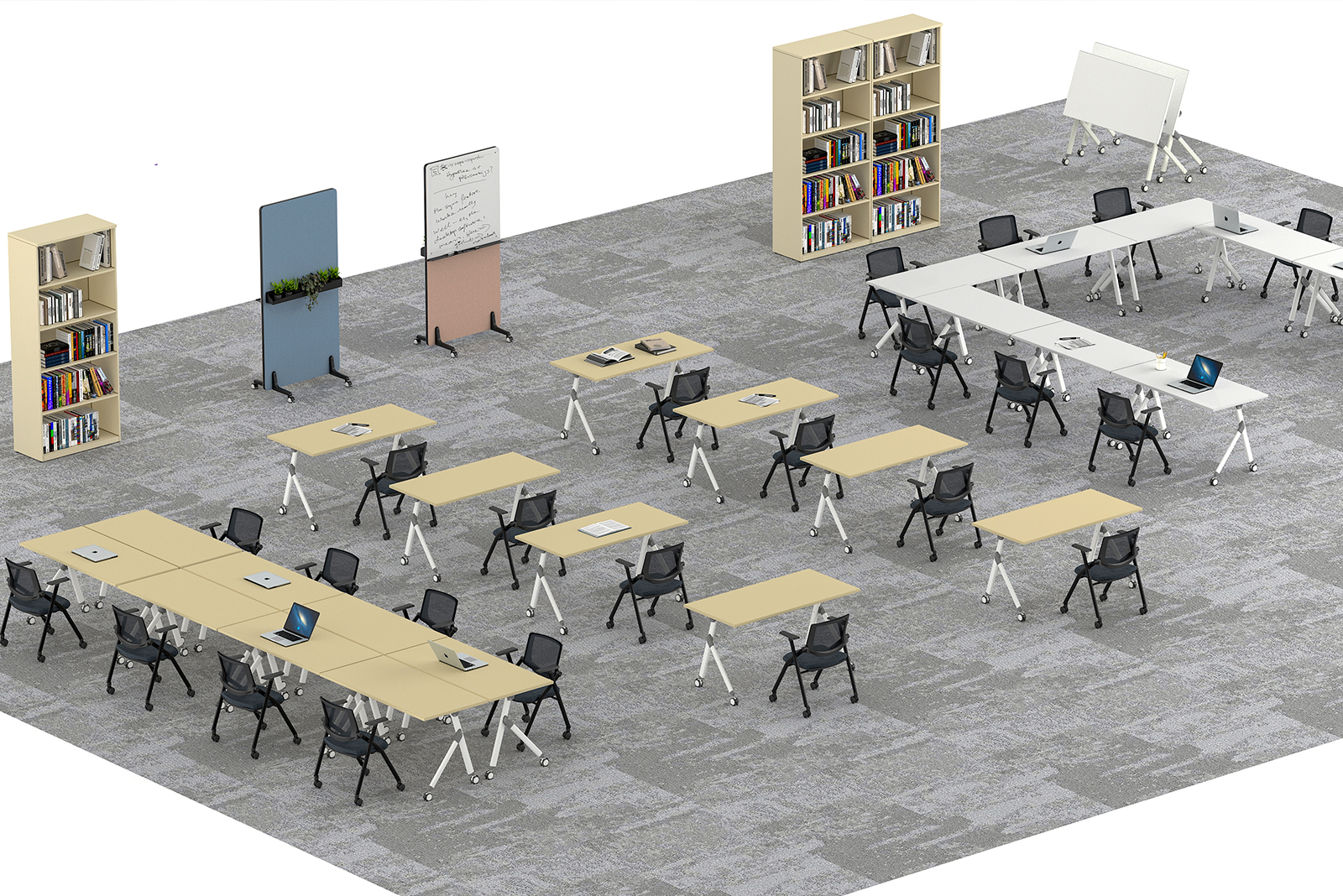
Discover how to choose the right school chairs for better student posture, focus, and learning outcomes. Expert guidance from AFC Furniture Solutions for Indian schools.
Why Do School Chairs Have a Direct Impact on Student Learning?
A student spends six to eight hours every school day sitting in the same chair. Over a full academic year, that adds up to more than a thousand hours of sustained seated posture.
The quality of the school chair during those hours directly shapes the student's physical health, their ability to concentrate, and ultimately their academic engagement and performance.
Getting the classroom seating right is not a minor procurement detail. It is one of the most consequential decisions a school administrator makes for the well-being of every student in the institution.
How Does Poor Seating Affect a Student's Posture?
A school chair that is too high leaves the feet dangling, creating pressure behind the knees that restricts circulation. One that is too low compresses the lumbar spine and encourages a forward slump.
Both positions create sustained physical stress that accumulates over the school day. Over months and years of daily exposure, poorly specified classroom seating contributes to the postural problems that are increasingly common among Indian school children.
Research in educational ergonomics consistently shows that children in poorly designed chairs adopt compensatory postures within the first hour of sitting, and that these postures create measurable muscular strain across the school day.
What Is the Connection Between Physical Comfort and Academic Focus?
When a student is physically uncomfortable, the brain devotes a portion of its attention to managing that discomfort. This is not a conscious choice. It is an automatic neurological response that directly reduces the cognitive resources available for learning.
A student who is shifting in their seat to relieve back pain, re-crossing their legs to restore circulation, or leaning forward to rest tired back muscles is a student whose attention is divided between the lesson and their body.
The right school chair removes this distraction entirely. When the body is supported correctly, the mind can direct its full capacity toward what the teacher is saying.
What Are the Different Types of School Chairs Available?
Standard Classroom Chairs
A standard classroom chair is a four-legged seat with a backrest, designed for general daily classroom use. It is the most widely used school furniture type in India across primary and secondary education levels.
Quality standard chairs are made from powder-coated steel frames with polypropylene or moulded plastic shells. They are durable, easy to clean, and available in a range of sizes to suit different age groups.
The key differentiator between a quality standard school chair and a budget one is frame gauge, edge finish quality, and whether the seat and backrest shell is designed with any ergonomic contouring or is simply flat.
Ergonomic School Chairs
Ergonomic school chairs are designed with deliberate attention to the physical proportions and postural needs of students. They incorporate contoured seat shells, backrest curves that follow the natural spine shape, and appropriate seat heights for the intended age group.
They are particularly valuable for secondary school students who sit for longer periods and undertake more intensive individual work than primary students. For university and college students, ergonomic seating is a functional requirement rather than a premium addition.
The investment in ergonomic school chairs pays for itself through better student health outcomes, reduced postural problems, and the stronger academic engagement that physical comfort supports.
Dual Desk Chairs
A dual desk chair integrates the seating and writing surface into a single unit. The chair frame supports an attached desktop that folds away when not in use, creating a compact, self-contained learning station.
They are widely used in Indian schools because they prevent chairs from being displaced around the classroom, maintain a consistent and organised layout, and eliminate the desk-chair alignment problems that arise when furniture is moved by students during group activities.
The trade-off is reduced flexibility for classroom rearrangement, which makes them more appropriate for classrooms with a primarily fixed, forward-facing instructional format.
Height-Adjustable Student Chairs
Height-adjustable student chairs can be raised or lowered to match the physical dimensions of different students, making them particularly valuable in classrooms that serve a wide range of heights within the same age group.
They are the most ergonomically flexible specification for school furniture because they ensure correct seating posture for every individual student regardless of body size.
For schools with multi-age classrooms or institutions looking to maximise the usable life of their furniture investment across successive student cohorts of varying sizes, height-adjustable chairs are the most cost-effective long-term specification.
Auditorium and Lecture Hall Chairs
Auditorium chairs for schools and colleges are fixed seating solutions designed for high-density assembly spaces including school halls, examination centres, and college lecture theatres.
Quality auditorium seating provides a comfortable, clear sightline for every seat position, a smooth and quiet folding mechanism, and upholstery durable enough for daily institutional use across many years.
For examinations, auditorium chairs with integrated writing tablets provide each student with an individual working surface within the fixed seating arrangement.

What Makes a School Chair Ergonomic?
Correct Seat Height
The single most important ergonomic specification in any school chair is the seat height relative to the student's body. The correct height allows both feet to rest flat on the floor with the knees at approximately a 90-degree angle and the thighs approximately horizontal.
When the seat height is wrong, the entire postural chain is affected. Incorrect seat height is the root cause of the majority of postural problems associated with classroom seating in Indian schools.
Height-adjustable chairs solve this comprehensively. For fixed-height chairs, specifying the correct size for the intended age group from the available size range is the critical procurement decision.
Seat Depth and Width
The seat depth should allow the student to sit fully back against the backrest while leaving a small clearance between the front seat edge and the back of the knees. Too deep and the front edge presses into the knee, restricting circulation. Too shallow and the thighs lose support.
The seat width should accommodate the student comfortably without compressing the outer thighs. For primary school children, narrower seats are appropriate. For secondary and college students, wider dimensions are needed.
Both dimensions should be verified against the physical range of the intended student age group before any bulk school chair order is placed.
Backrest Design and Lumbar Support
A flat backrest provides no meaningful postural support. A quality school chair backrest follows the natural curve of the spine, with a contoured lower section that supports the lumbar region and prevents the progressive forward slumping that flat-backed chairs encourage.
For secondary and college students who sit for extended periods in individual study or examination settings, a defined lumbar support zone in the backrest is a meaningful health specification rather than a premium feature.
The backrest height should be sufficient to support the full length of the student's back, not just the lower portion. A backrest that ends mid-back leaves the upper spine and shoulders unsupported during sustained sitting.
Stability and Safety Features
A school chair must be absolutely stable under the dynamic conditions of a classroom. Students lean back, rock forward, and shift their weight in ways that place non-uniform loads on the frame multiple times throughout the day.
The four-leg base should be constructed from commercial-grade steel with sufficient gauge to resist the bending forces of sustained daily use across multiple student cohorts. Legs that flex under load indicate a frame gauge insufficient for institutional use.
All joints and fixings should be permanently assembled rather than relying on hand-tightened hardware that loosens over time. A chair that becomes wobbly under normal use is not just uncomfortable. It is a safety risk.
Tip: When evaluating school chairs for a new procurement, have a member of staff deliberately rock back on the rear legs of the sample chair and lean forward with full body weight applied to the front edge. A chair that flexes, creaks, or shows any instability under these conditions will not withstand the realities of classroom use by active students over a school year.
How to Match School Chairs to Different Age Groups?
Primary School Children (Ages 5 to 10)
Primary school chairs must be sized for small bodies. The seat height for most primary age children falls between 310mm and 380mm from the floor, depending on the specific year group.
Safety is the first priority at this level. All edges must be fully rounded with no exposed sharp metal or plastic. The chair must be light enough for a young child to move independently during group activities without risk of tipping.
Bright, welcoming colours contribute positively to the primary learning environment. Research in educational psychology supports the use of colour in primary spaces as a contributor to engagement and positive association with learning.
Secondary School Students (Ages 11 to 17)
Secondary students cover a wide range of physical sizes, from early adolescence through near-adult proportions. The school chair range for this group typically spans seat heights of 380mm to 460mm to accommodate this variation.
Durability is the primary specification consideration at secondary level. Teenagers are significantly harder on furniture than any other age group. Powder-coated steel frames with commercial-grade joints are the correct specification for secondary school furniture that will remain functional across many years of intensive use.
Technology readiness is also relevant. Secondary students increasingly use devices in class. A school chair that is comfortable for sustained laptop and tablet use requires a backrest that supports an upright, slightly forward-engaged posture as well as a relaxed reading posture.
College and University Students (Ages 18 and Above)
College and university students sit for longer continuous periods and undertake more intensive individual work than school students. The ergonomic requirements at this level are closer to those of a professional office environment than a traditional classroom.
Ergonomic student chairs with defined lumbar support, adequate seat depth for adult proportions, and sufficient backrest height to support the full adult spine are the appropriate specification for higher education environments.
For lecture halls and examination centres, auditorium seating with comfortable upholstered surfaces and integrated writing tablets serves both the extended duration comfort and the functional working surface requirements of university-level study.
What Material Is Best for School Chairs in India?
Plastic Shell Chairs
Polypropylene or moulded plastic shell chairs on steel frames are the most commonly specified school chairs across India. They are lightweight, easy to clean, resistant to the staining and wear of daily classroom use, and available in a wide range of sizes and colours.
Quality plastic shells are injection-moulded to precise specifications with consistent wall thickness across the entire shell. Budget plastic shells have variable thickness and weak points that develop cracks under sustained institutional use within months.
The frame to shell connection is the most critical quality point in any plastic shell school chair. Permanent fixings that do not loosen over time are essential for chairs that will be moved multiple times every day.
Fabric Upholstered Chairs
Fabric upholstered school chairs provide greater physical comfort for extended sitting and are more appropriate for higher education environments where students remain seated for longer periods.
The upholstery must be specified to a commercial Martindale rating appropriate for institutional daily use. Fabric that is not rated for commercial wear will show visible deterioration within months in a high-use school environment.
Cleanability is the most important practical consideration for upholstered school furniture in India. Specify fabrics that can be spot-cleaned effectively, as spills and daily soiling are inevitable in any environment occupied by students.
Metal Frame Chairs
Steel frame chairs without an upholstered shell, typically used with a simple seat pad, are common in Indian school environments due to their extreme durability and low maintenance requirements.
The frame should be constructed from powder-coated steel to resist rust and surface damage. In humid regions of India, the quality of the powder-coat application is the primary determinant of how long the frame maintains its appearance.
All exposed metal edges must be finished smooth. Sharp or rough metal edges on school chairs used by children are a genuine and entirely preventable safety hazard.
Which Material Works Best for Indian School Conditions?
For most Indian schools across primary and secondary levels, a powder-coated steel frame combined with a polypropylene or moulded plastic shell is the most practical specification. It delivers durability, cleanability, and appropriate weight for the institutional context.
For higher education environments where extended sitting comfort is a priority, fabric upholstered ergonomic chairs on steel frames provide the right balance of comfort and durability.
In all cases, the frame gauge and finish quality are more important than the shell material choice. A quality frame with a modest shell specification will always outperform a premium shell on an inadequate frame.
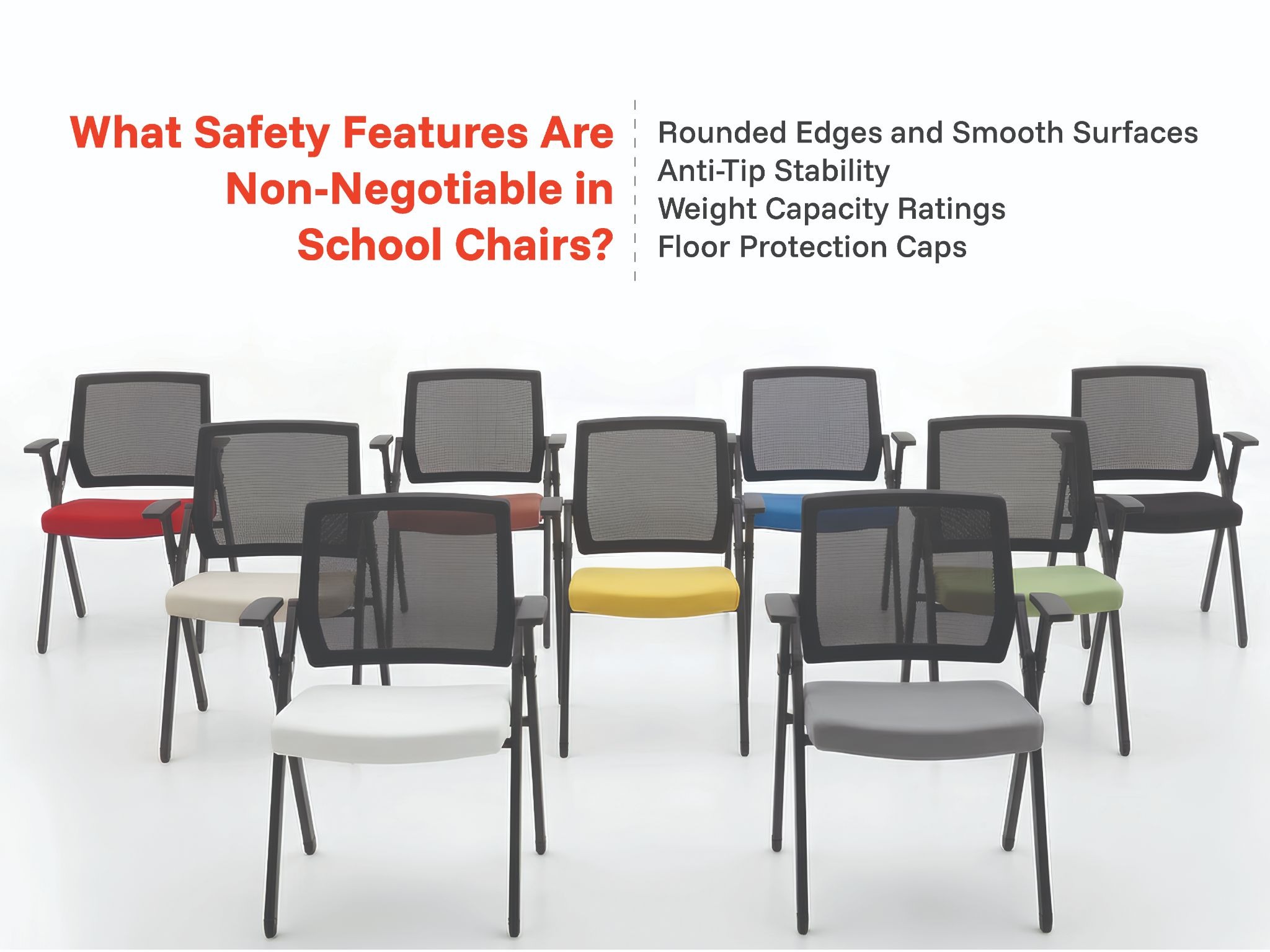
What Safety Features Are Non-Negotiable in School Chairs?
Rounded Edges and Smooth Surfaces
Every edge and corner on a school chair used by children must be fully rounded with no exposed sharp angles. This applies to both the frame and the shell or seat surface.
Sharp metal edges at knee height or hand height in a classroom occupied by moving children are a genuine injury risk. This is not a quality preference. It is a non-negotiable safety requirement for any school furniture used by young students.
Inspect every edge of any sample school chair before approving a bulk order. Run your hand along every frame member, every shell edge, and every connecting point. Any roughness or sharpness is unacceptable in an educational environment.
Anti-Tip Stability
A school chair must remain stable when a student leans back on the rear legs, which is a behaviour that occurs in every classroom regardless of instructions to the contrary.
The rear leg geometry should prevent the chair from tipping backward under the weight of a leaning student. Some designs achieve this with rear leg extensions that increase the rear footprint. Others use leg angle geometry that makes tipping physically very difficult.
Test this specifically with any school chair sample before approving a specification. The safety of the chair under this specific dynamic load is more important than its stability under static vertical loading.
Weight Capacity Ratings
Every school chair should be specified with a verified weight capacity that exceeds the maximum likely user weight for the intended age group. For secondary school chairs, this should be at least 100 to 120 kilograms to accommodate the full range of student sizes including older and larger students.
Weight capacity ratings should come from independent load testing rather than the manufacturer's own claims. Ask suppliers to provide test documentation for the specific products you are considering.
A chair used by a student whose weight exceeds its rated capacity is a structural failure waiting to happen. This is an entirely preventable safety risk that correct procurement eliminates completely.
Floor Protection Caps
Rubber or plastic floor protection caps on all chair legs serve two purposes. They protect the classroom floor surface from scratching and surface damage, and they reduce the noise generated when chairs are moved during group activities.
In Indian classrooms with stone or ceramic tile floors, the acoustic impact of thirty students moving chairs simultaneously without floor caps is significant. It creates a jarring noise that disrupts concentration and contributes to the general noise level of the school environment.
Quality floor caps should fit securely and not loosen under the lateral forces of normal chair movement. Caps that fall off within weeks of installation are worse than no caps at all because the exposed metal leg is then free to scratch the floor.
Bonus Point: For schools replacing existing school chairs across multiple classrooms, specify that the new chairs match the same colour across every classroom rather than using different colours per year group or floor. A consistent colour scheme across the school makes the environment feel more coherent and professionally managed, and it simplifies future replacement orders because all classrooms use the same specification.
How to Plan School Chair Procurement for a New or Expanding School?
Step 1: Assess Student Age Range and Physical Size
Before approaching any supplier, establish the precise age range of students who will use each classroom. This determines the correct seat height specification for each room.
For schools with multi-age classrooms or flexible room allocation, height-adjustable chairs eliminate the need for multiple size specifications and provide correct ergonomic support for every individual student regardless of size variation.
Document the physical height range of the intended student group as a specification input. Most reputable school furniture suppliers can map this to the correct chair size from their available range.
Step 2: Measure Classroom Desk Heights
The school chair height must be coordinated with the desk height to achieve the correct ergonomic relationship between the two. A chair that is correctly sized for the student but mismatched with the desk height will still produce poor posture.
Measure the existing desk height in each classroom and verify that the chair specification you are considering will place the student's elbows at approximately desk height when seated correctly. If the desk heights vary across classrooms, the chair specification may need to vary accordingly.
For new school builds where both desks and chairs are being specified simultaneously, establish the desk height first based on the intended age group and then specify the matching chair height.
Step 3: Define Your Budget by Priority
Allocate the highest budget per unit to the chairs that will be used most intensively and for the longest daily duration. Secondary school chairs used for eight hours daily by students undertaking examination preparation deserve a higher specification than chairs used for short morning assembly sessions.
For primary school chairs, safety features and age-appropriate sizing are the non-negotiable priorities. The specification does not need to be the most expensive available, but it must meet the safety and sizing requirements without compromise.
Step 4: Request Samples Before Bulk Ordering
For any significant school chair procurement, request sample units of every model being considered before placing the bulk order. Have students from the intended age group sit in each sample chair for a full school day and collect their feedback on comfort and physical fit.
Teachers who observe the students throughout the day will also provide valuable feedback on how the chairs perform under real classroom conditions including group activities, transitions between tasks, and the general movement patterns of the age group.
Tip: When conducting sample trials for school chair procurement, ask teachers to specifically note whether any students are observed slouching, shifting frequently, or complaining of discomfort during the trial period. These observations are more reliable indicators of chair suitability than any specification comparison or showroom assessment.
How AFC Furniture Solutions Designs School Chairs for Indian Educational Institutions
What School Chair Options Does AFC Offer?
AFC Furniture Solutions offers a comprehensive range of classroom seating for students across every educational level through its dedicated educational furniture range.
The Classroom range includes student chairs designed for primary, secondary, and higher education with age-appropriate sizing, safety-first edge finishing, and commercial-grade frame construction suited to the intensity of daily institutional use across many student cohorts.
For higher education environments, ergonomic student chairs with lumbar support and adult-proportioned seat dimensions provide the level of postural support that extended university study sessions require.
Explore the full AFC Furniture Solutions. Classroom range for student chair options designed across all educational levels and age groups.
What Quality Standards Back AFC Educational Furniture?
AFC Furniture Solutions holds BIFMA Level 3 certification, the highest internationally recognised standard for furniture quality, safety, and sustainability performance. Every product in the educational range is manufactured at AFC's Greater Noida facility and tested to BIFMA-compliant standards.
All materials used across the school furniture range meet verified safety standards appropriate for educational environments, including non-toxic powder-coat finishes and low-emission board materials suited to spaces occupied by children.
You can also explore the complete AFC Furniture Solutions Educational furniture range covering classroom, library, hostel, and auditorium solutions for schools and colleges across India.
Frequently Asked Questions
Q1. What is the most important specification in a school chair?
Correct seat height for the intended age group is the single most important specification. If the chair height does not allow a student's feet to rest flat on the floor with the knees at approximately 90 degrees, every other ergonomic quality of the chair is secondary to this fundamental misfit.
Q2. How do I choose the right chair size for different year groups?
Map the intended year group to its typical height range and select the chair size from the supplier's available range that places the seat at the correct ergonomic height for that range. For classrooms with a wide height variation, height-adjustable chairs provide the most effective solution.
Q3. What is the difference between a standard and an ergonomic school chair?
A standard school chair provides basic seating at an appropriate height. An ergonomic school chair adds deliberate postural support including a contoured backrest, lumbar zone design, and seat dimensions calculated for the specific body proportions of the intended age group. The ergonomic version supports correct posture actively rather than simply providing a surface to sit on.
Q4. How long should quality school chairs last?
Commercial-grade school chairs from a reputable manufacturer should deliver ten to fifteen years of reliable daily institutional use. The key variable is whether the frame was constructed to commercial rather than residential specifications and whether the finish quality is appropriate for the intensity of school use.
Q5. Can school chairs be customised in colour to match the school's identity?
Yes. AFC Furniture Solutions offers customisation across frame colours and shell or upholstery options to align with institutional brand guidelines and interior design requirements. Confirm available options and lead times before placing any order.
Q6. What is the correct way to maintain school chairs to extend their lifespan?
Wipe plastic and metal surfaces with a damp cloth regularly. Check and tighten all frame fixings monthly as daily use progressively loosens joints. Inspect and replace floor protection caps promptly when they become loose or worn. Address any cracks in plastic shells immediately as small cracks under load develop into structural failures quickly in active classroom use.
Final Thoughts
The school chair a student sits in every day is one of the most direct physical influences on their health, comfort, and ability to engage with learning. It deserves the same careful thought that any institution brings to curriculum design, teacher quality, and learning resources.
Getting the specification right, from correct seat height and ergonomic backrest design through to safety features and material durability, creates a classroom environment where every student can sit comfortably, focus fully, and learn without the constant distraction of physical discomfort.
AFC Furniture Solutions has been designing and supplying school chairs and educational furniture to institutions across India for over 15 years, with BIFMA Level 3 certification and a complete range covering every age group and every educational space.
Explore Other Popular Blogs

Let’s build together
Tell us about your project and we’ll help you plan, design, and deliver at scale.
.jpg)
.svg)