.svg)
Growing Team, Limited Space? Choose Modular Office Cubicles

Discover how modular office cubicles help growing Indian businesses maximise space, reduce costs, and create a professional, flexible workplace without relocating.
One of the most common challenges facing growing businesses in India is a mismatch between the pace of hiring and the capacity of the office. A group of five people in a comfortable space becomes a team of fifteen before the lease is up, and suddenly the office feels crowded, disorganised, and inadequate.
Relocating to a larger premises is expensive, disruptive, and often premature. Building permanent partition walls is time-consuming and inflexible. The most practical solution and the one that has become standard in well-run Indian offices is modular office cubicles.
At AFC, we have helped hundreds of organisations across India navigate exactly this challenge over the past 15 years. This guide shares what we have learned about choosing, specifying, and installing modular cubicle systemsPanel Series that grow with your business.
What Are Modular Office Cubicles, and How Have They Evolved?
The word "cubicle" carries outdated connotations for many people: grey, oppressive boxes that isolate workers and flatten morale. Contemporary modular office cubicles are an entirely different proposition.
A modern modular cubicle system is an engineered assembly of interchangeable components worksurfaces, panel screens, storage pedestals, overhead units, and cable management accessories that connect together to form defined individual workspaces within an open floor. The defining characteristic is that every component is designed to work with every other component in the system, and the configuration can be changed without tools or structural intervention whenever needs evolve.
This is what distinguishes modular systems from both traditional built-in carpentry and standard open-plan desk arrangements. Built-in carpentry is permanent and cannot be adapted. Standard open desks provide no privacy or spatial definition. Modular cubicles provide structured, professional individual workspaces that can be reconfigured, extended, or relocated as the organisation changes.
Why Growing Indian Businesses Need Modular Office Solutions
The growth trajectory of a successful Indian business rarely follows a predictable, linear path. Hiring decisions accelerate. New functions are added. Teams merge or separate. Office layouts that were sensible six months ago may be completely inadequate today.
Modular office furniture is designed specifically to accommodate this reality. It allows an organisation to start with the configuration that suits its current headcount and working style, and to adapt that configuration incrementally as circumstances change — without the cost and disruption of replacing all the furniture, building new partitions, or moving premises.
For organisations operating in high-density urban markets — Mumbai, Delhi NCR, Bangalore, Hyderabad, Pune — where commercial real estate is expensive and every square metre of floor space carries a real monthly cost, the ability to configure a modular workstation system to maximise the productive use of the available area is a genuine financial advantage.
Key Benefits of Modular Cubicles Over Traditional Office Furniture
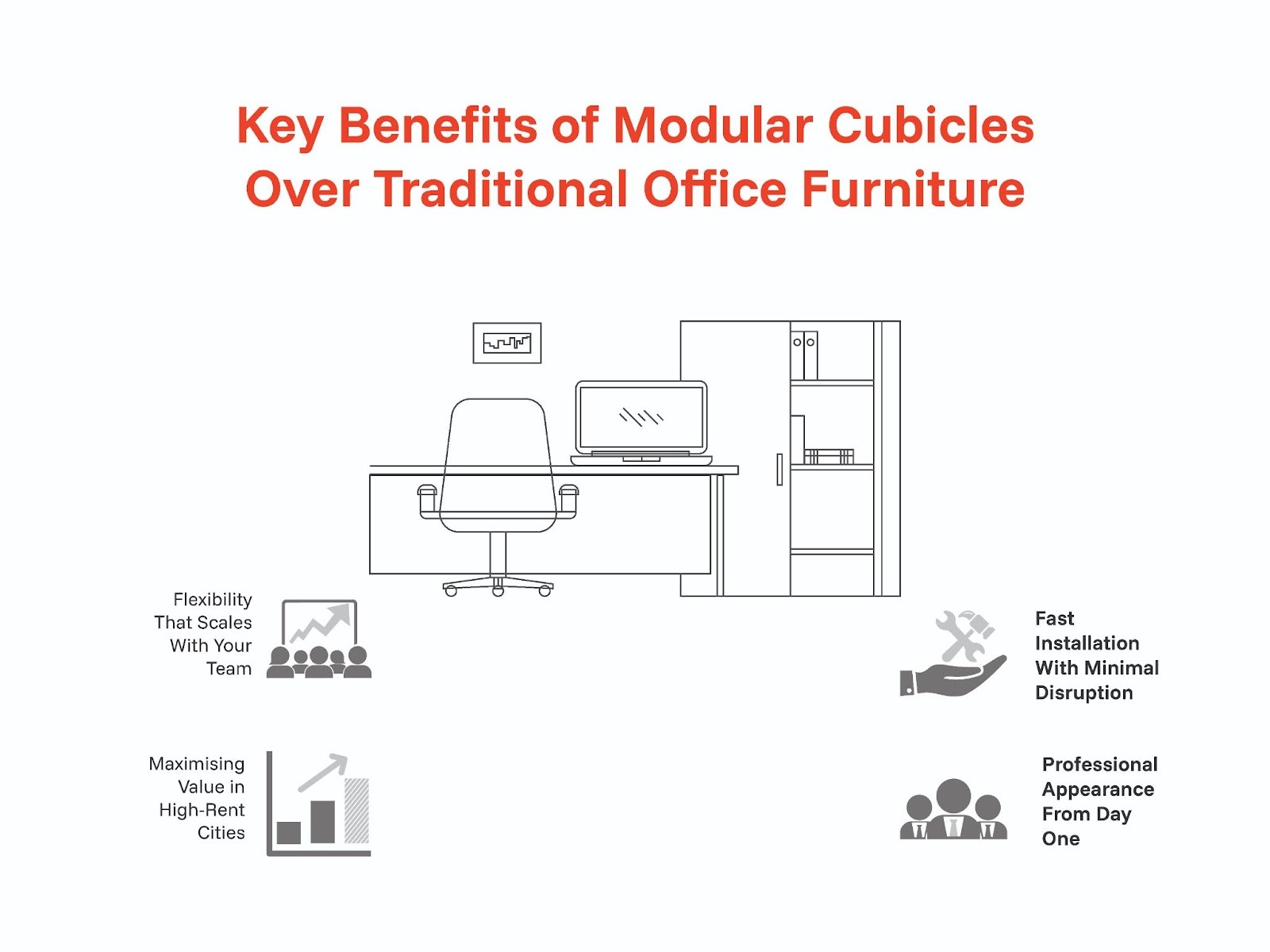
Flexibility That Scales With Your Team
The most significant practical advantage of modular office systems is their scalability. When a new employee joins, adding a matching workstation to the existing configuration requires ordering additional components — not commissioning new furniture from scratch. The new unit integrates seamlessly with what is already installed, maintaining the visual coherence of the space.
This scalability also works in reverse. If a team reduces in size, modular components can be reconfigured to consolidate the space, repurposed in a different area of the office, or stored for future use. The investment is preserved regardless of how the organisation evolves.
Maximising Value in High-Rent Cities
Modular cubicle systems are engineered to achieve higher workspace density than conventional furniture arrangements without sacrificing individual comfort. Shared panel systems between adjacent workstations eliminate the duplication of spacing that separate freestanding desks require. Integrated storage — pedestals, overhead units, and locker systems — keeps personal belongings and working materials organised without consuming additional floor area.
AFC’s Panel Series is specifically designed for this context — providing individual workspace definition, acoustic management, and integrated cable routing in a system that maximises productive occupancy per square metre.
Fast Installation With Minimal Disruption
A modular cubicle installation is fundamentally different from traditional office construction in terms of its impact on business operations. There is no structural work, no dust, no extended periods of noise, and no requirement to vacate the premises. Components arrive pre-fabricated from the manufacturing facility and are assembled on-site by an installation team, typically within one to two days for a complete office floor.
This means an organisation can plan a complete workspace reconfiguration over a weekend and have the team working in a fully functional new layout on Monday morning. For businesses that cannot afford extended downtime, this is a critical advantage.
Professional Appearance From Day One
The visual impression an office makes on clients, partners, and prospective employees is a real business asset. A workspace furnished with a well-specified modular cubicle system — consistent materials, clean lines, integrated wire management, and considered use of panel heights — projects organisational competence and attention to quality regardless of the company's size or age.
First-generation offices fitted with mismatched furniture, visible cabling, and ad-hoc layouts communicate the opposite. For early-stage businesses particularly, the investment in a professional modular office setup pays dividends in every client visit and every recruitment conversation.
How to Choose the Right Cubicles for Your Office
Approaching a modular cubicle procurement thoughtfully — rather than reacting to immediate pressure — produces significantly better outcomes.
Start with a precise floor plan.
Before approaching any supplier, measure your space accurately and document the positions of doors, windows, structural columns, and electrical sockets. A reputable supplier will use these measurements to produce a scaled floor plan — often in 2D and 3D visualisation — showing exactly how the proposed configuration fits the space before any commitment is made.
Define circulation requirements.
Regardless of how much workstation density your floor area could theoretically accommodate, people need to move. Allow a minimum of three to four feet of clear walkway between rows of workstations — sufficient for two people to pass comfortably and for fire egress routes to remain unobstructed. An office that feels cramped and difficult to navigate undermines morale regardless of how well-specified the furniture is.
Plan for growth.
If you anticipate hiring additional staff within the next twelve to eighteen months, specify a system that can be extended with matching components. Confirm with your supplier that the specific configuration and finish you are selecting will remain available from the same manufacturer over that period.
Pair workstations with appropriate seating.
A modular cubicle system delivers its full value only when paired with ergonomic office chairs suited to the working hours and nature of the tasks being performed. The AFC Seating range — including mesh chairs designed for India's climate and leather chairs for senior roles — provides the complementary seating layer that completes a well-specified workspace system.
Understanding Panel Height and What It Means for Your Team
The height of the panel screens that define individual workspaces is one of the most consequential specification decisions in a modular cubicle project, and it is worth understanding the trade-offs carefully.
Low panels (approximately 900mm high) sit below seated eye level, keeping the workspace visually open while providing a defined boundary between adjacent users. They suit collaborative teams — sales, creative, customer service — where frequent informal communication is part of the working culture. They maintain a sense of openness and allow natural light to penetrate across the floor.
Medium panels (approximately 1200 to 1400mm high) provide seated privacy — enough height to prevent visual distraction from adjacent colleagues while working, while still allowing standing communication without requiring the user to move. This is the most versatile specification for mixed-function office environments.
High panels (approximately 1600 to 1800mm high) provide full seated and standing privacy, creating genuinely enclosed individual workspaces. They suit departments handling sensitive information — finance, HR, legal — and roles requiring sustained deep-focus work with minimal interruption. The trade-off is reduced natural light penetration and a more enclosed visual atmosphere.
Many offices combine panel heights across different zones — higher panels in areas requiring concentration, lower panels in collaborative and client-facing areas — creating a spatial variety that serves different working modes across the same floor.
Layout Options and What Works Best for Different Teams
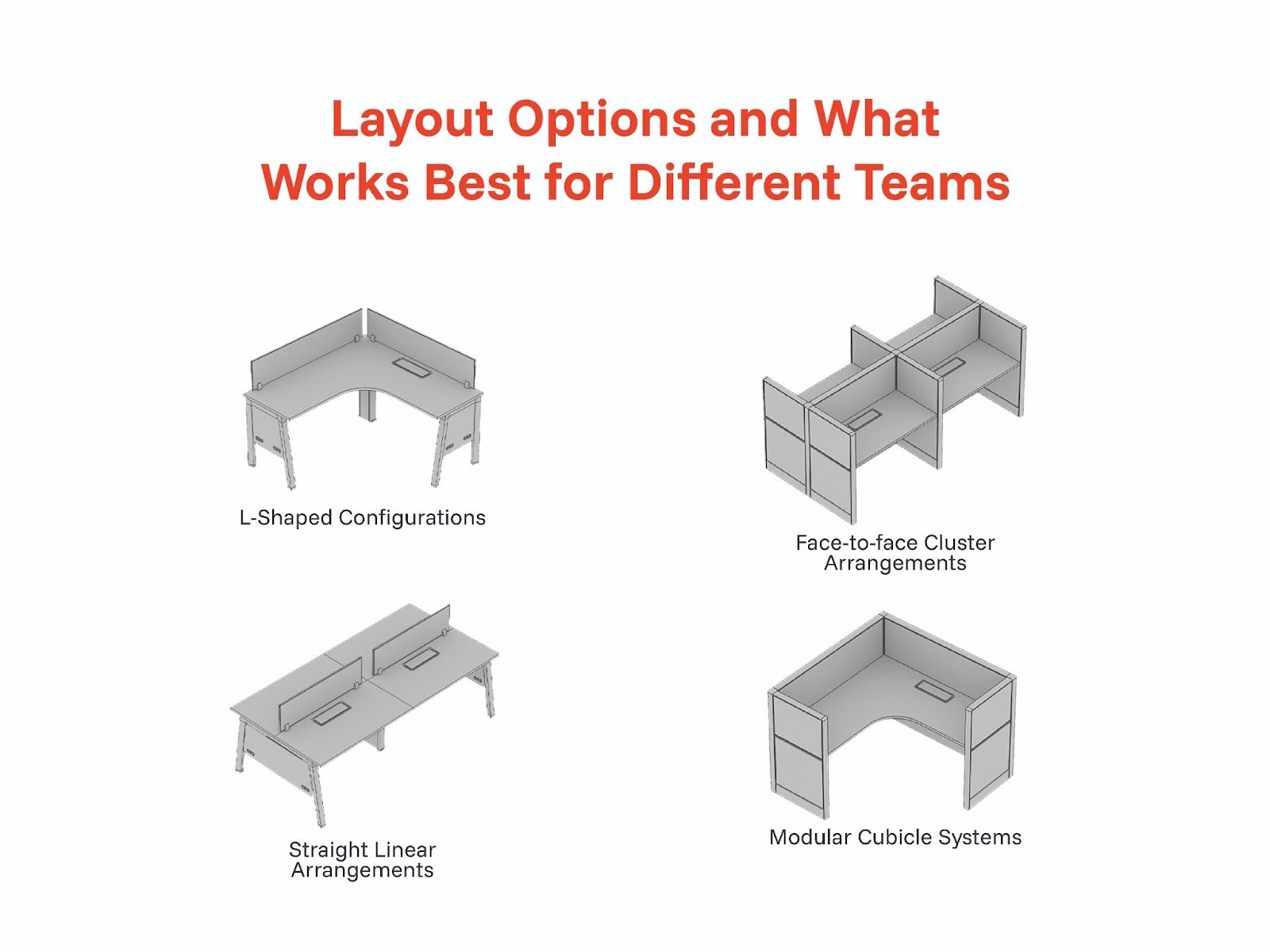
Modular cubicle systems support a range of spatial configurations, each with distinct advantages for specific working styles and team structures.
Straight linear arrangements position workstations side-by-side in continuous rows, with back-to-back pairs facing in opposite directions. This is the most space-efficient layout for high-density environments — call centres, data processing teams, and similar operations where individual task focus is the primary requirement and visual communication between colleagues is less important.
L-shaped configurations give each user a primary worksurface and a perpendicular return surface, creating a corner workstation with significantly more usable area. These suit roles that require simultaneous use of a computer and physical reference materials — managers, analysts, and professionals handling complex multi-source work.
Face-to-face cluster arrangements position pairs or groups of workstations with users facing each other across a shared panel divider. This maximises the efficiency of shared power access and cable management infrastructure, and creates a natural team-unit structure that suits project-based working.
How to Get Quality Without Overspending
Modular office cubicle procurement offers meaningful opportunities to optimise value without compromising on the specifications that actually matter.
Specify standard configurations. Bespoke dimensions, unusual angles, and non-standard finishes all add cost. The most economical approach is to choose from within a manufacturer's standard range — products that are produced at volume and therefore priced accordingly. Standard configurations also offer the longest-term availability for future extensions.
Prioritise material quality on high-contact surfaces. The worksurface finish — the surface your employees interact with every working day — deserves the best specification your budget allows. High-pressure laminate (HPL) over an engineered wood core with PVC edge banding is the appropriate specification for Indian commercial environments: resistant to scratching and moisture, easy to clean, and durable over many years of heavy use.
Integrate cable management from the outset. Internal cable raceways within panel structures — channels that route power and data cables completely out of sight — are far more economical to install during the initial fit-out than to retrofit later. The visual and practical difference between an office with managed cabling and one without is significant.
Consider bulk procurement strategically. If you anticipate growth over the next twelve months, procuring for your projected headcount rather than your current one typically yields meaningful cost savings through volume pricing — and eliminates the disruption of a second installation project.
Modern Trends Shaping Office Cubicle Design in 2026
Office cubicle design has evolved substantially in recent years, and the most progressive Indian offices reflect these developments.
Integrated glazing. Replacing the upper portion of panel screens with glass panels clear or frosted allows natural light to penetrate across the floor while maintaining visual structure. This creates a significantly more pleasant working environment and is associated with improvements in energy and mood that solid-panel alternatives cannot deliver.
Acoustic panel technology. Fabric-faced acoustic panels absorb ambient sound meaningfully, reducing the cumulative noise level of a busy open floor. In environments where background noise is a significant distraction and in most Indian offices of more than fifteen people, acoustic management through panel specification delivers immediate and noticeable improvements in concentration.
Sit-stand integration. An increasing number of modular cubicle systems are designed to accommodate height-adjustable desk mechanisms, allowing individual workstations to be raised for standing use. This reflects the growing understanding well supported by research — that postural variation throughout the working day meaningfully reduces the health risks of prolonged sitting.
Biophilic elements. The integration of natural materials, warm wood finishes, and plant-friendly ledge storage into cubicle systems contributes to a working environment that feels less institutional and more human — an increasingly important consideration as organisations compete to attract and retain talent.
What Quality Actually Looks Like — The Details That Matter
When evaluating any modular cubicle product, the quality indicators that matter most are often the ones least visible in photographs.
Edge treatment. Run your finger along the edge of any worksurface in the range. The PVC edge banding should be flush, smooth, and securely bonded. Poorly applied banding lifts and peels within months, exposing the board core to moisture. Well-applied banding remains intact for the life of the product.
Panel connector quality. The mechanical connectors that join modular panels at corners and intersections determine the structural integrity of the assembled system. They should fit precisely, engage securely, and hold the panels at exactly the correct angle without play or wobble.
Drawer and storage hardware. If the configuration includes integrated storage — pedestal drawers, overhead units, locker compartments — test the drawer slides, the hinges, and the lock mechanisms. These are high-frequency-use components that will be operated dozens of times each day. Cheap hardware fails quickly in commercial environments; quality hardware operates smoothly for years.
Frame and leg structure. The steel frame supporting the workstation should be of sufficient gauge that it is rigid under load and does not flex when the worksurface is pressed firmly. Adjustable levelling feet on all leg bases are essential for achieving a level, stable surface on the slightly uneven floors that are common in Indian commercial buildings.
Maintenance Tips to Protect Your Investment
Daily surface care. Wipe laminate worksurfaces with a soft, dry microfibre cloth for routine cleaning. For stains, a lightly damp cloth with mild soap is sufficient. Avoid abrasive cleaners and strong chemical solvents, which progressively damage the laminate finish and accelerate wear on edge banding.
Regular structural checks. The vibration of daily use gradually loosens the fasteners that hold modular components together. A brief monthly inspection — checking that all connecting hardware is tight and that no panels have developed movement — prevents small issues from developing into structural instability. This takes less than ten minutes and can double the functional lifespan of the system.
Cable management maintenance. Periodically check that cables routed through internal raceways are correctly seated and that no cable has been pulled in a way that stresses a connector or creates a snag point. Tidy cabling is both safer and easier to service when equipment changes require rewiring.
Moving components safely. When reconfiguring the system, always disassemble properly rather than dragging components across the floor. Dragging stresses the leg joints and levelling feet and scratches flooring. Engage the supplier's installation team for any significant reconfiguration rather than attempting to dismantle complex assemblies without the appropriate tools.
Frequently Asked Questions
Q1. What is the practical difference between modular cubicles and standard open-plan desks?
Modular cubicle systems provide defined individual workspaces with panel screens, integrated storage, and cable management creating privacy, acoustic separation, and visual structure that standard open-plan desks cannot deliver. They are the appropriate choice wherever individual focus, personal storage, or a professional visual standard are important requirements.
Q2. How many workstations can I fit in a given floor area?
A general planning benchmark is 50 to 60 square feet per person, including the workstation itself and each individual's share of the circulation space. A 1,000 square foot office can comfortably accommodate 15 to 18 people using a well-specified modular system. A layout plan produced by your supplier will give you a precise answer for your specific space.
Q3. Can modular cubicles be relocated when we move offices?
Yes — this is one of their most significant practical advantages over built-in alternatives. A modular cubicle system can be completely disassembled, packed, transported, and reinstalled in a new location without damage. The installation investment is preserved through a move rather than written off.
Q4. Are colour and finish choices available to match our brand?
Yes. Most modular office cubicle manufacturers offer a range of laminate finishes for worksurfaces, powder-coat colours for frames, and fabric options for acoustic panel faces. Specifying colours that align with your brand identity or interior design direction is straightforward within standard product ranges.
Q5. Is professional installation necessary, or can we assemble the furniture ourselves?
Professional installation is strongly recommended for complete modular cubicle systems. Correct assembly requires the right tools and experience to ensure that all components are properly aligned, levelled, and connected — and that the completed system is structurally stable. Incorrectly assembled modular systems can be difficult to correct after the fact and may not perform as intended.
Final Thoughts
A growing team is a success problem — and like most success problems, it is best addressed with a clear strategy rather than a reactive response. Modular office cubicles offer a structured, scalable, and cost-effective approach to workspace planning that serves growing Indian businesses far better than the alternatives: expensive relocation, disruptive permanent construction, or the false economy of mismatched furniture.
The investment in a well-specified modular system pays for itself through improved space efficiency, reduced replacement frequency, professional visual standards, and the ability to adapt the workspace continuously as the organisation evolves. It is, in the most practical sense, the furniture that grows with your business.
AFC has been designing and supplying modular office solutions for Indian organisations for over 15 years, with a manufacturing facility capable of supporting projects of any scale and a team of workspace consultants available to guide you from initial planning through to completed installation.
Contact Us
📧 Email: customercare@afcindia.in
📞 Phone: +91 9999006933
🌐 Website: www.afcindia.in
Head Office: Plot No. 33, Ecotech 12, Greater Noida West, UP – 201310
Experience Centres: Noida · Gurugram · Mumbai · Bengaluru · Hyderabad· Pune
Explore Other Popular Blogs



Let’s build together
Tell us about your project and we’ll help you plan, design, and deliver at scale.
.jpg)
.svg)